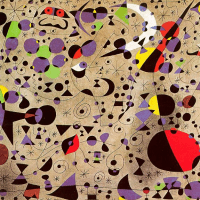
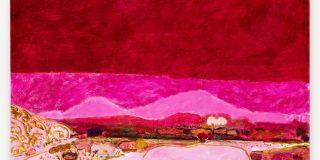
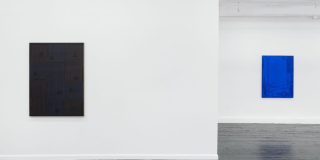
Contributed by Peter Schroth / Anyone with an aversion to charm might want to sidestep Rob Lyon’s seductive show at Hales Gallery. Those seeking a diversion from the world’s traumas may find a refuge there. From Sussex, England, the artist finds his inspiration in the local landscape – a common point of reference for modern British painters. Their ghosts and others’ are clearly traceable here. Indications emerge of several additional painting traditions. Lyon borrows freely from his British forbears – note his use of rosy sand and faded blues in line with their penchant for muted palettes – but also from the Cubists and Giorgio Morandi.
Tag: Cubism
Clintel Steed’s careful daring
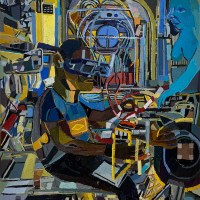
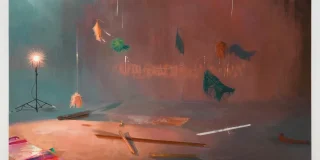
Contributed by Margaret McCann / In Clintel Steed’s show of paintings at Shrine Gallery, “Different Time Zones, Different Dimensions,” temporal experience is evoked through formal language as much as subject matter. In most, dynamic fragmentations of contemporaneity are fixed in static tessellations of paint. Richly varied shapes, packed in shallow space on dense surfaces, lead from abstraction to illusion.
JoAnne Carson: Raucous retro-futurism
Contributed by Mary Jones / Exuberance is a word frequently used in describing the work of JoAnne Carson, and, in “Cosmic Chatter,” her first solo show at DC Moore, it’s in hyperdrive. Twelve large, colorful paintings share the main gallery space with one eight-by-six-foot monochromatic sculpture of an intricately crafted white flowering tree. Placed near the entrance, the sculpture serves as a three-dimensional model and introduction to the paintings. The fragile delicacy of this surprising and marvelous object resembles an encounter with a conjured specimen preserved in ice, a fact among fiction.
Painters in conversation: Jeanette Fintz and Stephen Westfall
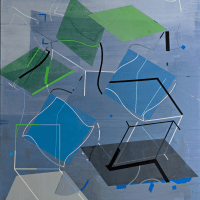
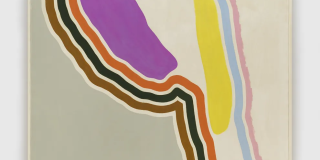
Contributed by Sharon Butler / At 68 Prince Street Gallery, a spacious new gallery in Kingston, now featuring Jeanette Fintz’s paintings alongside Monika Zarzeczna’s architecturally oriented work in “Elusive Thresholds,” Fintz engaged in a freewheeling conversation with noted painter Stephen Westfall. I was fortunate enough to get hold of the recording and here try to distill some wisdom. Both artists are geometric abstractionists, and they discussed the evolution of Fintz’s artistic practice from cubist-influenced studies in the 1980s to her current explorations of the environment through geometry, touching on philosophical and technical considerations underlying contemporary abstract painting.
Dan Schein’s muddy sublime
Contributed by Lucas Moran / On Instagram, where most artists list their websites, exhibitions, and accomplishments beneath their handles, Dan Schein keeps it simple: “artist/painter,” followed by “Person Who Stutters.” It’s fitting for a painter whose work, some now on display at JJ Murphy Gallery, feels as though it may sometimes have a tough time coming out of him. But Schein, a painter’s painter, knows how to elicit beauty from struggle….
In Conversation: Diana Copperwhite and Erin Lawlor
In this thoughtful exchange, artist Erin Lawlor talks to Diana Copperwhite about the role of intuition and emotion in their work, their love of music, and their mutual interest in painter Howard Hodgkin. Copperwhite’s paintings will be on view alongside Hodgkin’s work at the Auckland Art Fair from May 1-4, and Lawlor ‘s solo “Divining” opens at the Highlanes Municipal Gallery in Ireland on April 26.
Berthe Weill: The gallerist who loved art too well
Contributed by John Goodrich / Hindsight, of course, is 20/20. Looking back at the early decades of modernism, we may sense something inevitable about the ascent of Picasso and Matisse. Weren’t both driven, gifted artists poised to take advantage of their cultural moment? And wasn’t the time ripe for Matisse’s upending of expectations of color, and Picasso’s overturning of pictorial structures? Of course, life is not so tidy and linear for the artists operating in the moment. As the luminous exhibition “Make Way for Berthe Weill: Art Dealer of the Parisian Avant-Garde” at NYU’s Grey Art Museum demonstrates, none of the early modernists had a monopoly on talent or a singularly dominant vision of what painting had to be.
Call it Orphism
Contributed by Adam Simon / At a Four Walls event in Brooklyn in the early 1990s, Erik Oppenheim, at that time a young artist, stood up and said, “I’m starting an art movement. Anyone who wants to join, meet me in the back after the show.” It was a hilarious and audacious gesture, in part because no one joins an art movement on a whim, like a list-serve or an exercise class, but also because there hadn’t been any artist-initiated movements for a very long time. They proliferated in the late nineteenth and early twentieth century with the advent of Impressionism, Surrealism, Futurism, and Dada, and enjoyed something of a resurgence in the 1960s with Fluxus in the United States, Supports/Surfaces and Zero in Europe, and the Gutai Group in Japan. Most of what we consider movements were proclaimed by an outside observer, usually a critic or curator, looking to group artists who had similar concerns and made work that fit the designation. For the artists themselves to rally around a specific cause, even an aesthetic one, was not required.
Emily Noelle Lambert: Trapping butterflies, chasing wild birds
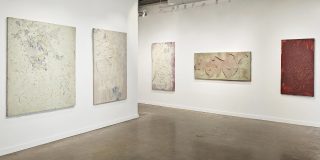
Contributed by Jason Andrew / In ‘Wild Birds,” Emily Noelle Lambert’s second solo exhibition at Freight+Volume, she provides an unbridled experience of color and tactility. The show includes five paintings that fence in an array of stacked ceramic works on improvised pedestals. Known for her vibrant, abstract work, Lambert is bold and direct in her exploration of organic forms and dreamlike compositions.
Carol Bruns’s aesthetic moralism
Contributed by Gwenaël Kerlidou / Heart of Darkness, Joseph Conrad’s 1899 novella, is one of the first fictionalized accounts of the ravages of European colonialism in Africa. Marlow, the narrator, while surveying the grounds of an ivory collecting station on the Congo River, catches sight of a row of shriveled heads mounted on stakes. The episode segues to a deeper exploration of the psyche of Kurtz, a terminally ill but very successful ivory harvester working for the king of Belgium. His cryptic last words – “the horror, the horror” – sum up the situation. The title and content of Conrad’s novella reverberates through Carol Bruns’s current exhibition at White Columns of mostly monochromatic frontal sculptures, in which the human figure is omnipresent, either as hieratic totems or as ritual masks. Scattered in the gallery space, an unruly mob of chimeras and other nightmarish characters seems to be stoically harboring the scars, wrinkles, creases, and other traces of immemorable sufferings.