

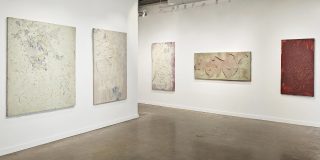
Contributed by Sharon Butler / At 68 Prince Street Gallery, a spacious new gallery in Kingston, now featuring Jeanette Fintz’s paintings alongside Monika Zarzeczna’s architecturally oriented work in “Elusive Thresholds,” Fintz engaged in a freewheeling conversation with noted painter Stephen Westfall. I was fortunate enough to get hold of the recording and here try to distill some wisdom. Both artists are geometric abstractionists, and they discussed the evolution of Fintz’s artistic practice from cubist-influenced studies in the 1980s to her current explorations of the environment through geometry, touching on philosophical and technical considerations underlying contemporary abstract painting.
Beginning as a plein air landscape painter who worked “religiously” outdoors, Fintz moved away from direct observation when she relocated to Manhattan, abandoned landscapes entirely during her years teaching at Parsons and Purchase, and segued to musical scores and geometric patterns. At Parsons, she taught a course called “Pattern, Color, Pattern and Symmetry,” which required her to study the grid in many of its historical incarnations. These included its use in Islamic geometry, which has spiritual as well as mathematical dimensions. Simultaneously, she began meditating, which she found aligned nicely with the repetitive endeavor of making geometric art. Her process involves overlaying two geometrically clashing grids – hexagons and squares – to create what she calls “a very weird space” that doesn’t follow conventional perspectival rules. In allowing different spatial systems to interact within a single composition, this technique gets her closer to the “parallel worlds and parallelism” that have long intrigued her.


Westfall – himself a rich, exacting, and sophisticated painter – introduced the crucial concept of “landscape as diagram,” referencing John Berger’s essay “The Moment of Cubism,” which argued that by the early twentieth century, the visible world had become recognized as merely one narrow band of complete reality. This idea resonates with Fintz. In her approach, aesthetic cognates of landscape function not as direct observations but as ways of mapping her experience – tracking eye movements through space, identifying objects, and establishing waypoints for visual navigation. While flat, opaque surfaces once characterized her work, it now incorporates vaporous, forward-projecting spaces that seem to extend beyond the edges of the canvas and invite viewers to move through sculpture-like forms both visually and temporally.


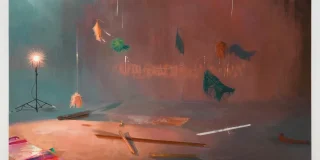
Canterbury (right), 2014, 15 x 75 feet. Courtesy of the artist’s website.
Personal circumstances as well as scholarship, of course, have shaped Fintz’s artistic development. Her move from rural New York to Hudson, the construction of her studio, and particularly her mother’s death all inform the contemplative, liminal qualities of her recent work. One painting, The Intermediate Place, explicitly references her current living situation, depicting the small green space between her house and studio, which she describes as “our little bardo.” A mosque visible from her window adds a layer of meaning to her use of Islamic geometric principles, giving rise to what Westfall describes as one of life’s “rhymes” – the way circumstances conspire to reinforce artistic directions taken years earlier. Although Fintz’s process involves extensive planning via vellum overlays and digital manipulation, she resists contrivance. Her marks and lines are “accurately placed,” but she introduces drips, blots, and gestural marks to interrupt and complicate the journey. She has “no idea how it’s gonna look” because getting in her own way is sometimes “more fun.”
Throughout the conversation, both artists emphasized the temporal and musical aspects of the work. Fintz describes her paintings in terms of “basso continuo,” with steady underlying structures supporting more lyrical, floating elements. She hopes the viewer’s experience becomes like choreographed movement, finding “markers” and “locations” that lodge rhythm and emphasis. Indeed, Westfall identifies synesthetic qualities in the work, where different colors function as distinct timbres, generating what he calls “expanded percussion” effects.

For both Fintz and Westfall, geometric abstraction is not cold or purely intellectual. It can serve as a vehicle for deeply personal expression while maintaining connections to both spiritual tradition and lived experience. Fintz’s migration from landscape observation to geometric meditation and back to a new form of landscape-cued consciousness is a fine example of how artists at once maintain continuity and reinvent themselves. As Westfall aptly put it in a 2021 Two Coats of Paint interview, “painters are always trying to figure out how to keep painting.”
“Jeanette Fintz and Monika Zarzeczna: Elusive Thresholds,” 68 Prince Street Gallery, 68 Prince Street, Kingston, NY. Through August 17, 2025.
About the author: Sharon Butler is a painter and the publisher of Two Coats of Paint.




I have wanted to listen to a recording of this conversation, and reading this adept condensation whets the intrigue. The paintings are dazzling in person but it is easier to read them on the screen, especially after this description.
If you want to know about the color green, just ask Jeanette. Her spectacular paintings capture green’s spectral range and transcendent spirit. A masterful show topped by a deep dive of an artist conversation with Stephen. A total pleasure to be there!
Sharon,
Thank you for this patient and insightful interpretation of our long and digressive conversation. What you’ve highlighted is a tribute to your awareness of what matters .I am truly appreciative.
Wow, Sharon, thanks for the juice! I was merely Jeanette’s interlocutor. The credit should go to her and Monika for a terrific show.
Thank you for this terrific distillation. I think it’s one to save, lots of food for thought for us painters “always trying to figure out ways to keep painting.” I love the artist’s clear thinking combined with chance and drips. Wish I could get up to see the show in person!