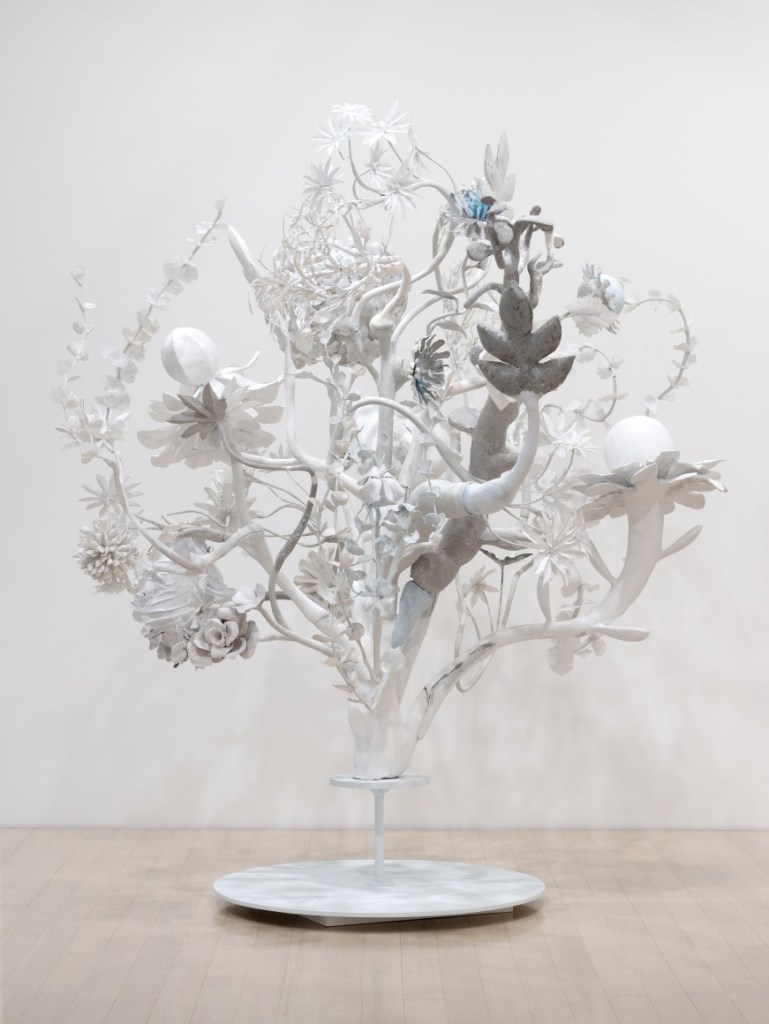
Contributed by Mary Jones / Exuberance is a word frequently used in describing the work of JoAnne Carson, and, in “Cosmic Chatter,” her first solo show at DC Moore, it’s in hyperdrive. Twelve large, colorful paintings share the main gallery space with one eight-by-six-foot monochromatic sculpture of an intricately crafted white flowering tree. Placed near the entrance, the sculpture serves as a three-dimensional model and introduction to the paintings. The fragile delicacy of this surprising and marvelous object resembles an encounter with a conjured specimen preserved in ice, a fact among fiction.
In the paintings, Carson favors a technicolor palette and a style that nods to a 1960s Disney-esque childhood. Teeming landscapes, mutant and fecund, are blossoming perpetually in a neon season of raucous retro-futurism. There’s an urgency to this work, a vivid, original language that has evolved from a variety of sources. Carson studied in Chicago in the 1970s and her time there seems formative. She cites Elizabeth Murray as an influence, and the high contrasts, patterns, and funky surrealism of Chicago Imagism also comes to mind. Mark Rothko’s surrealist work, Cubist collage, Charles Burchfield’s visionary landscapes, plus the experience of creating her own renowned garden have all been revelatory for her.
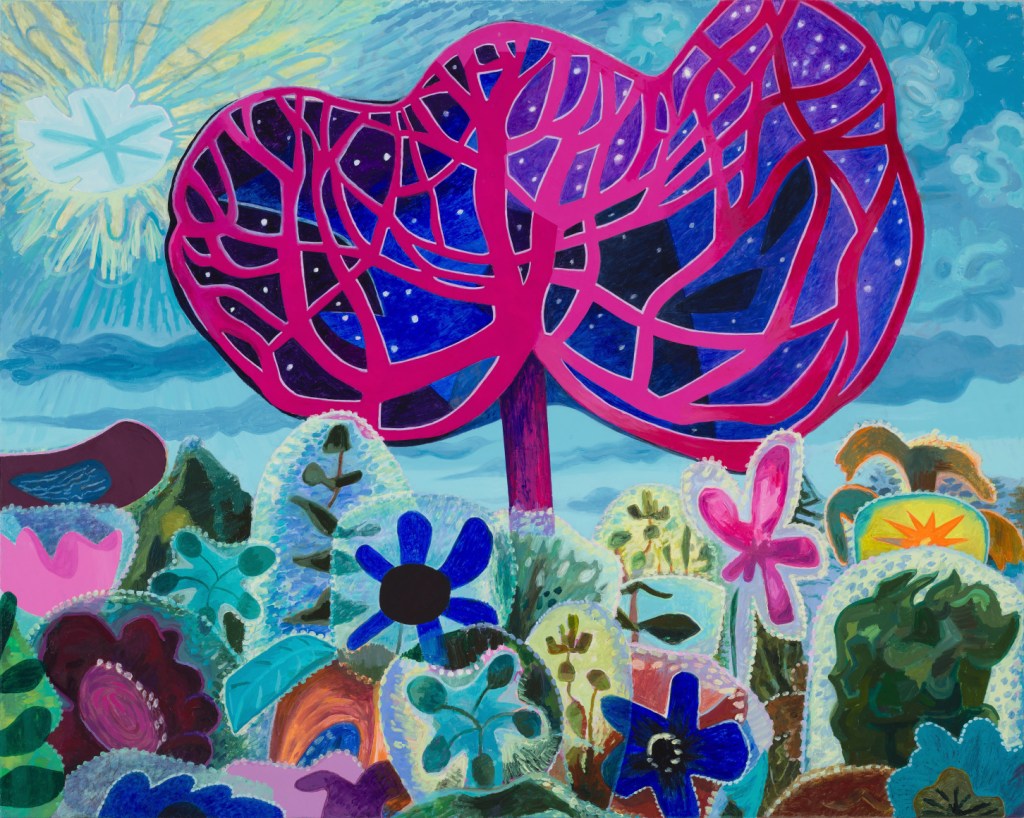

For at least a decade, trees have been the signature bearers of Carson’s theatrical narratives. Among the most potent symbols in almost every culture since recorded time, trees arrive with powerful backstories. The mythology of Daphne, the Tree of Life, and the Tree of Knowledge are all noted in Carson’s oeuvre. Recently, she described the trees as characters having a “grow-or-die ethos.” In this series, they’re grappling with slippery terms of existence. A single tree (two in the diptychs) dominates every composition from top to bottom, each with an illuminated canopy and a labyrinth of branches juggling enigmatic symbols and, as the title “Cosmic Chatter” suggests, humming with messages.
The animated, antic quality of Carson’s work fits critic Sianne Ngai’s definition of the “zany” as a “savagely playful” aesthetic. Demonstrative of a frantic I Love Lucy level improvisation, Ngai writes, the zany dramatizes how easy it is to reverse the precarious positions of safety, emphasizing the sheer out-of-controlness of the artist’s or worker’s performance. In Carson’s work, trees act as beleaguered arbiters in a topsy-turvy world, feverishly working, maybe with a little slapstick, to keep it all together.

In the futuristic diptych Fireball, dawn is breaking on the left, a chromatic gradation from sunset to midnight unfolds on the right. Intense, hallucinatory colors heighten the senses, implying that we are seeing beyond our natural capacity. Chartreuse skies and a tree crowned in white light hold flowers beginning to open. Against a cloudy midnight sky, a night-blooming tree sports a giant, mutant blossom. The fireball hurtles to Earth. Stars and flowers function as avatars of skewed time and distance and, as in Van Gogh’s work, all matter is alive, ablaze with color, wild and abundant. Details are crucial for Carson, and richly rewarding. Varieties of patterns, marks, outlines, and interlocking shapes also attest to Carson’s mastery of collage. The puzzle-like compositions serve her subject–a world of pieces that somehow fit together. Carson portrays the tension between order and chaos, and, with a feminist ethos, the investment of affective labor for nurturing growth or change.


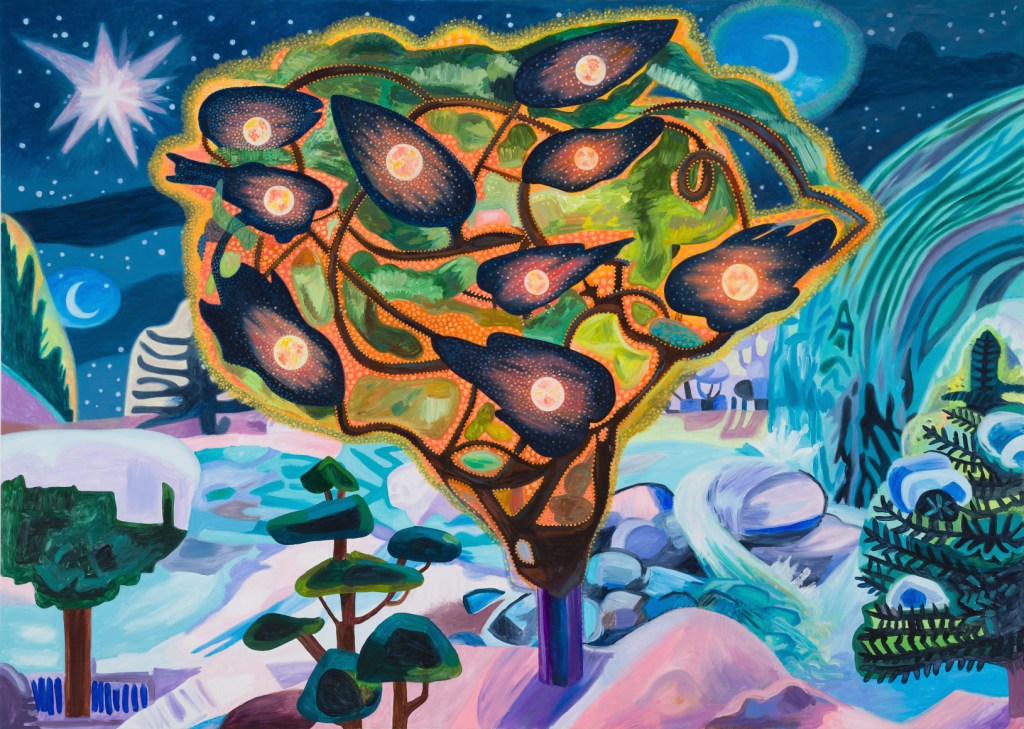
Nocturnal Hijinks highlights Carson’s reversals of natural norms. The night sky is filled with stars and crescent moons under a blanket of snow, pink with moonlight. In silhouette, the tree’s canopy is lit, perhaps irradiated, with pointillist patterned dots. Its branches sprout giant leaves, or windows, filled with stars and moons. Surreally poignant, the tree portends its own universe. Behind it, in teal and lavender, is an idyllic landscape, including topiary recognizable from Carson’s personal garden. It’s a quiet and reflective “what if” proposal.
“Cosmic Chatter” is dazzling and insistent. Carson is clear about her intentions. As evidenced by two rooms of 36 artworks, practice and experimentation have honed her craft. The arc of her imagination might begin with Burchfield-like awe for nature, but it bends, as she has said, towards “a universe of alternative biology and psychological spectacle.”

“JoAnne Carson: Cosmic Chatter,” DC Moore Gallery, 535 West 22nd Street, New York, NY. Through October 11, 2025.
About the author: Mary Jones is an NYC-based artist, a Senior Critic at RISD, and an Instructor at SVA.