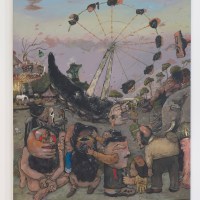
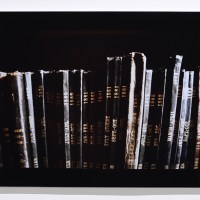
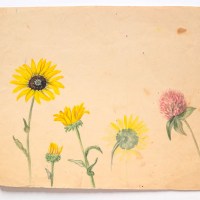
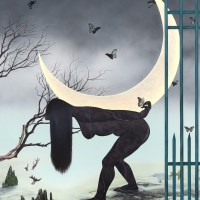
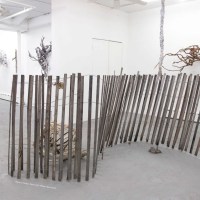
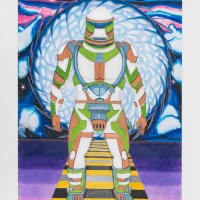
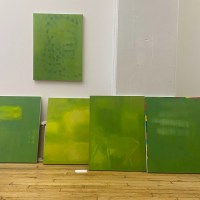
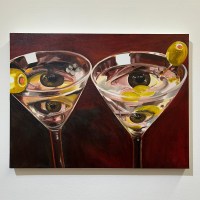
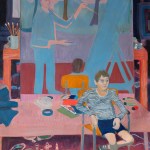
On the occasion of “A Legacy of Making: 21 Contemporary Italian American Artists,” a sprawling group show on view at the Calandra Institute through January 12, 2024, Two Coats of Paint invited John Avelluto, one of the artists in the show, and Joanne Mattera, the mastermind behind the whole project, which began as an online exhibition called “Italianità,” to talk about growing up in Italian families, and how the experience shaped their lives and their work. John currently has a solo exhibition on view at Stand 4 in Bay Ridge, Brooklyn, too.
Latest articles
The uppercrust on display in “Wave Pattern”
Contributed by Jacob Patrick Brooks / The lofts of downtown New York occupy a special place in American art history. They functioned most importantly as incubators for Abstract Expressionism in the 1950s, eventually giving way to the galleries of the 1980s and 1990s. Today, the spaces once occupied by Barbara Gladstone, Pat Hearn, and Willem de Kooning have been replaced with Uniqlo, Nike, and expansive apartments for the super wealthy. In “Wave Pattern,” a downtown apartment show on the sixth floor of an unassuming Broadway building, art world scions Dylan Brant and Max Werner provide some relief from this cluttered, big-box nightmare.
Stephen Whisler: Smoke signals
Contributed by Natasha Sweeten / In Stephen Whisler’s solo show “Past is Prologue” at 325 Project Space, I seem to have stumbled onto an archeologist’s record of discovery, showcasing a vanished world. Three large black-and-white charcoal drawings are straightforward portraits isolating simple, mysterious organic structures. The two cast-iron sculptures strike me as rendering long-lost implements whole again. This work is imbued with a somber sense often associated with scientific research. Yet lurking within is a playfulness, and a tender, vulnerable unraveling.
Rebecca Morris: Resisting beauty
Contributed by Sharon Butler and Jonathan Stevenson / Rebecca Morris, a masterly abstract painter who could do pretty if she wanted to, insists that when a painting starts to look beautiful she catches herself on and pivots to more discomfiting territory. That kind of grim integrity and its visual realization has an austere appeal, but there’s no need right now to get into the niceties of infinite regress or meta paradox. Judging by her solo show at Bortolami, parsimoniously titled “#31” after the number of solo shows she has presented during her career, Morris does consciously resist the pursuit of visual beauty and representation. The large-scale oil-and-spray-paint works are all untitled, distinguished only by parenthetical number indicating the year and the order in which the paintings were made. Each canvas is replete with vivid color and divergent shapes but embodies an irresolute and disconsolate state of play. This could ramify for a given viewer in any number of ways – though not, presumably, as lovely.
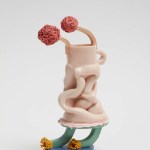
Daniel Giordano’s sculpture: Memory fueled, magically sprouting
Contributed by Kari Adelaide Razdow / Daniel Giordano’s sculptures, some of them currently on view at MassMoCA and Visitor Center in Newburgh, NY, it is possible to decipher a deeply personal language ensconced in forms and symbols. His works defy easy classification while honoring memories that inhabit his industrially tinged studio in Newburgh, NY, once his family’s clothing factory. His freewheeling use of materials and evocative titles suggest a comprehensive embrace of sculpture as a repository of humor, narrative, and poetics, as well as a means of integration and rupture alike. There is a logic underpinning the wild combinations and ambiguous forms in his work. It resonates with echoes from the past and suggestions of the future, like a postcard from someone we have not yet met.
Stockholm’s art scene: Gracefully forward
Contributed by Jonathan Stevenson / A sense of continuity and integration permeates Stockholm’s grand state museums, its smaller konsthalls, its bountiful old salons, its stylish established galleries, and even its hipster-ish artists’ spaces. Just as consistently, though, contemporary assertiveness challenges tradition. At least on the evidence of an unavoidably incomplete late September visit to the city, the net result is contained vibrancy, exciting and inventive but also richly contextualized and sensibly progressive.
Ron Linden’s eccentric abstraction
Contributed by Katy Crowe / Ron Linden’s exhibition “re.dux” at 478 Gallery in San Pedro is a welcome introduction to a large body of visually engaging abstract work that invites interpretation. His reductive, conceptual approach has persisted while evolving. Linden’s palette is minimal, mostly ochre and shades of black with, now and then, red oxide and cobalt blue. Included in his tool kit are staples of traditional painting, commercial and scenic art from which he also borrows tricks of the trade, such as forced perspective, stencils, and faux-finish techniques. The show comprises 16 medium-to-large paintings and a dozen smaller ones installed as a single set. They all adhere to his minimal palette, and most are acrylic and charcoal on canvas, just two on paper. 478 Gallery’s generous exhibition space allows for plenty of air between works, and the consistent palette, punctuated by a spot of red oxide here and there, makes for visual coherence.
NYC Selected Gallery Guide: Nov 2023
Welcome to the Two Coats of Paint painting-centric guide to galleries in New York. Interesting shows this month include Keltie Ferris at Mitchell-Innes & Nash, Katherine Bradford at Canada, Fran Shalom at Kathryn Markel, Ann Craven at Karma, and Yinka Shonibare, who is exploring African abstraction in his solo at James Cohan. A group show at Marinaro called “The Triumph of Death” seems to suit the mood of the past few weeks, as does Yevgeniya Baras’ solo at Sargent’s Daughters. She began the series of paintings while she was on a summer residency in Tel Aviv. We’re intrigued by images of Anna Berlin’s work at Olympia. Are the paintings made in grayscale or are the pictures black and white? Must run over and check them out IRL this week.
Hudson Valley Selected Gallery Guide: Nov 2023
New stuff for November: Last month we produced a handy interactive map of the galleries in the Hudson Valley region for the Two Coats Gallery Crawl, with links to both the galleries and to their location on Google Maps. As out-of-towners, we found it incredibly helpful driving from space to space, so we have decided to create a version for use year-round. Readers can find a link on the menu bar at the top or click here to take a look. Keep in mind it’s a work in progress, and more galleries will be added shortly. Note that a couple of galleries have closed for the season: Elijah Wheat and the Re Institute.
The sea: Vulnerable and mysterious at Field of Play
Contributed by Jenny Zoe Casey / The title of the group exhibition “1,000 Year Current,” on view at Field of Play Gallery in Gowanus, refers to the time it takes for a particle of water to circumnavigate the earth. Curated by gallery director Matt Dogsdon, the show encompasses a generous range of linked subjects, from the sea’s primal mysteries to its vulnerability to climate change.
Charline von Heyl’s audacious eclecticism
Contributed by Barbara A. MacAdam / Where to begin in exploring Charline von Heyl’s formidably eclectic and multifaceted show of new paintings at Petzel Gallery? She embarks on a visual discussion with her mostly nineteenth- and twentieth-century European and American predecessors and counterparts in a tour de force. The show, cluttered yet precisely deployed, demands equally targeted unpacking, close looking, and an individual assessment of each painting on its own terms.
Meet UConn’s MFA Studio Art Class of 2026
UConn’s MFA Studio Art program is a fully funded three-year graduate program which supports a broad range of art making including painting/drawing, photography/video, printmaking, and sculpture/ceramics with an international faculty and superior and generous facilities in a rural environment centrally located in Southern New England for easy day trips to New York, Boston, Providence, Hartford, and New Haven. The program culminates with an exhibition in a NYC gallery. and a thesis exhibition in UConn’s William Benton Museum of Art. The deadline for submitting the application is January 15, 2024.
Frieze London: Quieter voices
Contributed by Kenneth Greiner / Having recently relocated to London, I was delighted when a friend offered me a free ticket to the twentieth-anniversary Frieze Art Fair in Regent’s Park. On a sunny Saturday, I took the Jubilee Line tube from my new flat in northwest London to Baker Street before joining the line in front of the fair’s enormous white tent. This, I would discover, was where the contemporary works were on display. With 130 galleries participating, I knew I’d need to be a bit discerning if I was going to spend more than a few seconds with any particular painting. I soon found myself standing in front of The Only Thing Left Behind, a mid-size oil painting by British artist Martyn Cross at the Hales Gallery booth.
David Humphrey and Gregory Amenoff’s long conversation
Contributed by David Humphrey / On a sunny August afternoon, I visited Gregory Amenoff in his Kerhonkson, New York studio, crowded with paintings and a circular palette table piled with paint. I’ve known Gregory for years and our paintings have been talking to each other but we have never had a sustained dialog like this one. It was a great pleasure to prompt words from an artist who has had ambitious art pouring out of him for half a century. “Chords of Memory,” a survey of five decades worth of Greggory Amenoff’s work, is on view at Pamela Salisbury through November 5.
Gandy Brodie’s loaded brush
Contributed by David Carrier / Painting with a loaded brush to create heavy layers of pigment by juxtaposing strands of varied colors is a distinctive, philosophically interesting art form. Eugène Leroy (1920–2000), a notable practitioner of it, had real doubt about the validity of the very act of making paintings. So did Alberto Giacometti. They asked when an artwork was finished, and answering the question is a particularly stiff challenge for one who wields a loaded brush. Such an artist tends to feel compelled keep painting until he or she can “get it right,” which may never happen. Repainting, of course, can also simply manifest love of the activity, and the desire that it never end.