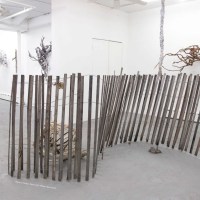
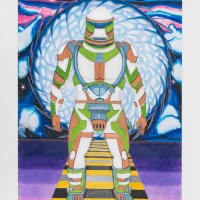
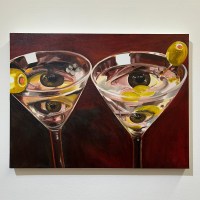
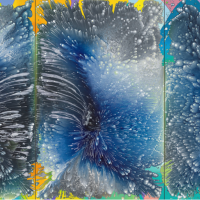
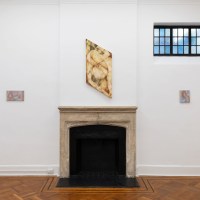
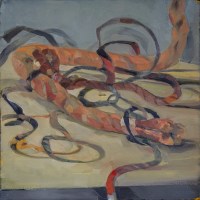
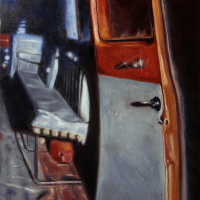
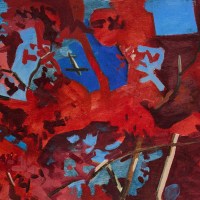
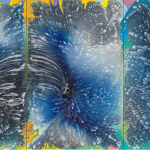
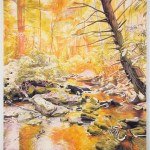
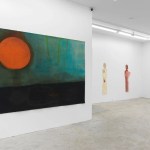
Contributed by Chunbum Park / In the seventeenth century, the English justified their North American conquests with the Roman concept of res nullius, whereby all people owned unoccupied land until it was put to some worldly use. The English philosopher John Locke suggested that the Europeans could disregard all indigenous forms of government and deny indigenous peoples sovereignty because Europeans, unlike the indigenous, valued and worked the land. G. Peter Jemison, a member of the Heron Clan of the Seneca Nation, makes paintings and drawings that encapsulate indigenous beliefs about the land, many now on display in his show “On the Right Path” at 47 Canal, quietly but firmly countering the colonialist narrative.
Latest articles
Joan Snyder’s brilliant command of chaos
Contributed by Abshalom Jac Lahav / “ComeClose,” Joan Snyder’s current exhibition at Canada, testifies to her enduring brilliance and evolving artistic language. Now 83, Snyder has been a trailblazer since the 1970s. With her “stroke paintings,” she disrupted the Minimalism that was then fashionable, left cold by its austerity and masculinity. Her rebellion made Snyder a feminist shaper of contemporary abstract art. The distinctive juxtaposition of vivid colors and earthy backdrops in her work reflects a lifelong determination to explore and push its boundaries. The exhibition’s title is an invitation to examine not just the art but also why we make it.
A (mostly appreciative) response to Saul Ostrow
Contributed by Adam Simon / I was struck by the last two sentences of Saul Ostrow’s essay, “Painting simulacra: Brice Marden, David Reed, and Gerhard Richter.” He writes: “Marden, Reed, and Richter have sustained abstract painting’s aesthetic and cultural value as a mode of resistive thinking. In most cases, though, this has been misread or at least subsumed by its own model, thereby giving rise to the kind of acritical aestheticism and nostalgia that bolsters painters who promote gestural abstraction as a genre or motif rather than a mode of inquiry.” It took a minute to unpack this statement and allow it to sink in. Ostrow’s critique is dense, and appears to implicate most contemporary gestural abstract painters as well as contemporary criticism that dismisses the possibility of radical formalism.
Jane Swavely and the Bowery tradition
Contributed by Michael Brennan / Magenta Plains is located on the Bowery, just as it breaks left onto Canal Street, in Chinatown. Upon entering, viewers are immediately greeted by a washy terre verte Jane Swavely painting, OID #3 Green, hanging above the desk. It sets an organic tone and is indicative of the half-dozen paintings to follow, hanging in the first-floor main gallery. Swavely’s seven canvases are all vertical, and are mostly diptychs, internalized or externalized. They are loosely painted with a 2- to 2 ½-inch flat brush, heavy on the solvent, with some wiping away by hand. Much color mixing happens directly on the surface. Swavely favors flared, phosphorescent hues. She cleverly manipulates paint with rags to create the illusion of light emitting from the ground. Her work glows, appearing backlit.
John O’Connor’s formidable pencil
Contributed by Riad Miah / John O’Connor’s tools are basic and everyday, materials that one might think a child would use for their initial foray into art making. For his works on paper, many now on display in his solo exhibition “Man Bites Dog Bites Man” by way of Pierogi and L’SPACE, he uses colored pencils and graphite. But behind the simple tools is a discerning mind.
Painting simulacra: Brice Marden, David Reed, and Gerhard Richter
Contributed by Saul Ostrow / “Let the Painting Make You,” the exhibition of Brice Marden’s last paintings; at Gagosian Gallery, set me to thinking about the relationship between Marden’s earlier gestural works and Gerhardt Richter’s process-oriented abstract paintings, which in turn led me to consider the connection of their works to those of David Reed and then to the French artists Simon Hantai and Bernard Frize who, like Reed, creates the illusion of an impossible spontaneity. Slowly, I came to focus on the question of why Richter is identified with post-modernism, while Marden and Reed’s works are most often critically identified as being quintessentially modernist and formalist. While Hantai (the modernist?) and Frieze (the post-modernist?) fit the question of what constitutes post-modern abstract painting, their references and histories are different for consideration here. Instead, I decided I would focus on Richter, Reed and Marden all who seem to transgress the formalist and modernist dictums that were generated in the 1950s and 1960s in the United States and then exported abroad, as such Hantai and Frize are part of another genealogy.
The Zone of Interest and Eileen: Varieties of creepiness
Contributed by Jonathan Stevenson / Some might have thought that the cultural well had run dry on the Holocaust – that writers, filmmakers, and playwrights had said all they could about Hitler’s Germany, having plumbed it so exhaustively as to entrench an existential deterrent to its reprise. But that view assumed that the species was advancing. In the last ten years or so, the late-twentieth-century idea of human progress has taken an obvious hit. The political success of Donald Trump, the MAGA crowd, and their imitators has reanimated the fear of vicious fascism and the warped ethos that allows it to flourish. So Jonathan Glazer’s The Zone of Interest, loosely based on Martin Amis’s novel of the same title, is not just a brilliantly imagined dramatization of genocidal lunacy compartmentalized within the saccharine Gemütlichkeit that the Nazis idealized and retailed. It is also a cold-eyed warning about the persistent human capacity for morbid normalization.
Cordy Ryman, maestro of the quotidian
Contributed by Sharon Butler / While nostalgia and the yearning it precipitates may be gripping the art world, Cordy Ryman’s gently dazzling painting installations, on view at Freight + Volume, are unapologetically about the here and now – that is, what’s happening in one place today. Titled “Monkey Mind Symphony,” the show captures the distractions we encounter day by day, minute by minute. What could be more apt for our time than a visual language comprising small objects? Logically, they are the physical manifestations of tweets or threads, crafted easily, sometimes beguilingly unfinished in the traditional sense of the word, and arranged so as to radiate Ryman’s idiosyncratic energy.
Conor Gannon’s sculptural tone poems
Contributed by Liz Scheer / On Harmonious Regulations, released on Bandcamp on January 6, Bronx-based poet and musician Conor Gannon interlaces disparate mediums and genres to develop what he terms “tone poetry,” which uses electronic music to establish and maintain meter. Born of Gannon’s preoccupation with the shapes of audio waves, his tone poems have a sculptural quality in their use of sample-based repetition to structure metered verse.
Maki Na Kamura: “Caspar David Friedrich plus Hokusai minus Romanticism minus Japonisme”
Contributed by David Carrier / Born in Japan, Maki Na Kamura was trained in Germany, where she now lives and works. In that light, it’s not too surprising that she describes her work as “Caspar David Friedrich plus Hokusai minus Romanticism minus Japonisme.” Identifying herself as both a traditional painter and a contemporary artist, she notes that she might, on the same canvas, use both tempera and oil paint– two materials traditionally used separately. Her paintings and charcoal-on-paper drawings are poised between figuration and abstraction. The paintings are often centered on figures, but it’s not usually clear what’s happening in the work on view at Michael Werner. It may be hard to tell just what we are looking at, but it is obvious that her central concern is visual pleasure.
The grit of Frank Auerbach
Contributed by Natasha Sweeten / As a young art student, I revered Frank Auerbach. His practice was a battle with inner demons, one of splayed brushstroke and open flesh that plunged deep into his psyche. The stories of him laboring countless hours on the same small portrait, painting and repainting, scraping it all off at day’s end – were they not the perfect embodiment of my own tortured soul? Were we not linked by artistic fury, the desire to express something frustratingly beyond our reach?
Hudson Valley (and vicinity) Selected Gallery Guide: Jan 2024
January is a slow month outside the city, and many galleries knock off for a couple weeks, so make sure to check the hours before setting out to see shows. Peace and love in 2024 to all.
NYC Selected Gallery Guide: Jan 2024
Hello 2024! Last year the art-fair spaceship landed in NYC during September, stealing thunder from the local galleries. Is January now the best month for solo exhibitions? Lots of our favorite local artists are having openings: Joan Snyder at Canada, Jane Swavely at Magenta Plains, Sharon Horvath at Lori Bookstein, Greg Drassler at Betty Cuningham, Bill Carroll at Elizabeth Harris, and Tamara Gonzales at Klaus von Nichtssagend. Former Bushwickers Julie Torres and Ellen Letcher are returning…
Eyal Danieli: Embracing history in abstraction
Contributed by Michael Brennan / Israeli-American artist Eyal Danieli passed away earlier this year. I met him a few times, but I didn’t know him. I was impressed by the force of his personality, or more specifically of his presence. It was not that he was intimidating. In fact, he struck me as a tender soul – a gentleman – but also a man weighted with a distinct and uncommon gravity. His painting, in its blunt sensitivity, is similar. Sadly, Danieli’s first exhibition with 57W57 Arts, solemnly called “Preoccupied,” is effectively a memorial show. But nothing can diminish the innate power of his small pieces.
Dana Schutz: Too big to fail?
Contributed by Peter Malone / The airplane-hangar dimensions of the top-tier commercial art gallery can be justified by the flexibility they offer both dealer and artist. In 2017, I watched David Zwirner adapt his Chelsea location on 19th Street to accommodate Alice Neel’s modestly sized portraits, then open it up to create the parking lot rug sale vibe that suited Josh Smith’s 2019 “Emo Jungle” bazaar. Those two events occupied my thoughts as I walked through the grandiose layout of Dana Schutz’s recent “Jupiter’s Lottery” exhibition.