
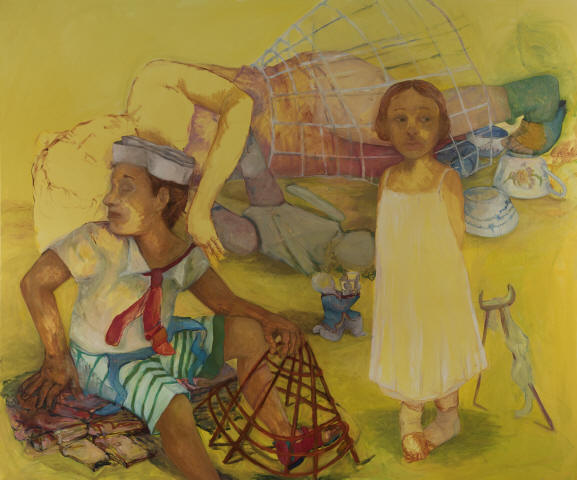
Contributed by Riad Miah / Philemona Williamson’s paintings delve deeply into the concept of arrested development. For her, the term signifies a profound state of emotional or psychological stagnation, often linked to unresolved childhood issues. Yet her overall vision is expansive and not unhopeful. In her current exhibition of 15 large and small oil-on-canvas works at June Kelly Gallery, complex narratives inform her paintings and affect the very process of their creation while remaining purposefully unarticulated. In this respect, her work is in line with that of Balthus, Lucien Freud, and Max Beckmann. Stylistically, it is not unlike Eric Fischl’s, William Kentridge’s, and Henry Taylor’s. She could have placed the fact that she is a Black woman front and center in her governing storyline. But she has not done so. While identity politics is hardly banished from her work, it emerges from a gentle, indirect angle.
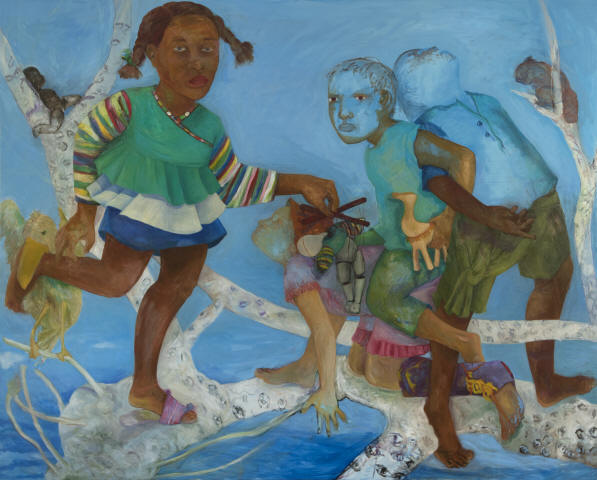
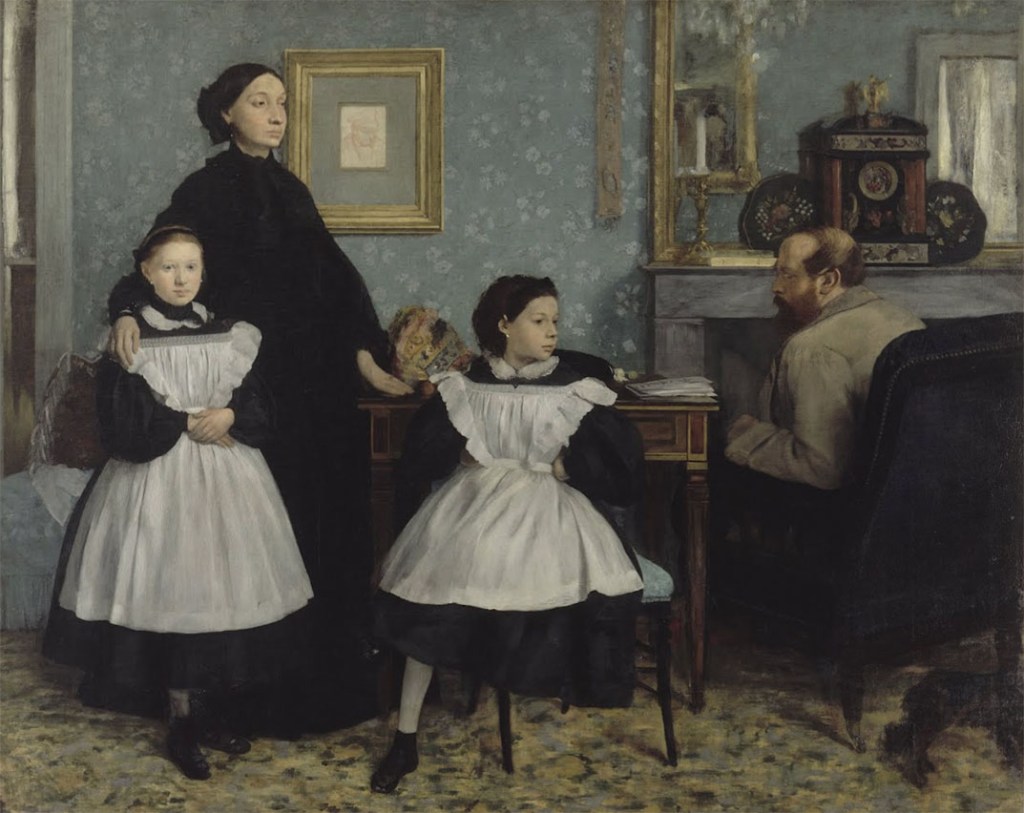
In The Light of the Gingko, there are four or five figures, some obscured and two of which could be dolls. An event is unfolding, but the nature of the place and the details of the action are unclear. Most of the characters appear to be adolescents and seem off-balance, underlining the liminal and potentially disruptive aspects of the scenario. Their race, gender, and identity remain ambiguous. Some clues do appear, but they are hardly conclusive or, therefore, interpretatively confining. The figure to the left is dressed in a sailor’s outfit, and the one above it, more sketchily rendered, appears to be sleeping in a crinoline garment. In the figures’ placement, the vague state of the horizontal one, and the canvas’s relatively large scale, the painting is reminiscent of Degas’ The Bellelli Family. Like him, Williamson masterfully conveys a complex and fraught social and psychological state without overt narrative mediation.
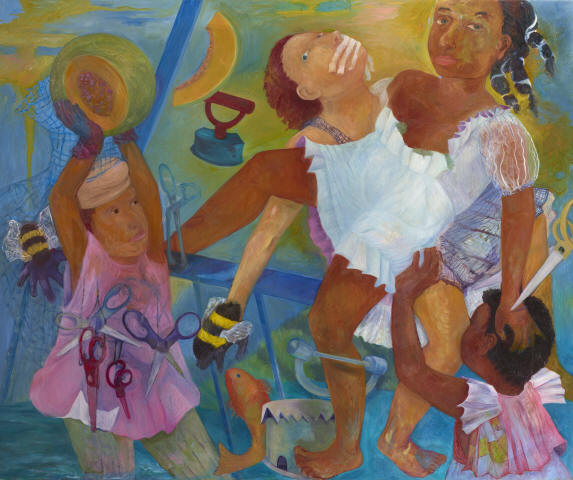
Williamson’s paintings capture the nuances of transition. All of them present threshold states: under-developed spaces of open-ended possibility. On a formal level, they often seem unfinished in places, which lodges the compulsion towards completion in defiance of psychological obstacles. The youthful figures are aware of their bodies but clumsily so, amplifying the potential for spontaneous accident or unintended consequences. One reading is that Williamson is simply picturing what it means to be alive. What distinguishes her work is its submergence of topical politics in a noble and successful effort to frame perpetual and universal human challenges.

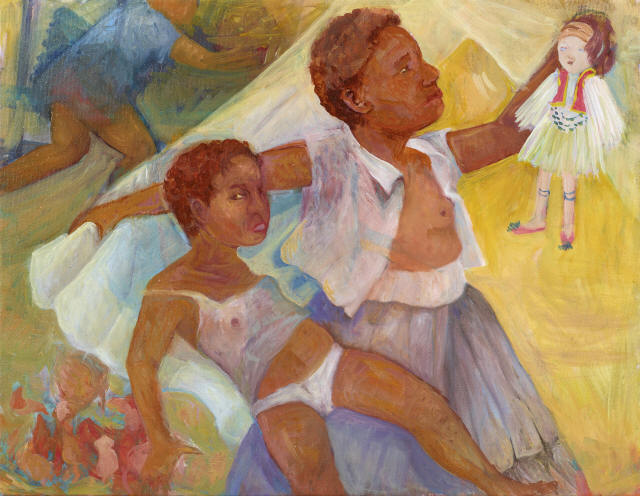
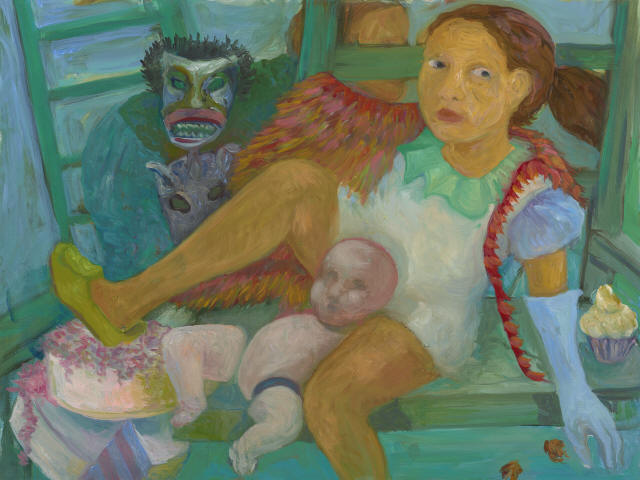
“Philemona Williamson: Recent Paintings,” June Kelly Gallery, 166 Mercer Street, New York, NY. Through June 4, 2024.
About the Author: Artist and educator Riad Miah was born in Trinidad and Tobago and lives and works in New York City. He has exhibited with Lesley Heller Workspace, Rooster Gallery, and Sperone Westwater Gallery. His 2023 solo show was at Equity Gallery in New York.







An extremely thoughtful review of a beautifully-painted, gripping show.