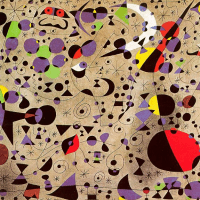
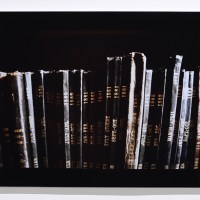
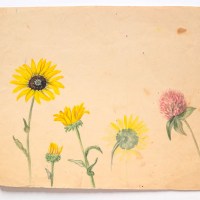
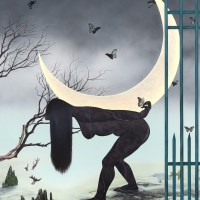
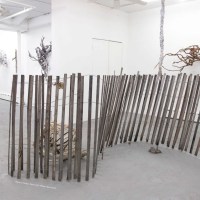
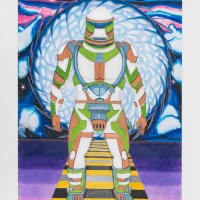
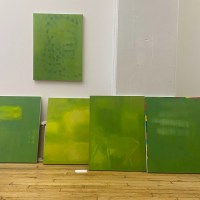
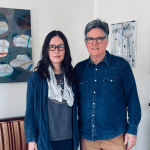
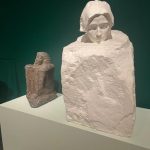
Contributed by Jonathan Stevenson / Gary Stephan has been an abstract painter for over fifty years. His command of that vocation – touch, line, color, concept – is duly acknowledged. But he is far from content. Stephan came of age at what was arguably the extended peak of modernism, when creative people across the board presumed to tackle existential problems for the ages.
Latest articles
What the hell is water? How Instagram hurts art
Contributed by Laurie Fendrich / For the past eight years, I’ve been merrily swimming along in the waters of Instagram without once stopping to ask what it is. My first post was on December 10, 2016 – five weeks and four days after Trump won his first presidential election, when, like many people, I was devastated. I thought Instagram might bring me out of my post-election torpor. Rapidly scrolling through my feed, posting images (especially of art), seeing what my artist friends were posting, and discovering new art and artists initially felt
Francesco Clemente’s visual facility
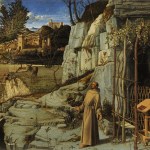
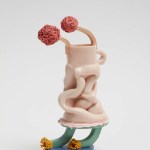
Contributed by David Carrier / I have been writing a book about art in the churches of Naples’ historic center. There I also visited the new Kunsthalle Madre, which contains an elaborate two-story permanent installation by Francesco Clemente called “Ave Ovo.” Like baroque Catholic art, Clemente’s work features elaborate symbolism. While the old masters employed it to present church dogma, his symbolism is personal and more elusive. In Naples, however, both exhibit a penchant for sensory overload: more is more. In his splendid show “Summer Love in the Fall,” now at Lévy Gorvy Dayan, Clemente still uses some of the same symbols – male and female body parts, his own portrait – but the colors in its 23 paintings are more subdued. The title may well refer to the psychic place of erotic images in his later life as well as the timing of this exhibition, for now his work seems more serene.
A group apart at Springs Projects
Contributed by Jonathan Stevenson / There are a fair few viable organizing concepts for group art exhibitions. One particularly challenging one is to present viewers with a tour d’horizon of emotions and attitudes that seem to prevail at a given historical moment. The key to optimal execution, of course, is to avoid both the obvious and the obscure. In “Each Own” at Springs Projects, curators and gallery co-founders Cate Holt and Tommy White strike the right balance, strategically deploying the work of six exceptional…
Jim Osman: Multiplicities of balance
Contributed by Rachel Youens / The sculptures in Jim Osman’s show “Walnut 3,” now at McKenzie Fine Art, are both architectonic and playful. His constructions, placed on pedestals, are formalist balancing acts made of found lumber, some elements lightly reworked, that are stacked and arranged. Osman’s overall intention is to find a complex situation for entry, where forms assembled from Euclidean solids generate stability or dynamism through exquisitely contrasting proportions and scale. The experience of seeing unfolds in the extended time required to walk around each small free-standing work.
Vincent Szarek’s odysseys
Contributed by Ben Godward / Vincent Szarek’s current solo exhibition at R & R, a joint venture between Chart and Marvin Gardens at the juncture of Ridgewood and Bushwick, is his first in New York since moving back to the city from LA. The show is exquisite in itself and enhanced by an ideal location. His works are predominately black with hints of color that flash against the grey and brown industrial trappings of the space. Whereas the preserved vine-covered brick wall behind the largest painting echoes Old Europe, the pitted, patched, cracked, and grooved concrete hosting the central sculpture is pure Brooklyn/Queens. The swells of Szarek’s glossy surfaces flatter both settings, and vice-versa.
Jadé Fadojutimi’s glorious self-restraint
Contributed by Millree Hughes / Painters in their twenties and thirties, particularly those whose work is figuration bordering on abstraction and somewhat gestural, may be trying to do too much. Too often it features too many colors, too many forms, too much of everything. It’s hard not to sympathize. Such artists have grown up in a time when communication occurs in morphing, moving pictures at high speed, and when consumer culture assaults mass consciousness. For some, the most honest response is to be overwhelmed and paint accordingly. Jadé Fadojutimi, whose enigmatically titled solo show “Dwelve: A Goosebump in Memory” is at Gagosian, sees another way.
Michael Handley, Greg Lindquist: Chemistry and fire
Contributed by Katy Crowe / Michael Handley and Greg Lindquist’s show at the Landing Gallery – identified by the emoji for fire – could not have been more poignantly timed. It coincides with California’s fire season and more particularly the destructive Mountain Fire just north of Los Angeles, beyond that with drought-induced fires on the east coast, including Brooklyn’s Prospect Park, and with an incendiary presidential election.
Hudson Valley (+vicinity) Selected Gallery Guide: December 2024
Contributed by Karlyn Benson / December is the month for small works and holiday group shows, such as LABspace’s annual “HOLIDAY” show featuring 400 artists and “ALL small” at Pamela Salisbury. There are a few weeks left to see Chie Fueki’s “Petal Storm Memory and Non-Objectified” at Kino Saito; “When the Spirit Moves You” and Eve Biddle’s “I have time for death and rebirth” at Geary; and “All At Once” at SEPTEMBER. December 6 is the opening of “The 5 by 7 Show” at the Kleinert/James Center for the Arts, marking the 25th anniversary of this popular fundraising exhibition. On December 7, Front Room Gallery celebrates their 25th anniversary with an exhibition of gallery artists. For this edition of the guide I have also included artist and maker fairs and pop up shows taking place at galleries and art spaces throughout the region. Shop local and give the gift of art this season!
NYC Selected Gallery Guide, December 2024
This month, as many in the art world head to Miami for the fairs, most galleries have extended their exhibitions into December. If you missed a show you were hoping to catch, there’s good news—it’s likely still on view. But before you scroll down to see what’s in the galleries
Pierogi at 30: Revisiting the personal, peculiar, and droll
Contributed by Adam Simon / There have been group shows that represented cultural milestones – the Armory Show of 1913, the “‘Bad’ Painting” show at the New Museum in 1978, the Times Square Show of 1980. In the shadow of a foreboding US presidential election, “Pierogi 30” has that kind of historical weight.
Lydia Baker: Pooling consciousness
Contributed by Jacob Patrick Brooks / It would be hard to miss the overarching theme of Lydia Baker’s show “Sonnet,” up at Massey Klein Gallery: metamorphosis. But rather than relying on overused signifiers, she gently guides us through life’s whitewater rapids, her work practically whispering “the only constant is change.”
Dannielle Tegeder’s freighted abstraction
Contributed by Riad Miah / Informed by early modernists such as Piet Mondrian, Kazimir Malevich, Wassily Kandinsky, and Stuart Davis, Dannielle Tegeder’s abstract paintings are in themselves traditional, painted with acrylic on stretched canvas. When displayed, however, their import extends beyond the canvas edges into wall paintings, immersive installations, and even musical collaborations, encouraging a searching and interactive viewing experience. Her solo show “Signals,” currently on view at Standard Space in Sharon, Connecticut, incorporates new elements into her visual vocabulary, including ladder mobiles, stained linen, and walnut panels, freshly drawing on other aspects of art history.
Black and blacker at Studio 10
Contributed by Elizabeth Johnson / Planned with hope and trepidation, “In the Dark,” now up at Studio 10, leans into post-election malaise and dread with work by Mike Ballou, Tom Butter, Larry Greenberg, David Henderson, and Kate Teale – Brooklyn-based artists whose studio explorations are unified through the color black, via shape, mood, and phenomenon. Designed as a positive project for unsettled times, the exhibit coheres as a short list of nascent strategies for coping with darkness writ large before it has been parsed, studied, and conclusively judged. The works share a resistant sense of seduction, anticipation, and opportunity. By virtue of piecemeal construction, the show sustains an alluring in-between emotion, just right for entering voids that are only partly plumbed or viewing objects that are but partly known.
Aggregate: The city as nature
Contributed by Anna Gregor / The anxiety of being unable to distinguish artifice from nature has haunted art since the Ancient Greeks. No one wants to be the prisoner who mistakes the shadow on the cave wall for Truth, or, more embarrassingly, the bird who tries to eat the grapes in Zeuxis’s trompe l’oeil still life. But today, as human-made technology permeates all aspects of life, the difference between what is artificial and what is real is not so clear. This ambiguity is most apparent in the city, where nature manifests itself as a force of decomposition and aggregation that acts on all objects indiscriminately, whether “natural” or human-made. Here, art and nature are indistinguishable. This relation of artifice and nature in the city is the driving force behind “Aggregate,” now up at Studio 9D.