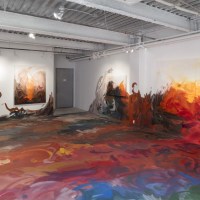
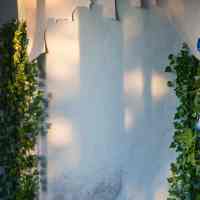
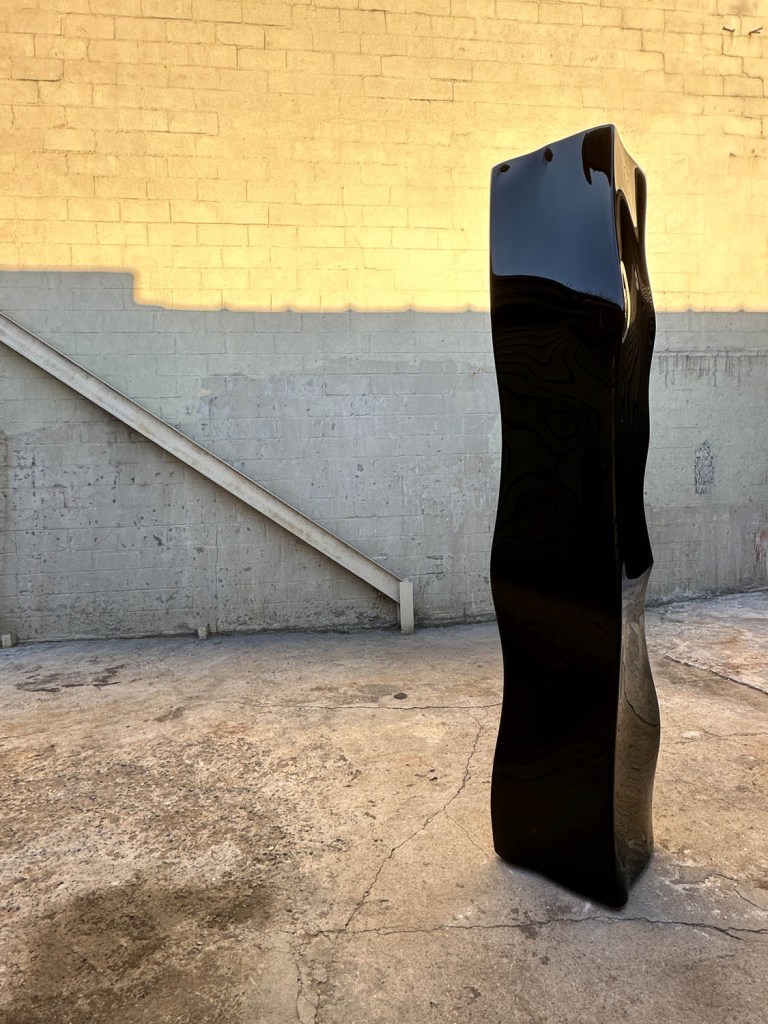
Contributed by Ben Godward / Vincent Szarek’s current solo exhibition at R & R, a joint venture between Chart and Marvin Gardens at the juncture of Ridgewood and Bushwick, is his first in New York since moving back to the city from LA. The show is exquisite in itself and enhanced by an ideal location. His works are predominately black with hints of color that flash against the grey and brown industrial trappings of the space. Whereas the preserved vine-covered brick wall behind the largest painting echoes Old Europe, the pitted, patched, cracked, and grooved concrete hosting the central sculpture is pure Brooklyn/Queens. The swells of Szarek’s glossy surfaces flatter both settings, and vice-versa.

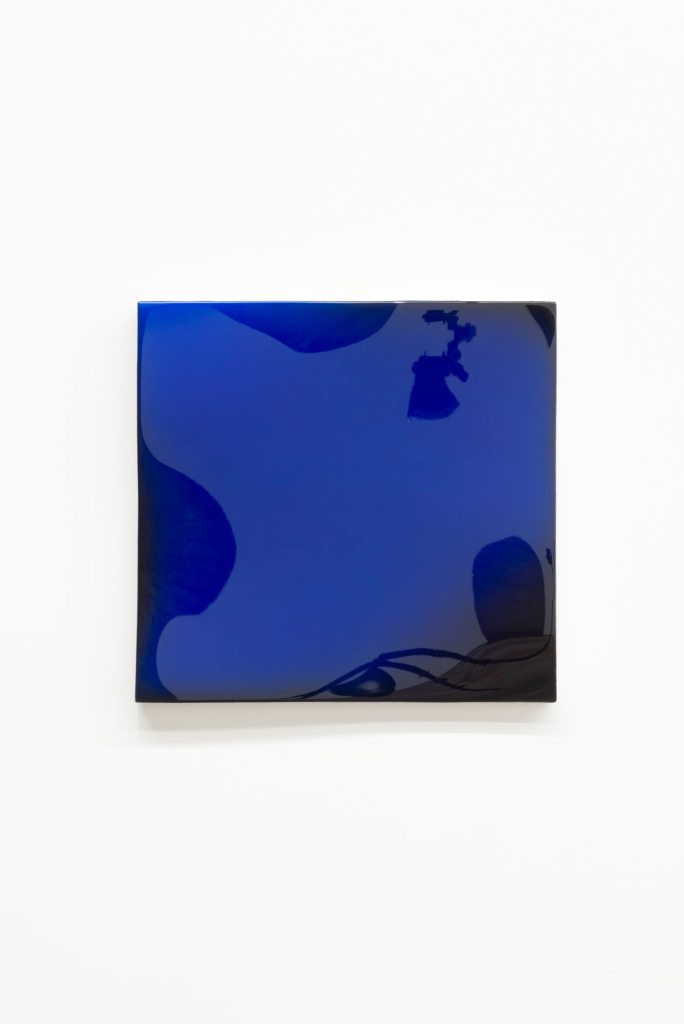
The new work reflects a very deliberate shift from what was on display in the last show of Vincent’s I saw with my eyeballs: “Hi-Fi Chassis” at Leo Koenig Inc. in 2011. Gone are the text and the slick, seemingly bejeweled objects of pop and car culture. Replacing them are more abstract undulating waves of canvas covered with paint and many coats of clear, showroom-polished to create a surface with slight variations of color and visceral smoothness that cause distorted reflections to dance as we move past the objects.
The titles of the works allude to The Odyssey – “that tired sea song” – and more proximately to the Steely Dan tune “Home at Last” from Aja, the band’s fusion masterpiece. Steely Dan co-founder and lead singer Donald Fagen’s comments in a 2006 interview could well apply to Szarek’s new approach:
I like it when songs develop in some way and four minutes usually isn’t sufficient time for something to develop musically. I’m still plugged into the Duke Ellington model, something akin to classical music, where you start with a theme, then expand on it, bit by bit, and veer off at tangents, and strive your utmost to book the listener on a mystery journey where he or she can’t quite guess the final destination and then, hopefully, they get caught up in the puzzle and stay on for the ride, because, when you get a decent groove going, time flies.
Tied to the Mast is the show’s lone sculpture and its centerpiece. Incorporating the visual language of the surrounding works, it evokes the writhing and squirming of Odysseus as the Sirens sing, evoking in equal degrees restraint, disdain for it, and outright abandon. The Sirens are not identified or directly presented, but we feel their pull.
Perhaps the most pronounced technical departure for Szarek is his new approach to walls. He once made wall sculptures in shapes vaguely like UFOs. Now he makes bonafide paintings. While they are not flat and contain no distinct image, they are devoid of texture. Five works of different sizes and undulations are built on curvy wooden stretchers with canvas stretched over top, then painted on the surface. Taped edges are removed to reveal raw canvas, yielding a delightfully frayed edge – sort of an event horizon between finish and support. At the same time, the uncanny refinement of the surfaces compels us to linger and draws us into the journey that the work embodies.
Szarek himself appears to be home at last, having forged his own nimble, confident fusion between sculpture and painting. I am sure this isn’t the end of his journey and look forward to seeing how it proceeds.

“Vincent Szarek: Hot Dogs and Milk Shakes,” R & R, 1548 Decatur Street, Ridgewood, NY. Through December 15, 2024.
About the author: Ben Godward is a Brooklyn-based sculptor.