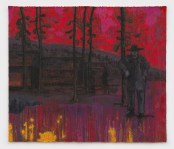
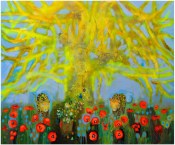
Contributed by Jonathan Stevenson / Despite the still breathtaking majesty of the physical world, human machinations are undermining its habitability. The United States is more starkly and toxically divided than it has been since the Civil War, and some Americans claim, contra Woody Guthrie, that “This Land” – the title of Leslie Wayne’s cogent new exhibition at Jack Shainman Gallery – was made only for them and not for other Americans. This existential double-whammy leaves artists with something of a conundrum: how to honor and present beauty robustly without seeming cluelessly disengaged. Wayne finds the sweet spot.
Solo Shows
Dan Dowd and the folds of memory
Contributed by Mark Wethli / As I viewed Dan Dowd’s intimate and poetic work, now at Magenta Plains, I considered our inclination to cathect feelings and memories onto objects. Clothing in particular echoes the shapes of our bodies; touches them; connotes gender, time, and economic status; and absorbs everything from our scent to our DNA. Dowd creates small, iconic assemblages out of found materials, including fragments of inner tubes, clothing, rags, and home décor.
Hung Liu’s timeless twentieth century
Contributed by Rosetta Marantz Cohen / Rare among contemporary artists, Hung Liu, who died in 2021, chronicled the trauma experienced by the Chinese diaspora in the aftermath of the Cultural Revolution. Her paintings, currently on view at Ryan Lee, vividly depict a female artist’s efforts to reconcile the terror of China’s recent past and the “otherness” she experienced after her emigration to the United States. The exhibit seems especially poignant now as questions about homeland, memory, and trauma resonate with such immediacy.
Andrea Sulzer and the art of intuition
Contributed by Mark Wethli / In an artist’s statement about her works on paper, Andrea Sulzer once wrote: “Instead of helping you find your way, these pages will help you get lost.” This notion not only sets aside a common assumption about what some viewers look for in a work of art, but also, in her choice of the word “pages,” connotes a different kind of art object altogether — something we’re meant to decipher, like a book or an atlas. She invites the viewer into a contemplative experience, grounded in uncertainty, that doesn’t purport to have the last word but presents a labyrinth of potential meanings that the artist welcomes us to explore. Like our first inkling of inspiration–what Emerson called our “gleams of light”–Sulzer’s art presents us with visual puzzles that resist logical interpretation but reward us instead with a quickening sense of our own creative intuition. Sulzer’s latest exhibition, “see through simple,” now on view at Sarah Bouchard Gallery in Woolwich, Maine, is a welcome opportunity to explore the work of this important mid-career artist.
Elizabeth Flood’s numb sublime
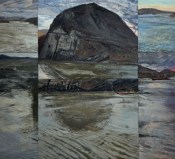
Contributed by Margaret McCann / Elizabeth Flood’s landscapes in “Lookout” at Storage Gallery included oil paintings that emphasize realism and expressionistic ink drawings. The latter express vigorous engagement with the outdoors. Gettysburg (Pickett’s Charge, October 9) channels the drama of that day. Stirring energy like that of George Nick’s alla prima work drives the eye deep into a field under a sensational sky. Conversely, mental distance accompanies Flood’s large polyptychs, whose combinations resemble photographic contact sheets, art website layouts, or bulletin board accruals. At their best, artifice is imbued with the existential doubt of Edwin Dickinson or Giacometti. Repetition and variance become metaphors for modern contingency and ambivalence. Multiple views rouse a mix of ennui, curiosity, taste, and choice, like that fueling our daily shuffle through cyberspace.
Sedrick Chisom’s American monsters
Contributed by Marcus Civin / The Philadelphia-born, New York-based painter Sedrick Chisom’s gothic, thematically inventive “…And 108 Prayers of Evil” at Clearing is his first solo show in New York. At the entrance to the gallery, a block of wall text sets the scene for Chisom’s mostly large-scale oil paintings and charcoal drawings. The action depicted occurs in the year 2210, when the Greek mythological figure Medusa is in trouble again. Almost comically, various political groups accuse her of listening to whispers in the forest and slipping gangsta rap lyrics to pious youth. A magmatic eruption threatens, and massacres have occurred in a place called Capital Citadel.
Alessandro Twombly: Strikingly original, richly allusive
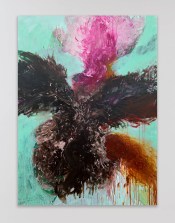
Contributed by David Carrier / Alessandro Twombly’s twelve large new paintings, now on view at Amanita Gallery, all employ one basic, immensely fruitful motif: knots of color resembling enlarged floral forms, depicted in high-pitched, gesturally painted oranges, pinks, reds, and blacks on bright turquoise backgrounds. An artist friend nicknamed these pictures ‘Tiepolo in the Sky,” which accurately describes them. Twombly’s abstract images look like drastically enlarged figures you might find in a work by the eighteenth-century Italian painter Giovanni Battista Tiepolo. They are strikingly original yet richly allusive.
Jennifer Coates: Edgy indeed
Contributed by Jonathan Stevenson / Several notable painters – Julie Heffernan, Jules de Balincourt, and Alexis Rockman, among them – have seized on the perils of climate change. In Jennifer Coates’s new solo show “Edge Effects,” jointly mounted at Chart Gallery and High Noon Gallery, she drills deeply into the subject and emerges with work that dazzles to engage, and vice-versa. The show’s title is an ecological term for what happens when one habitat impinges on another, which climate change is accelerating and amplifying. The phenomenon implies crowding, ergo potential conflict and trouble, and Coates’s canvases are appropriately busy and calculatedly unnerving. Bacchanal, a large painting, depicts the jangled co-location of lush plant life, bemused animals, and humans naked but often distressed. No doubt intentionally, it’s a far cry from Nicolas Poussin’s eponymous seventeenth-century study ingenuously celebrating sensuality. For Coates, the title sharply intimates collective hedonism gone awry. Touché.
Charlotte Zinsser: Fine deception at Haul
Contributed by Michael Brennan / Haul Gallery is in the light industrial section of Gowanus, an area typically defined by one- and two-story brick buildings faced with rolling metal gates. These house local non-chain businesses cast as, for instance, “Tool Rental,” “Collision Repair,” and “Switch Electric.” DOS Garbage Trucks, a surplus of Park Slope ambulances, and old-style levered voting machines are warehoused nearby. Big-box stores like Home Depot and Lowe’s are present, too. Uncharacteristic patches of big sky often appear above, bisected by a gargantuan elevated section of the BQE. In 2024, post-pandemic NYC, a truly adventurous art space, and perhaps an alternative model, has also emerged in the neighborhood. Premised on the defiantly alternative anti-manifesto of founders Erin Davis and Max C. Lee, the gallery awards residencies to artists who then use the space to present exhibitions. Currently featured there is Charlotte Zinsser’s first solo show. Zinsser’s aesthetic is distinctive, refreshingly peculiar, and not easily categorized. I think of her broadly as a conceptual collator of Americana in the tradition of artists like Walker Evans and William Christenberry.
Philemona Williamson’s threshold states
Contributed by Riad Miah / Philemona Williamson’s paintings delve deeply into the concept of arrested development. For her, the term signifies a profound state of emotional or psychological stagnation, often linked to unresolved childhood issues. Yet her overall vision is expansive and not unhopeful. In her current exhibition of 15 large and small oil-on-canvas works at June Kelly Gallery, complex narratives inform her paintings and affect the very process of their creation while remaining purposefully unarticulated.
Ron Milewicz’s Thoreauvian sensibility
Contributed by Michael Brennan / If you are interested in the ongoing relevance or advancement of landscape, Ron Milewicz’s current exhibition “Second Sight” at Elizabeth Harris Gallery is for you. Milewicz, who has taught for decades, is an expert hand at drawing, painting, and, most importantly, seeing.
Lucy Puls: Meaning in obsolescence
Contributed by Talia Shiroma / Pink teddy bears, plastic ponies, and the blank face of a Mac 512 computer peer out from blocks of amber murk. They are among the discarded goods on display at Nicelle Beauchene Gallery as part of Berkeley-based artist Lucy Puls’s solo show, spanning works created between 1989 and 2003. For the series In Resin, which she began in the early nineties, Puls amassed secondhand items from thrift shops and encased them in translucent resin prisms. Ranging from a BB gun to records, these once-coveted objects now register as curiously impotent, floating in their chambers like specimens in jars. Although they are up for sale once more, the encased objects feel unobtainable, as if quarantined from both time and human desire.
Joe Bradley: Merging night and day
Contributed by Natasha Sweeten / On a warm, sunny day that teased people outdoors, I stepped into Zwirner to catch Joe Bradley’s current exhibition, “Vom Abend.” Nine large paintings gleamed within the pristine gallery. I’d in fact been on my way to see another show, but at Zwirner I lingered and I looked, unexpectedly beguiled. Pretty soon I relaxed and accepted I’d be here a while.
Ian Myers: A painter’s faith
Contributed by Anna Gregor / Ian Myers’ paintings blur the lines between art, nature, and miracle, asking what painting’s vocation is at a moment when anything can be art, nature is under threat, and miracles are unfathomable. His five paintings, on view in his solo show “immortal flub” at New Collectors Gallery, are obviously art. Rectangles do not occur in nature, nor do the white gallery walls on which his rectangular paintings hang. But these rectangles don’t act like windows that allow us to enter an illusionistic space, as we expect from mimetic paintings. Nor do they reveal the human hand or thought processes that we assume to be involved in making abstract work. They eschew the exhibitionist gesture of Abstract Expressionism, the clarity of hard-edge abstraction, and the planned step-by-step process of much contemporary abstraction.
Farrell Brickhouse: The beat goes on
Contributed by Jonathan Stevenson / Farrell Brickhouse’s recent paintings, on view at JJ Murphy Gallery, embody aging and stamina and the grungy inventiveness that comes with them. In these terms, perhaps the signature piece is Summers End II, tucked away all by itself in the gallery’s rear alcove. Just a foot-and-a-half square, it is a still life of Rauschenberg-grade grit that holds court, depicting what looks like a vase of motley flowers on a stand, waning but defiant in the face of time. Distressed as they are, they look not just alive but capable of aggression. The work is textured in the extreme, Brickhouse having affixed to the canvas the congealed detritus of students’ pigment and painted thickly around it. It’s as though Chaïm Soutine or Frank Auerbach had possessed Morandi and gone to town.