
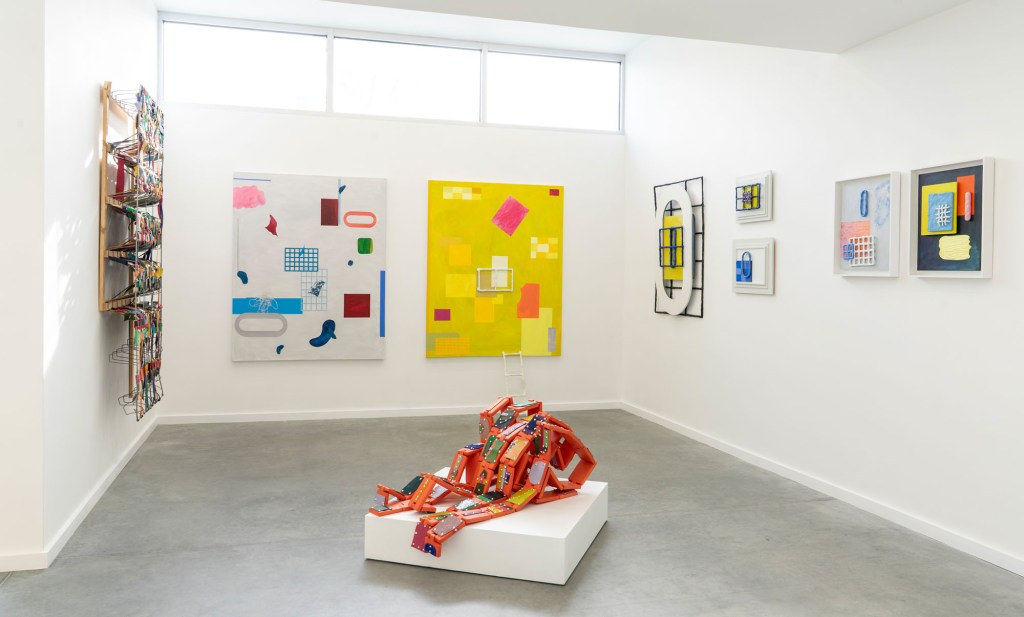
On the occasion of “Slip,” Olivia Baldwin and Barbara Owen‘s two-person exhibition at OVERLAP, an interesting artist-run space in Newport, RI, Two Coats of Paint invited the artists to contribute a conversation about their work. Each is engaged with personal history, found materials, and the emotional resonance of color. For both Baldwin and Owen, meaning emerges primarily through the process of making.
Barbara Owen: When we began studio visits for this exhibition, I was familiar with your use of leather but I didn’t know how it entered the work. Why leather?
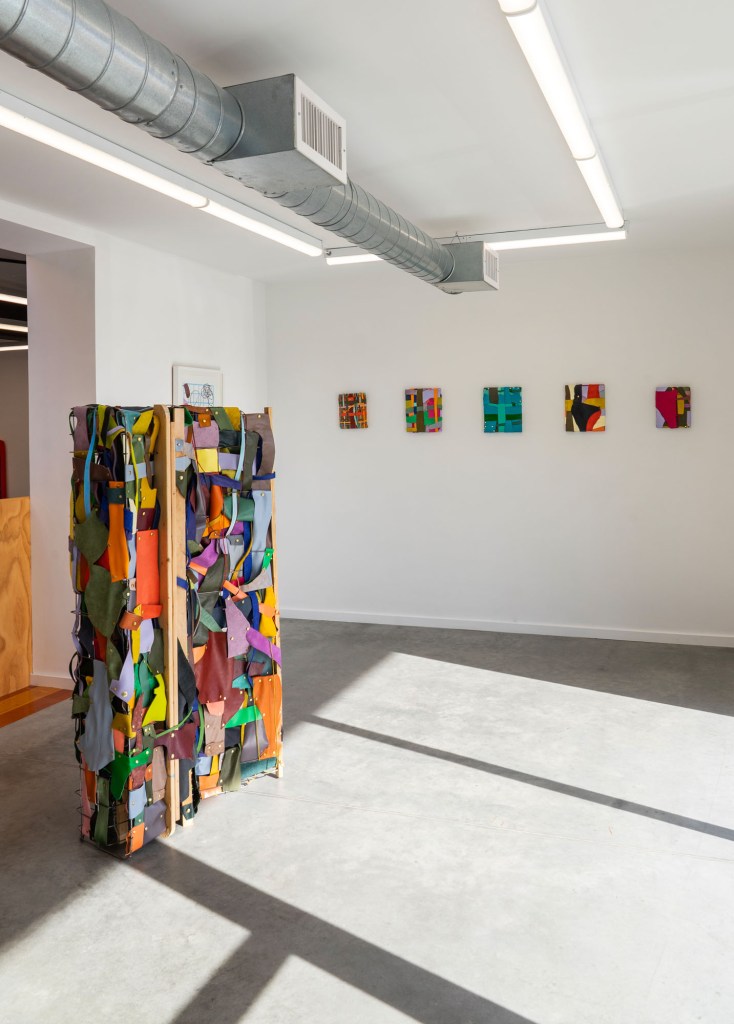
Olivia Baldwin: Two years ago, I was in my mother’s attic, sorting through her things, when I found the leather. It was varied in color, texture, and thickness, and although she was a fashion designer, she rarely used it out of fear she’d waste it. Using her leather allows me to bring her into my work. Later, I became connected with Lindquist, and now I work with their scraps, which has given me the freedom to make larger, more dimensional work.
Owen: The first work of yours I encountered wasn’t leather, but a log with painted canvas nailed onto it. The color and gesture feels connected to what you’re doing now.
Baldwin: I love that you made that connection. That was Hunk. A friend left that wood on my doorstep, and I slathered it in magenta acrylic and immediately regretted it. Five years later, when this faux slip cover gesture arose, it felt significant. It’s the first piece where I used upholstery tacks, and now they’ve reappeared in this work.
Owen: It’s interesting how the method transfers across materials— the pinning, the attaching. It feels practical, but also conceptual: an impulse to hold, fasten, and layer.
Baldwin: I often think I’m doing something new and then realize I’m just returning to something from years ago.
Owen: Yes! I’ve been drawn to the oval form since undergrad, when abstract gestures kept resolving into circular shapes. That shape progressed and transformed when I moved to Providence from Brooklyn and began cutting paper while pregnant. Repeating the same shape in a meditative way allowed me to make without overthinking. Those early forms became necklace shaped.
Baldwin: Did that shift happen with wood?
Owen: Yes, when laser cutting entered, precision followed. The repeated form shifted from necklace to portal, opening metaphors of threshold and passage. The portals wanted to be perfect – but I am not! But that tension became part of the work, and I’ve since undone that perfection by introducing epoxy clay, letting the hand record pressure and touch.

Baldwin: Right, something to work against. Can you say more?
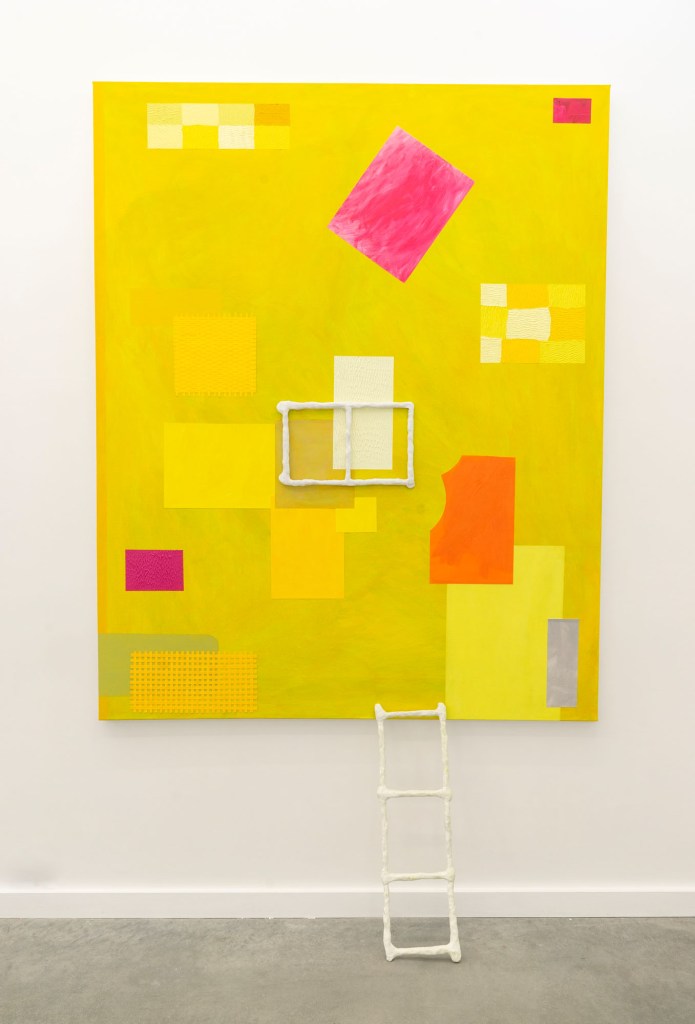
Owen: I find that figuring out how a form will hang, balance, or project from the wall can bring new ideas and meaning into the work. I encountered this last summer while installing twenty-seven works, discovering that inserting wire brads allowed each piece to hover slightly off the wall. What I loved most, though, was how that installation became a kind of mapping. Seeing the works together allowed me to understand relationships that I couldn’t see in the studio. Returning to canvas for this exhibition, I hoped to engage painting more traditionally. Instead, I kept adding objects and grids, resisting the constraint of keeping the work purely a “painting.” Eventually, I realized I was arranging shapes on the canvas the same way I had used the wall at Art Cake, treating the surface as a site of relationships.
Baldwin: I’m struck by the atmosphere in the new works. In Clairvoyance, the canvas becomes a field we can inhabit, and that’s complicated by the material variation of the other elements, from the epoxy clay ladder and gate forms to the intricately woven grids and the textural patches that read like keys. I’m particularly drawn to the blue form in Thought Shapes.
Owen: I created the hazy background by rubbing blue pigment into the wood, letting atmosphere build through touch rather than brush. Eventually, I wanted that color to become a shape, and began working it into epoxy clay.
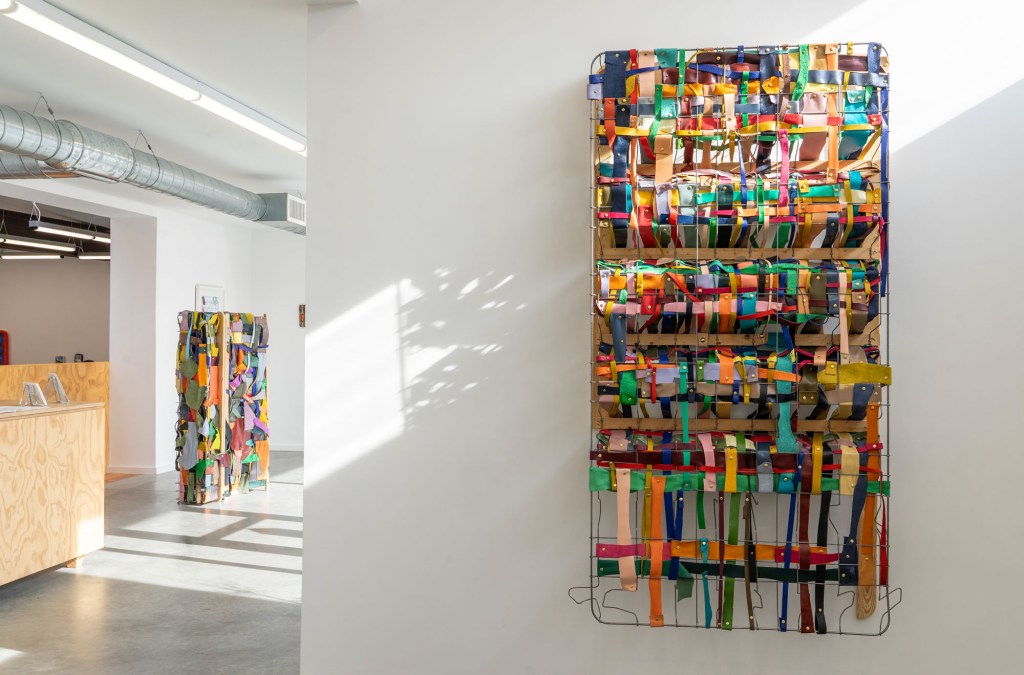

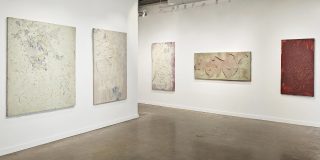
Baldwin: The physicality of that gesture registers. I relate to that sensitivity to touch. The box springs hold the body in their history—rest, weight, absence. Leather carries its own questions of skin and touch. “Slip” includes three of my larger works and several smaller woven paintings. I see the larger dimensional works, like Untitled (twin), acting like many small paintings gathered into single forms, with wooden armatures as organizing structures. Your silkscreen plays similarly with structure—the slipping beneath and over the grid.
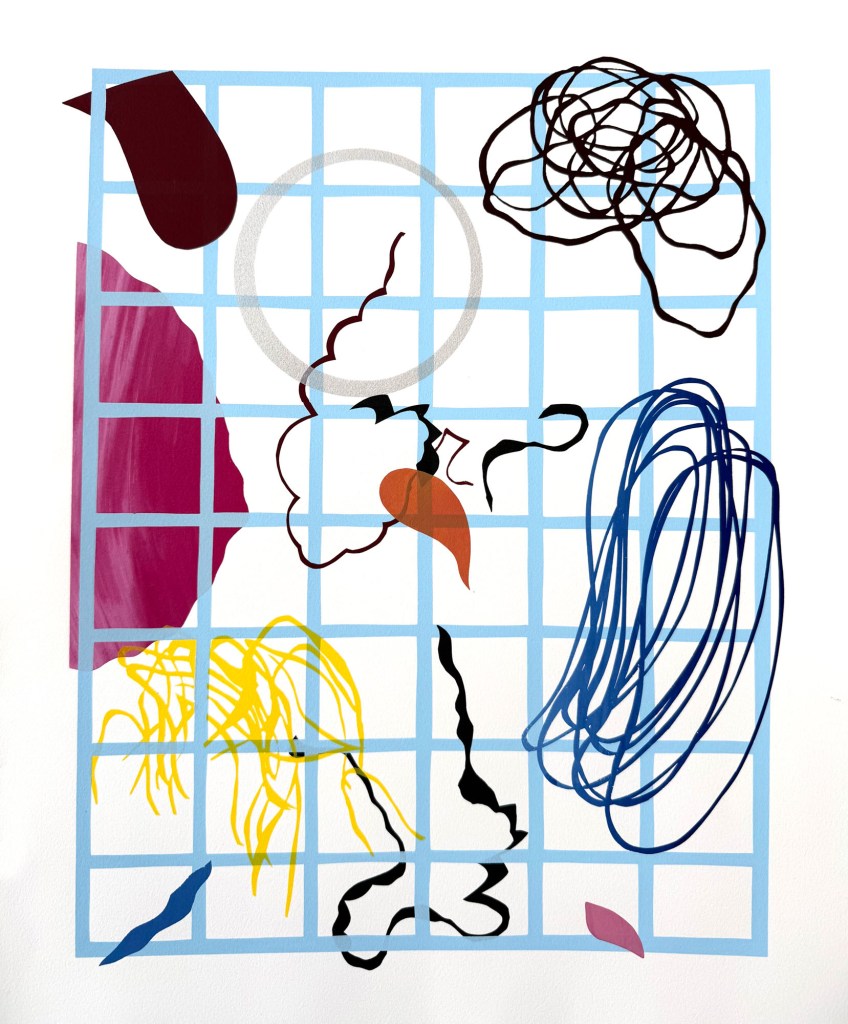
Owen: The silkscreen was developed through lessons with Henry Brown at Salad Editions. Working from layered cut-paper mockups, I explored what sits in front of and behind the grid. Henry’s suggestion to use transparency and subtle color transitions to create depth became central to the final image, opening new ways of thinking about layering, surface, and spatial illusion.
Baldwin: As we sit here in the gallery looking at each other’s work…
Owen: We really share language around color.
Baldwin: Yes, and form. And how it holds, interrupts, and recedes.
“Olivia Baldwin & Barbara Owen: Slip”, OVERLAP, 112 Van Zandt Street, Newport, RI. Through March 7, 2026.
Also on view: “Jai Hart: The Wall Wanted to Play Too: The Architecture of Tenderness,” OVERLAP, 112 Van Zandt Street, Newport, RI. Through March 7, 2026. Exhibition walkthroughs with the artists: Saturday, February 21, 2026, 3-4:30 pm.
About the artists:
Barbara Owen is an artist who lives and works between Rhode Island and Brooklyn, New York. She holds an MFA from the School of Visual Arts in New York. She has shown work in solo and group exhibitions at Chelsea Walls, Spring/Break LA, and Tiger Strikes Asteroid.
Olivia Baldwin is an artist who lives and works in Providence, Rhode Island. She holds an MFA in Studio Art from the University of Connecticut and teaches at Babson College. She has shown her work at Collar Works (Troy, NY), A.I.R. Gallery, White Columns, and Jane Lombard.



Great looking show and a wonderful dialogue. Thanks for sharing it here.