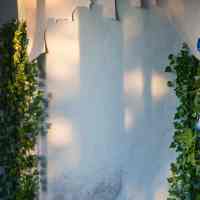
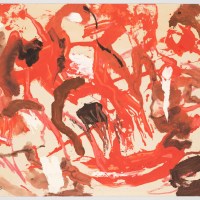
Contributed by Jason Andrew / It’s easy to associate the new paintings by Julie Beaufils, now on view at Matthew Brown Gallery in Tribeca, with a post-apocalyptic world. The sixteen paintings suggest fractured architectures and abandoned fields, sun baked and rising from a humming radioactive haze. Beaufils lives and works in Paris, and her precise lines and delineated spaces capture its curving promenades, narrowed boulevards, and sinking perspectives. Travels to Los Angeles and the American Southwest have also influenced this new work.
Solo Shows
Force field: Myron Stout’s drawings
Contributed by Natasha Sweeten / In the early 2000s, among the pines and solace of an artist residency, Polly Apfelbaum shared with me a small, well-thumbed through book. Right off the bat I took the isolated black-and-white image on its cover to possess talismanic powers. Such was my introduction to the work of Myron Stout.
Aaron Michael Skolnick: How heartbreakingly silly we are
Contributed by Nancy Friedland / I don’t remember exactly when I first came across the work of Aaron Michael Skolnick, but I do remember the feeling. Confronted by landscapes so filled with love and loss, I wondered how a painting of light in a forest could express so much. When the gorgeous images from his most recent project – face mash-ups of Aaron and famous, sometimes funny, often tragic characters – started to pop up in my feed, I needed to know more. I searched to see what was out there about Aaron’s show “The Entertainer,” currently up at MARCH Gallery in the East Village, and found nothing to satisfy my curiosity. As I began to dig into the work myself, I quickly realized that it had tentacles that wrapped around every aspect of the artist’s life. There were the paintings, yes, beautifully wrought, deftly painted, of course, but there was also an installation, photography, and performance. The work was so layered and complex that I felt the need to reach out directly to Aaron to ask him what it was all about. Last week, I picked up the phone and tried to uncoil some of those tentacles and make sense of a complex, brave, and very funny new body of work.
Fergus Feehily: The Horse and The Rider
Contributed by Joe Fyfe / Fergus Feehily, who is from Ireland but has lived in Berlin for years, is an unusual contemporary visual artist by virtue of his very careful degree of quiet obliquity. One almost hesitates to approach writing about him and, in this case, writing about his writing. It might be best to get the disclaimers over with: we share gallery representation in Köln, from Galerie Christian Lethert. He recommended me to the gallery, though at the time, long ago, I had never heard of him nor his work. I have since met him a few times. Once we had breakfast at Balthazar in New York and I remember how thoroughly he buttered and spread preserves on two sizable croissants. Feehily is somehow obscure but in plain sight, admired among an informed coterie of artists and collectors and an avid sharer. He does a lot of communicating. He posts on Instagram often, mostly very different kinds of artworks, though he appears to have something of a penchant for religious art. On his website are long year-end lists, an annī of enthusiasms for what he has read and listened to and looked at, whom he has met and spoken with.
Donna Moylan’s egalitarian eclecticism
Contributed by Elizabeth Johnson / “Recent Paintings,” Donna Moylan’s first exhibition at Bookstein Projects, collects works finished over the last year in her Kinderhook studio. In our email conversation, Moylan said that “sometimes paintings take years, as if they had to go off and think.” In addition to making paintings that carry time in the process of their production, she forgoes committing to a serial style, allowing her paintings to differ drastically from one to the next. “When I started doing that, in the nineteen-eighties,” she wrote, “I understood that what I wanted was to equalize, or make equivalent, many different styles of painting, and to refer to different cultures or eras with specificity but without differentiation or emphasis, without focusing on ‘styles.’” She has achieved this goal with considerable aplomb.
Andrew Mer: All things obscure and oblique
Contributed by Amanda Church / What do we not see every day even when we are looking? Andrew Mer, aka @bigfusss on Instagram (where these photographs were first discovered), considers the question in his current show “Agog” – the filmmaker’s first exhibition of photography since moving to New York 30 years ago – at Mitchell Algus Gallery. The show consists of thirty 14 x 11-inch digital prints, shot on an iPhone starting in 2020, in editions of five with two artist’s proofs. The spontaneous photos of street scenes are in one sense classic Instagram moments, evanescent and transient. At the same time, they capture the so-easy-to-overlook minutiae of urban existence in precise compositions.
Theresa Daddezio: A pinball wizard’s aesthetic order
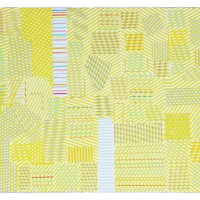
Contributed by Jason Andrew / In her new paintings in “Bloom” at DC Moore Gallery, Theresa Daddezio suggests an ornate elegance structured by a quirky sense of pinball-wizardry. Playful and lighthearted, each of the sixteen paintings in this packed show offers a vibrant world of color and fluid forms, simulating the visual experience of a flashy arcade. The paintings are spatially dense and lyrically conceived. Their all-over purity might tie her work to aesthetic movements like Neo-Plasticism. Indeed, her work, in Mondrian’s terms, expresses the “aesthetically purified” and ignores “the particulars of appearance.” Yet it also embodies a fantasized complexity that affords the paintings a dynamic arc. Daddezio has certainly found her cipher – an algorithm defined by petal-like structures, collaged color gradations, and zig-zagging linear forms.
Jen Mazza’s narrative interplay
Contributed by Michael Brennan / “Vicissitudes of Nature” is the magisterial title of Jen Mazza’s first solo exhibition with Ulterior Gallery, and, given the calamitous start of 2025, her Cassandra-like premonitions could hardly be any timelier. Nearly two dozen paintings and works on paper occupy the top floor of the tin-tiled, pitched-ceilinged space. Deftly and seamlessly, Mazza uses a variety of techniques and strategies, appropriating images from multiple sources. The idea is to conflate them with important cultural signifiers while recontextualizing them into new narratives of interiority, as, say, Virginia Woolf did in her contemplation of “the waves” in her eponymous novel, quoted in the show.

Deirdre Frost: Windows on the world
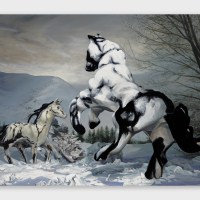
Contributed by Sharon Butler / Deirdre Frost’s multifaceted paintings, on display in her solo show “Tumbling Earth” at Kevin Kavanagh Gallery in Dublin, exude an edgy, futuristic energy you’d glean from a David Lynch movie, in which teal curtains and magenta skies feel oddly familiar yet distinctly foreign. Frost, who is based in Cork, challenges us to reconsider what home might look like when the distinction between indoor and outdoor no longer held. Her world could be the one that emerged after some kind of apocalypse, in the wake of civilization, viewed furtively, perhaps from caves.
Cyrilla Mozenter: The quieting of industrial material
Contributed by Michael Brennan / To my mind, the cultivation of art is mainly about making distinctions, and Cyrilla Mozenter’s solo show “Problems of Art” at 57W57 Arts hits that mark. She is essentially a sculptor – and a great one – in that she makes beautiful objects. Much as I admire her approach to volume, though, it’s her novel transformation of drawing into predominantly felt sculpture – decisive cuts made with sewing shears, silk whipstitching like super-sutures – that generates the greatest sense of adventure.
Chris Martin: Staring into the sun
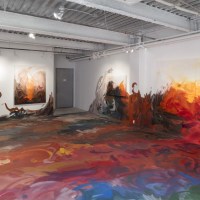
Contributed by Sharon Butler / Chris Martin is deep into a nearly five-decade-long artistic odyssey fueled by an unrelenting passion for process, spontaneity, and embracing the unexpected. His prolific energy, both physical and creative, melds into his broad knowledge of painting history and an insatiable desire to share his thoughts, feelings, and vast collection of everyday ephemera and small objects by embedding them in paint on canvas. Martin’s paintings are bursts of assemblage showcasing the power of proximity – vibrant cacophonies of glitter, pages ripped from textbooks books, magazine remnants, letters, and newspaper clippings. “Speed of Light,” his second solo exhibition with Timothy Taylor, draws inspiration from the dark night sky in the Catskills, inflecting profound questions about the universe with a comedian’s flair for the seriously absurd. The results are thought-provoking, funny, and, at times, ecstatic.
Theresa Hackett: Fractured, folded, flattened landscapes
Contributed by Jason Andrew / In her solo show “The Scenic Route” at High Noon, Theresa Hackett remains committed to a process of reimagining nature through abstraction, texture, and bold compositions. Inspired by the dynamic interplay of form and environment, the show echoes the pastoral and sublime themes of classical landscape art – where balance and harmony were paramount – while pushing boundaries with modern kick. Like the early modernist Oscar Bluemner, Hackett’s paintings are – and long have been – architectural distillations of landscapes, structured yet only symbolically realistic.
Kate Shepherd: Feel me
Contributed by Sharon Butler / Kate Shepherd’s 2025 exhibition “ABC and sometimes Y,” at Galerie Lelong & Co. in New York, hums in the space between precision and poetry. The paintings are specific and unshowy, rendered in colors that Shepherd selects for their emotional undercurrents. She teases out big questions: How do we interact with the world? How can we untangle what we see? And how do color and form quietly alter our perceptions? The result is a kind of geometric sorcery whereby shapes don’t sit still – they shimmer, shift, and keep you guessing. Every line, every wobble feels heartbreakingly human, which is extraordinary for geometric abstraction.
David Humphrey: The revel is in the details
Contributed by Jonathan Stevenson / The phenomenon of the selfie, an artifact of the smart phone, is a supreme irony. The act itself suggests a narcissistic preoccupation with recording one’s presence, but its frequency and ubiquity indicates that it doesn’t matter much what person or place gets that honor. Warhol’s fleeting fifteen minutes is compressed into a pandering fraction of a second. I was here; please care. The only auto-photographers who really seem to get durably noticed are the Darwin Award winners whose acrobatic exertions towards drama topple them into the lethal maw of treacherous vistas. Lost in the scree of evanescent look-at-me images is the self in full social and political context, and it’s not in plain sight. There are few painters better suited for excavating it than David Humphrey, as he demonstrates in “porTraits,” his formidable solo exhibition now up at Fredericks & Freiser. Humphrey’s crowning gift – born of comprehensive technical and aesthetic command, a uniquely graphic allusive approach, sardonic wit, and an irrepressible narrative impulse – is to coordinate the nuances of disparate visual elements so finely as to render the busiest of paintings piercingly, disturbingly coherent.
Emily Noelle Lambert: Trapping butterflies, chasing wild birds
Contributed by Jason Andrew / In ‘Wild Birds,” Emily Noelle Lambert’s second solo exhibition at Freight+Volume, she provides an unbridled experience of color and tactility. The show includes five paintings that fence in an array of stacked ceramic works on improvised pedestals. Known for her vibrant, abstract work, Lambert is bold and direct in her exploration of organic forms and dreamlike compositions.