
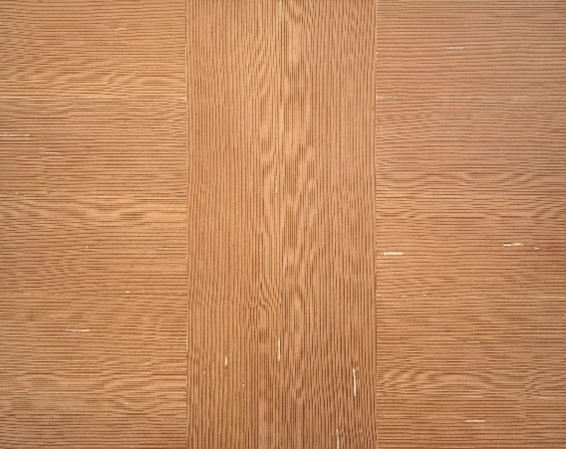
Contributed by Katy Crowe / In keeping with Sharon Butler’s recent review of painting that is not painting per se, Maxwell Hendler’s thoroughly satisfying show at The Landing in Los Angeles, his first in ten years, consists of works that fulfill the function of paintings — they are flat, largely two-dimensional, and mounted on walls – but do not involve paint at all.
Hendler’s painting career began in the 1960s with meticulously detailed small oil paintings of mundane objects. Exhibited at Ceeje Gallery, these works (and the gallery) were like willful counterpunches against the more avant-garde work shown at Ferus and other galleries that was getting most of the art world’s attention. He moved from those exquisitely realistic paintings to resin paintings featuring monochrome color and surface, sanded and polished to the nth degree, like the fetishistic work of John McCracken. Over time, the opacity of the color diminished, and the wood substrate emerged from transparent layers of resin. The current group of “paintings” are all about the wood.
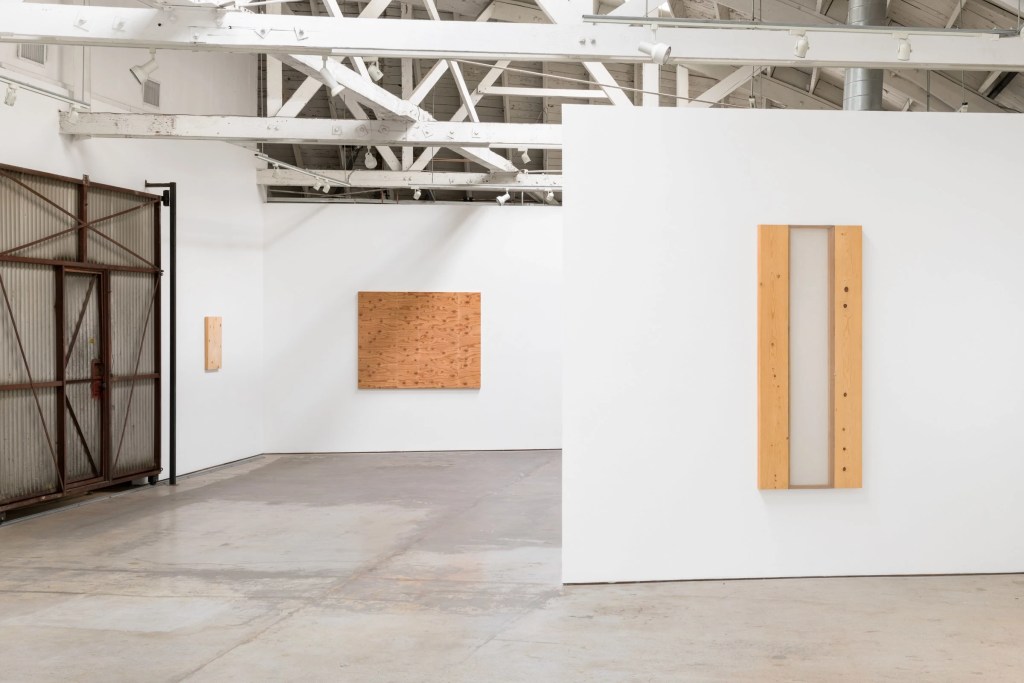
The “Lumber” works are as plainspoken as they are slyly humorous. They trade in arrangements of humble forms of wood from Home Depot and construction-grade fir plywood or pine planks, most of them transformed into landscapes that utilize – indeed celebrate – their flaws, including abstract arrangements of knots and plugs that could read as fields of eyes. The plywood might loosely evoke Sherrie Levine, who in her “knot paintings” emphasized the machined knots by painting or gold-leafing them.
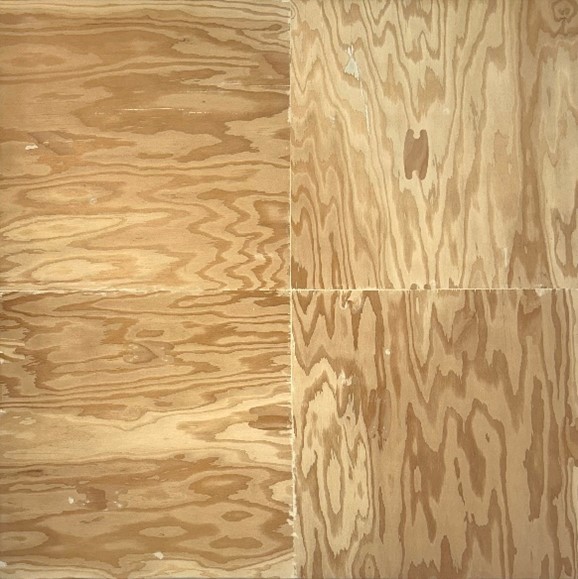
A few of the works are made of higher-quality wood, like the vertical-grain fir planks in Flag, the grain going in two different directions and thus acting like two colors or even brush strokes and yielding a pristinely reductive composition. Signal is a square divided into four equal squares of figured fir plywood, one side vertical and the other horizontal, with what is presumably the referenced signal a curiously shaped plug in the middle of the upper right square and a more obscure plug in the lower left.
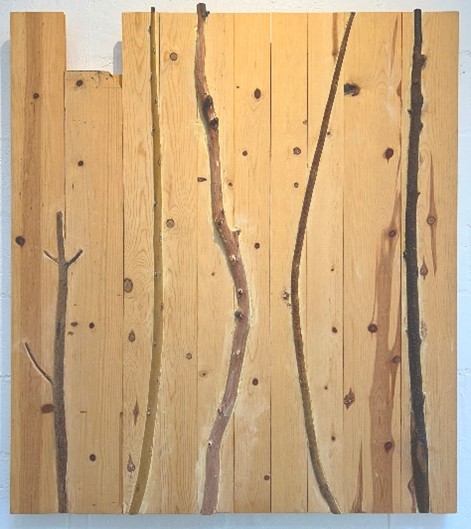
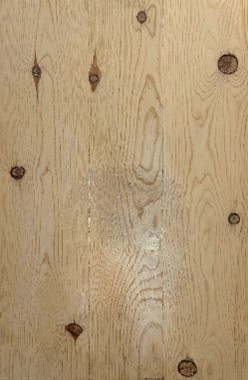
Woods is the most literal piece in the show. It’s composed of ten pine boards of varying widths, abutting one another, all the same height except for one short one. Embedded in these boards are five tree branches that disrupt piece’s machined verticality with their natural curves and bends. The boards look to have been gouged out by hand to nest the branches, and there is no disguising where filler material has been applied to patch a slip of the chisel. Primary comprises three vertical pine boards. A knot in the middle one and the area surrounding it appears to have been roughly gouged out, producing a large indentation that might accommodate a head.
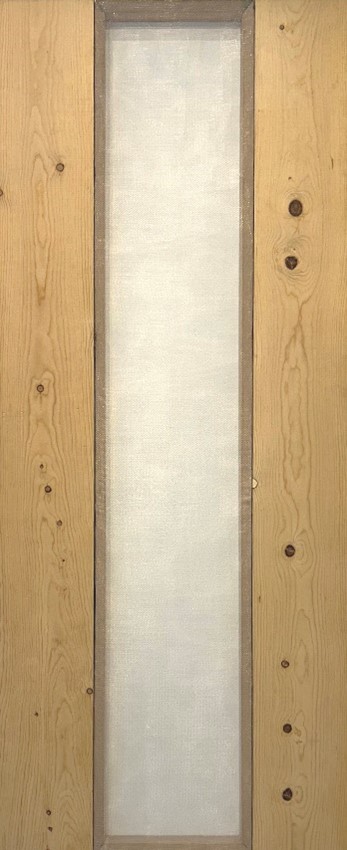
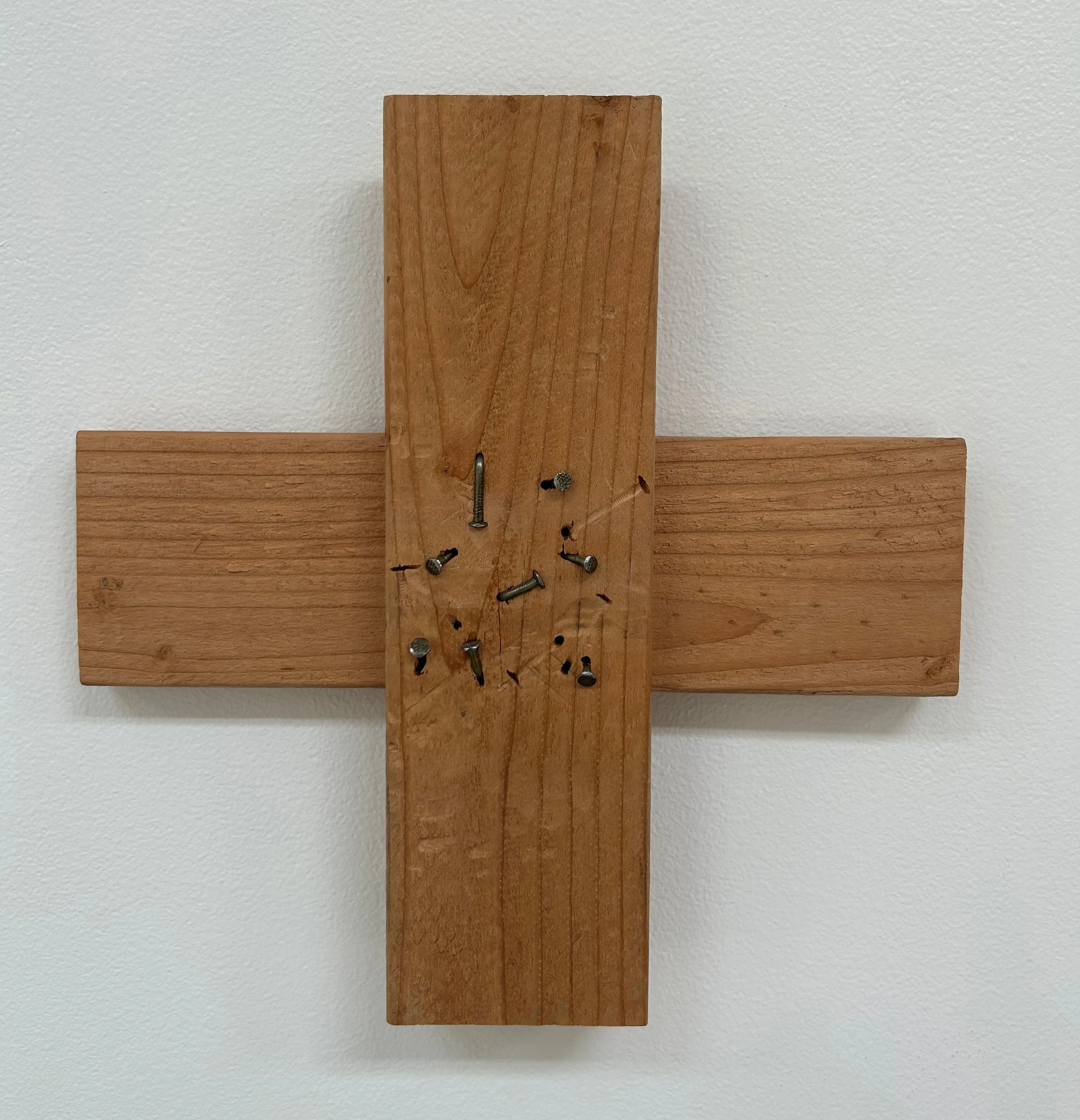
Speak Low is two vertical pine boards separated by a frame stretched with screen-door material. The screen material creates a soft-focus vertical rectangle between the hard edges of pine and alludes to something unseen on the other side. The title suggests not speaking too loudly, lest you be heard. Two by Four is made of two 12-inch-long 2x4s, attached at the middle with nails to form a cross. All eight nails are bent, and indentations and holes made by other hammered nails that must have been pulled out are visible. This mark-making, as it were, could reflect frustration, anger, or just messing around.
The color of the wood unifies the works, lending the show a contemporary feel without confining it to any trend, even if some might characterize it as Minimalist. The installation is open and spare, the restrained compositions calming. Yet Hendler has a lot to say.
“Maxwell Hendler: Lumber,” The Landing, 5118 W. Jefferson Boulevard, Los Angeles, CA. Through August 24, 2024.
About the author: Katy Crowe is a Los Angeles-based painter, working in oil and watercolor, whose last solo show was in 2022 at As Is Gallery in LA.










Nice review. This is the most purely visual show I’ve seen in a long time. Max is a true gem.
Katy Crowe’s articulate review of Max’s excellent exhibition doesn’t miss any telling detail. Excellent deconstruction of deceptively complex work.