

Contributed by Margaret McCann / “Chasing Rabbits,” the name of Dannielle Hodson’s show at Kravets Wehby Gallery, refers to the cautionary Chinese proverb, “if you chase two rabbits, both will escape.” Hodson accepts that risk, bypassing clear purpose to embrace multiplicity. Impelled by curiosity – as Alice was, and Grace Slick advised – Hodson’s visual gestalts, though far livelier than Cezanne‘s, similarly invite the viewer to re-experience their becoming, most saliently in the superb Mortal Coil. Description emerges from, then dissolves into, textures, a struggle the title (from Hamlet’s “to be or not to be” soliloquy) conveys. As though molting and renewing, its spindly, uncomfortable forms look like Louise Bourgeois‘ spiders tangled in a Max Beckmann carousal. Light and dark, volume and space, order and chance, compete like Zoroastrian dualistic forces. But, as lively figure-ground connectivity twists and turns, the dense, awkward web levitates toward possibility.

Hodson’s partly unconscious process echoes the surrealist automatism Gorky brought to abstraction, which inspired de Kooning. After the initial layer – a spontaneous tonal response to a master painting – her ready pareidolia (Hodson was encouraged as a child by her grandmother to find faces in her doodles) leads the way. Leonardo wrote about this phenomenon: “If you look at any walls spotted with various stains [you will see] figures in quick movement, and strange expressions of faces, and outlandish costumes.” Though lacking AbEx muscularity, Mortal Coil’s transformations are exploratory. Like late Guston without the sad heaviness, coarse brushwork builds precise ratios of fluctuation to solidity. Varying degrees of illusionism, from scant to cartoonish to quasi-believable, emerge. Like Rorschach inkblots, a range of interpretations are possible.

Hodson ironically contrasts thoughtful and refined color with reactive and clumsy brushwork. At first glance, precipitate textures and vibrant hues in Mud Slinging signal a pure path, as Clyfford Still exemplified, of paint finding its way into coherence. But lofty aims disappear as the image congeals into a violent clash of miscreants, which further devolves into farce as monstrously goofy faces appear. Grimaces may disturb, but the zany frenzy is no more dire than a food fight. Brueghel‘s wry take on human indulgence versus discipline in The Fight Between Carnival and Lent comes to mind, but the rough, Punch and Judy inanity of Hodson’s skirmish is temperamentally closer to Ensor. His absurd battles were animated by carnival masks in his family’s shop, some from the Commedia dell’arte‘s imperfect cast of human types, which perform improvisation, like those in Hodson’s schemes. Mud Slinging’s white-clad figures on the right resembles the outfits of Pierrot – painted by Gris, Watteau, etc. – or Pulcinella, as in Tiepolo’s many versions. Its patchwork of rich color recalls Harlequin, explored by Derain, Picasso, etc.
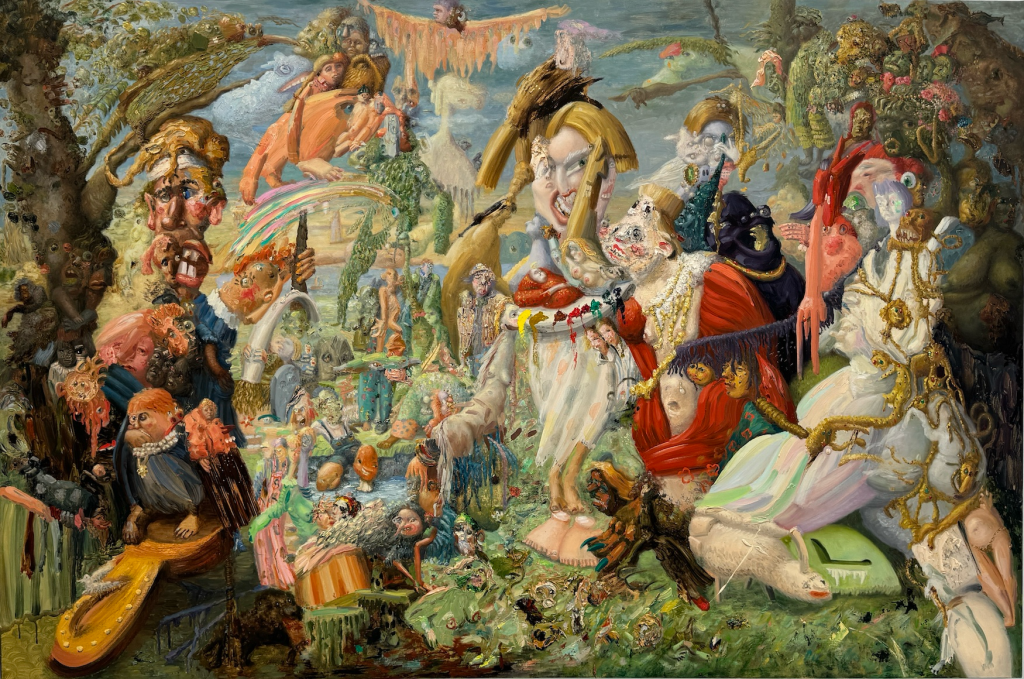
In the Service of an Idea tightens up execution, and from afar the pretty picture resembles the delicate festivity of Titian’s Pastoral Concert. But as its detail pulls us in, seemliness gives way to grotesquerie. Like a broken dream, poise disintegrates: trees spout faces a la Arcimboldo. Body parts surprisingly erupt, like creatures in an admonitory Bruegel. While completing her MFA at the Royal College of Art, Hodson studied how constant change in the structure of fairy tales and myths keeps the reader engaged. She lets Pop Surrealism and Expressionism, passivity and aggression, phantasm and loss, wrestle. Figures may conjoin in unsettling chimeras, but like a sheep in wolf’s clothing, comic resolution prevails. Hodson borrowed the painting’s palette from Rubens’s Judgement of Paris, and could be mocking that narrative’s beauty contest. The idealistic if not pompous title may also laugh at the vanity of painting, and the painter herself.

L’Éclat, inspired by Vouet’s Assumption of the Virgin, is French for “brilliant display,” an apt description of the amazing visualizations of Mary’s voyage to heaven by Titian or Correggio. Hodson’s irregular red, yellow, and blue forms slip and slide into slow arcing movement that shifts like a pendulum ride, then starts to swirl. The darks under The Virgin’s open crypt presage upheaval or regeneration. Close up, gallant players in the glorious drama expose their unseemly, insipid, or obnoxious visages. Witless faces and bungling forms circuitously cohere, then decompose. As though under a hypnogogic spell, like that Dali self-induced before painting, hallucinations multiply like rabbits. But subtle pictorial logic keeps chaos at bay, as it does in Brueghel’s Fall of the Rebel Angels. The promise of order is nervously, mischievously, celebrated. Despite doubt, a golden sky and triumphant title preside.

A disheveled mass of people scrambles across the rectangle of A Show. As in Mud Slinging, some might gawk – at acrobats performing, or at a street fight – while others pass by. Maybe it’s a caricature of the clueless or scornful throng in Bosch’s Christ Carrying the Cross – which Ensor may have emulated in his Self-Portrait Surrounded by Masks (his critical belgitude supplanting JC’s forgiveness). One diminutive character may sympathetically point, but gets lost in the crowd. With no clear hero or victim, we confront Hodson’s onlookers, some of whom look back. Does she make us complicit in the uncouth spectacle and its voyeurism? Or does A Show poke fun at the competition for attention among paintings on a gallery wall? As bright, pulsating color distracts and seduces, seeking deep meaning feels as pointless as the dreamy image is vague. The eye wanders as at a carnival, mirroring the shallow apprehension of the mob. Hodson’s infectious Heraclitan imagination questions and entertains. Like a jester, each provocative painting offers a captivating cross-section of the variegated continuum of human folly.
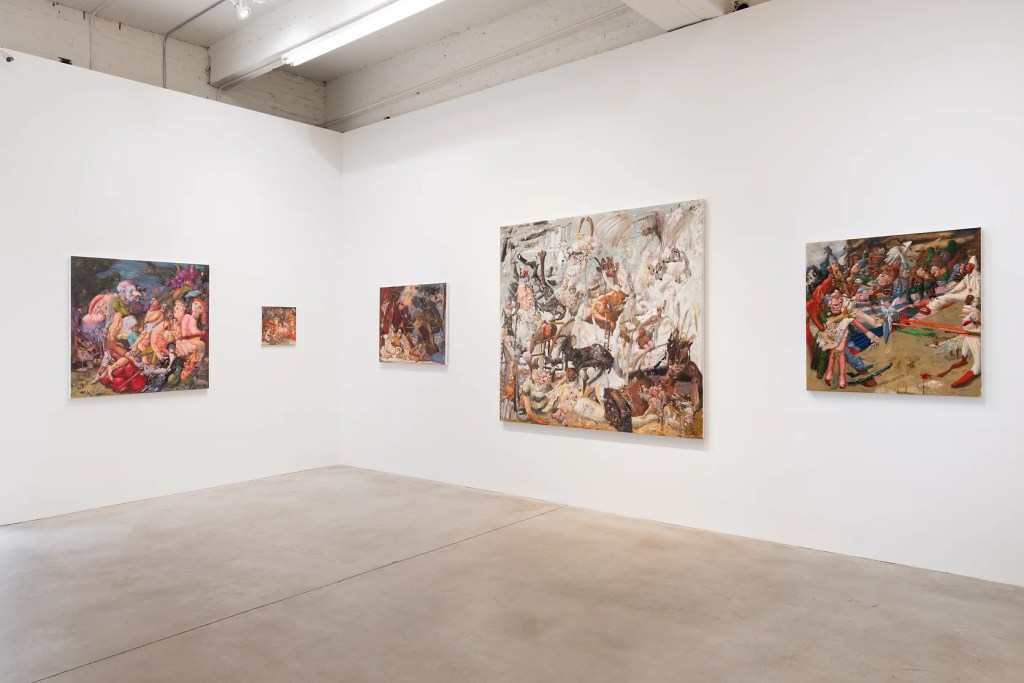
“Dannielle Hodson: Chasing Rabbits,” Kravets Wehby Gallery, 521 West 21st Street, New York, NY. Through October 12, 2024.
About the author: Painter and art writer Margaret McCann teaches at the Art Students League. She has shown her work at Antonia Jannone in Milan and been reviewed in La Repubblica, Corriere della Sera, and the Huffington Post. She edited The Figure (Skira/Rizzoli, 2014) for the New York Academy of Art and has written reviews for Painters’ Table and Art New England as well as Two Coats of Paint.












.jpg)
%23/media/File:Jheronimus_Bosch_or_follower_001.jpg)
_oil_on_canvas,_117_x_82_cm.,_Menard_Art_Museum,_Komaki,_Japan.jpg)