
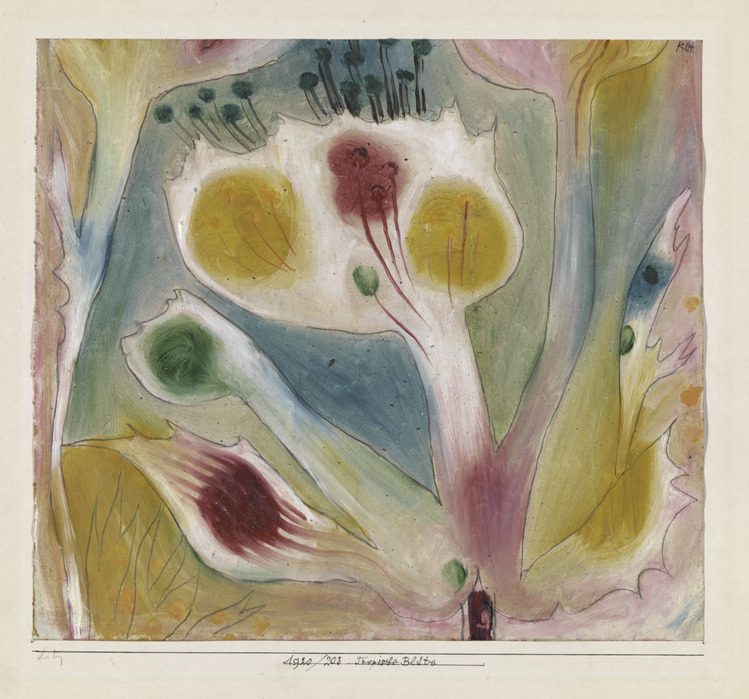
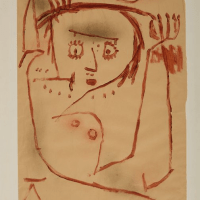
Contributed by Jonathan Stevenson / Branded a degenerate artist for his “insane childish scrawling” by the Nazis, Paul Klee, once anointed at the Bauhaus, left Germany for Switzerland in 1933. Scleroderma was already affecting his will and ability to paint, and his theretofore prodigious output waned. But as Germany’s onslaught in Europe effloresced into World War II, he regained purpose and productivity, yielding over 1,250 works in 1939, the year before his death. During this period, he downplayed his signature sublimation via color in favor of succinct line to expose the toxicity of fascism. Everything that concerned him as a citizen of the world seemed to catch light in his art. This valedictory turn is the subject of “Other Possible Worlds,” the Jewish Museum’s superbly curated show, uniquely centered on his final decade.
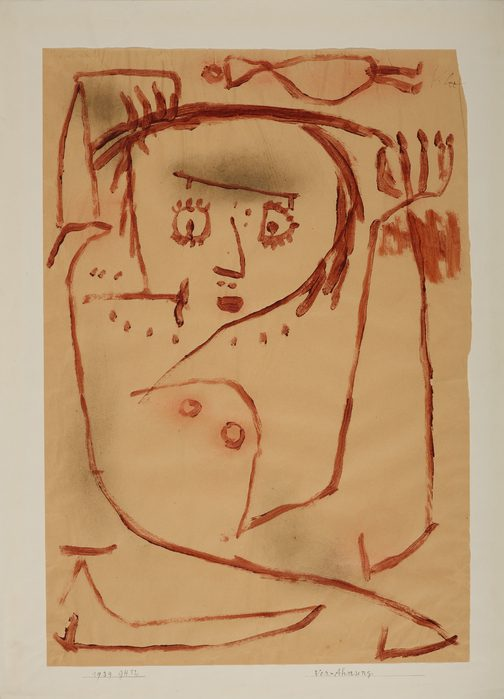
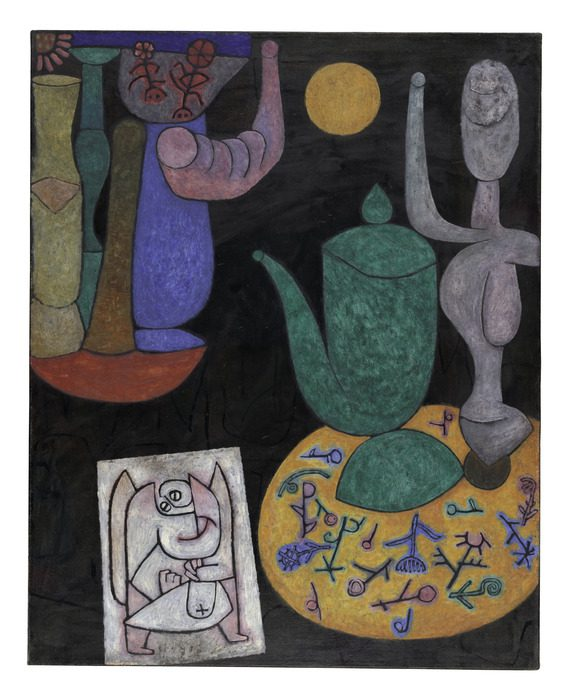
Klee’s extraordinary eclecticism – he eased fluidly among expressionism, cubism, pointillism, surrealism, and futurism – bespoke a restive and acquisitive mind. Much of his work is quite busy. Invariably, though, it is coolly resolved, abhors indiscipline and incoherence, and deftly balances representation and abstraction, and he maintained those sensibilities in those final years of exile. At the same time, any insular aesthetic circumspection and exclusion became firmly alien to Klee. But he remained subtle, inclined towards detached irony and satire rather than shrill emotion.
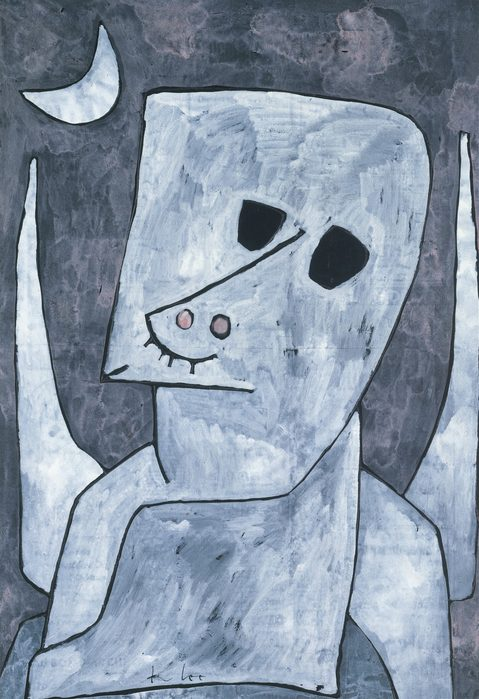
Showcased in “Other Possible Worlds” is Klee’s 1920 monoprint Angelus Novus – New Angel. Walter Benjamin, the doomed German critic and philosopher and Klee’s friend, saw it as “the angel of history,” turning back to face the past but propelled forward by an irrepressible wind, witnessing calamity unspool as “what we call progress.” By the lights of Klee’s late work, the artist might have considered speaking for that angel to be his civilizational function, much as Philip Guston’s sheepishness about cloistered art led him to directly confront latter twentieth-century iniquity.

From this perspective, Klee’s arc answers an increasingly persistent question: how politically inclined artists should approach – and can find value in – their endeavor in a daunting and desperate world. At his death in June 1940, with Hitler ascendant, Klee could not have realized and would have doubted that the label “degenerate” would eventually be a badge of honor. Still he worked in humble determination. Among his crowning final works is the archly crude and diminutive Kettledrummer, in ink and colored paste on paper affixed to cardboard. An oddly nimble one-eyed stick figure bangs an unseen drum, deadpan, against two red splotches. In a few childish scrawls, militarism is mocked, resistance celebrated, and art enshrined as the terse vehicle of history.
“Paul Klee: Other Possible Worlds,” Jewish Museum, 1109 Fifth Avenue at 92nd Street, New York, NY. Through July 26, 2026.
About the author: Jonathan Stevenson is a New York-based policy analyst, editor, and writer, contributing to the New York Times, the New York Review of Books, and Politico, among other publications, and a regular contributor to Two Coats of Paint.





I knew I wanted to see this show. Now I know why. Thank you for the lucid interpretation.