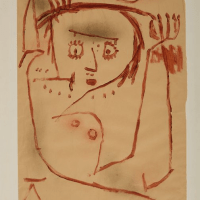
Contributed by Jonathan Stevenson / Branded a degenerate artist for his “insane childish scrawling” by the Nazis, Paul Klee, once anointed at the Bauhaus, left Germany for Switzerland in 1933. Scleroderma was already affecting his will and ability to paint, and his theretofore prodigious output waned. But as Germany’s onslaught in Europe effloresced into World War II, he regained purpose and productivity, yielding over 1,250 works in 1939, the year before his death. During this period, he downplayed his signature sublimation via color in favor of succinct line to expose the toxicity of fascism. Everything that concerned him as a citizen of the world seemed to catch light in his art. This valedictory turn is the subject of “Other Possible Worlds,” the Jewish Museum’s superbly curated show, uniquely centered on his final decade.
Tag: Paul Klee
At the Guggenheim: Gabriele Münter’s enduring brilliance
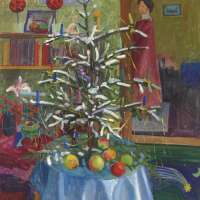
Contributed by David Carrier / The Guggenheim has frequently presented the work of Wassily Kandinsky (1866–1944). Now, finally, the museum has provided the opportunity to celebrate Gabriele Münter (1877–1962), Kandinsky’s domestic partner of ten years and a fellow founder of the Blue Rider Group – the Munish-based network of artists that pioneered German Expressionism just before the First World War.
Ben Shahn’s vigilance
Contributed by Margaret McCann / Ben Shahn’s lifelong advocacy against poverty, racism, and fascism is showcased in his solo exhibition “Ben Shahn and Nonconformity,” now up at the Jewish Museum. With engaging documentation, an array of global topics are addressed in printmaking, photography, commercial art, and calligraphy – and some excellent paintings.
Art versus politics
Contributed by Laurie Fendrich / “Modern Art and Politics in Germany 1910-1945” an exhibition of more than 70 paintings and sculptures on loan from the Neue Nationalgalerie, Berlin to the Kimbell Museum in Fort Worth, runs on three tracks. The first carries the art, two-thirds of which has never before been seen in the United States. The second, via informative and well-written wall texts, follows political developments in Germany during three-and-a-half fraught decades. The third consists of the imaginations of museumgoers who, like me, can’t help but see similarities between Weimar Germany in the years leading up to Hitler’s rule and America during Trump’s rise and authoritarian presidency.
David Hornung’s whispered secrets
Contributed by Natasha Sweeten / There should be a word for the glorious sensation you get when you realize the art in front of you is better than you’d expected, having initially seen it on a screen. You may scoff, “Isn’t everything better in person?,” but I beg to differ. These illuminated contraptions we carry around everywhere are remarkably good at turning life to 11. When I’m rewarded with this aforementioned word-I-don’t-yet-have, I chalk one up for being there. So it was when I stepped into David Hornung’s “New Work,” the inaugural exhibition at JJ Murphy Gallery on the LES.