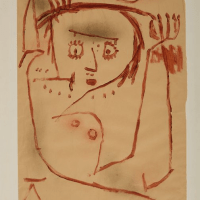
Contributed by Jonathan Stevenson / Branded a degenerate artist for his “insane childish scrawling” by the Nazis, Paul Klee, once anointed at the Bauhaus, left Germany for Switzerland in 1933. Scleroderma was already affecting his will and ability to paint, and his theretofore prodigious output waned. But as Germany’s onslaught in Europe effloresced into World War II, he regained purpose and productivity, yielding over 1,250 works in 1939, the year before his death. During this period, he downplayed his signature sublimation via color in favor of succinct line to expose the toxicity of fascism. Everything that concerned him as a citizen of the world seemed to catch light in his art. This valedictory turn is the subject of “Other Possible Worlds,” the Jewish Museum’s superbly curated show, uniquely centered on his final decade.
Tag: Jewish Museum
Ben Shahn’s vigilance
Contributed by Margaret McCann / Ben Shahn’s lifelong advocacy against poverty, racism, and fascism is showcased in his solo exhibition “Ben Shahn and Nonconformity,” now up at the Jewish Museum. With engaging documentation, an array of global topics are addressed in printmaking, photography, commercial art, and calligraphy – and some excellent paintings.
Clement Greenberg vs. Harold Rosenberg
In The New Yorker Peter Schjeldahl reports that The Jewish Museum’s chief curator, Norman L. Kleeblatt, has focussed “Action/Abstraction” on the writers, interspersing paintings and […]
The radical philosophy of Camille Pissarro
“Camille Pissarro: Impressions of City and Country,” Jewish Museum, New York, NY. Through Feb. 3, 2008. Nearly 50 paintings and works on paper culled from […]