Tag: Robert Ryman

Group Shows

Michael and Tim Maul: Art as antidote and refuge

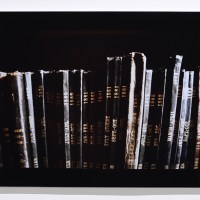
Contributed by Adam Simon / If I had walked into Kerry Schuss Gallery knowing nothing about the two artists on display, I would have thought the pairing unusual, elegant, and extremely interesting. One group of works consists of Michael Maul’s 11 x 8.5-inch ballpoint pen and colored pencil drawings on ledger paper depicting row after row of almost identical figures, rendered in a diagrammatic shorthand. Interspersed among these, are four 20 x 24-inch photographs of books taken by Tim Maul. The photographs are one of a kind Cibachromes, produced by printing directly from 35-millimeter slides; the method was discontinued in 2013. Cibachromes are long-lasting photographs of exceptionally vivid colors. All four of the photographs were shot in the 1990s but not printed until 2000. Two depict books open to what appear to be the blank pages preceding the title page. A third book is similarly splayed but face-down. The fourth photograph is of a shelf of books that appear to be journals or compiled records with dates on the spines ranging from 1859 to 1863, shot on commission at a library in Ireland. 
Solo Shows

Mitchell Kehe’s targeted irresolution

Contributed by Jonathan Stevenson / The title of Mitchell Kehe’s solo show at 15 Orient – “Bonded by the Spirit of Doubt” – encapsulates the ambiguity and contradiction in which he traffics. Doubt is fundamentally divisive and isolating, a fraught source of any bond in the sense of affection or solidarity. Maybe he means “bonded” in the sense of “certified,” the way American whiskey is, uncertainty and doubt being such pervasive phenomena that no work of art can claim validity or integrity without somehow imparting them. In his beguiling paintings, this idea is manifested in a casual tension

Solo Shows

Jacqueline Gourevitch: Skying abstraction

Contributed by Jason Andrew / Jacqueline Gourevitch’s resilience stems from restraint and slow observation. From her first solo exhibition in 1958 to the current striking survey of 21 cloud paintings dating from 1965–2018 at Storage Gallery in Tribeca, the nonagenarian has shown that sustained attention to a single subject can yield infinite and dynamic variations.

Solo Shows

Jan Dickey: The art of breakdown

Contributed by Lucas Moran / In art, limitations often define, shape, and mold strengths. We can embrace drawbacks and spin them into gold. An impoverished de Kooning, living off ketchup packets and free coffee, turned to house paint to create some of his most compelling work. A bedridden Matisse cut paper. Scarcity, oppression, impairment – these forces have shaped the course of art history. Rather than relying on convention, Jan Dickey – investigator, tinkerer, and forager as well as painter – has immersed himself in studying how things break down, bond, and hold together. “The High Collapse,” now on view at 5-50 Gallery, is the culmination of that endeavor….

Ideas about Painting

Painting simulacra: Brice Marden, David Reed, and Gerhard Richter

Contributed by Saul Ostrow / “Let the Painting Make You,” the exhibition of Brice Marden’s last paintings; at Gagosian Gallery, set me to thinking about the relationship between Marden’s earlier gestural works and Gerhardt Richter’s process-oriented abstract paintings, which in turn led me to consider the connection of their works to those of David Reed and then to the French artists Simon Hantai and Bernard Frize who, like Reed, creates the illusion of an impossible spontaneity. Slowly, I came to focus on the question of why Richter is identified with post-modernism, while Marden and Reed’s works are most often critically identified as being quintessentially modernist and formalist. While Hantai (the modernist?) and Frieze (the post-modernist?) fit the question of what constitutes post-modern abstract painting, their references and histories are different for consideration here. Instead, I decided I would focus on Richter, Reed and Marden all who seem to transgress the formalist and modernist dictums that were generated in the 1950s and 1960s in the United States and then exported abroad, as such Hantai and Frize are part of another genealogy.