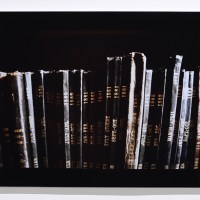
Contributed by Adam Simon / If I had walked into Kerry Schuss Gallery knowing nothing about the two artists on display, I would have thought the pairing unusual, elegant, and extremely interesting. One group of works consists of Michael Maul’s 11 x 8.5-inch ballpoint pen and colored pencil drawings on ledger paper depicting row after row of almost identical figures, rendered in a diagrammatic shorthand. Interspersed among these, are four 20 x 24-inch photographs of books taken by Tim Maul. The photographs are one of a kind Cibachromes, produced by printing directly from 35-millimeter slides; the method was discontinued in 2013. Cibachromes are long-lasting photographs of exceptionally vivid colors. All four of the photographs were shot in the 1990s but not printed until 2000. Two depict books open to what appear to be the blank pages preceding the title page. A third book is similarly splayed but face-down. The fourth photograph is of a shelf of books that appear to be journals or compiled records with dates on the spines ranging from 1859 to 1863, shot on commission at a library in Ireland.