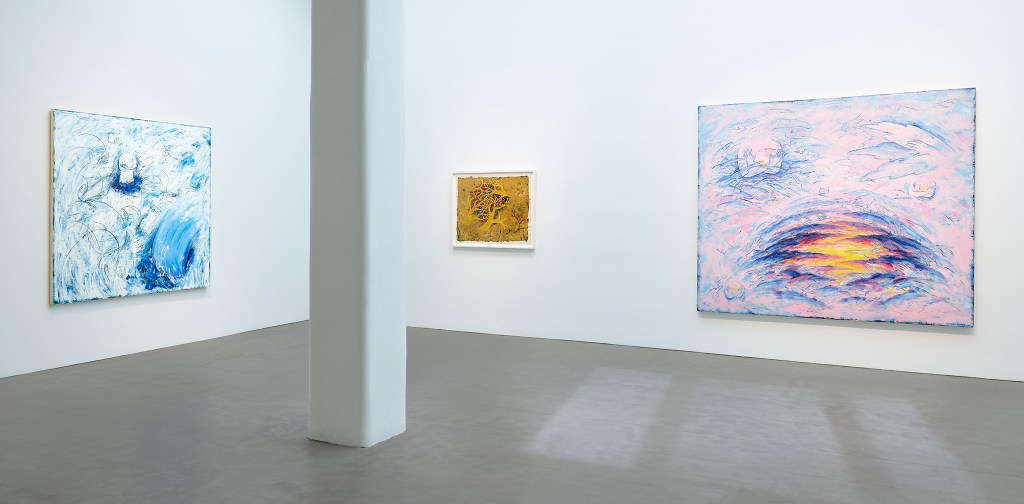
Contributed by Jason Andrew / At Berry Campbell Gallery, “Louisa Chase: The Eighties” is less a rediscovery than an emphatic reassertion of a leading painter who resisted easy categorization within the shifting narratives of the Neo-Expressionist and New Image movements in New York. Featured in this, the largest exhibition of the artist’s work in New York City in over 25 years, are works that span the decade between mid-1970s and the mid-1980s, Chase, who died in 2016, emerges as a more complex and pivotal artist than she is usually considered.
After training in printmaking at Syracuse University, Chase turned primarily to sculpture at the Yale School of Art. An encounter with Philip Guston in 1975, her final year, proved catalytic. From Guston, Chase got permission, as it were, to embrace symbolic figuration without sacrificing formal rigor, and to pursue painting grounded as much in emotional intensity as in structural invention. The result are canvases teeming with unstable imagery – shifting torsos, stretching limbs, curving waves, jutting cliffs, and fiery fields. Among her contemporaries, Chase’s work is not as nihilistic as David Salle, as muscular as Elizabeth Murray, as sexually edgy as Eric Fischl, as overtly gestural as Susan Rothenberg, or as grandiose as Julian Schnabel. It possesses what critic Kay Larsen in 1982 called a “brooding conviction” originating “straight from some inner source of strength.”
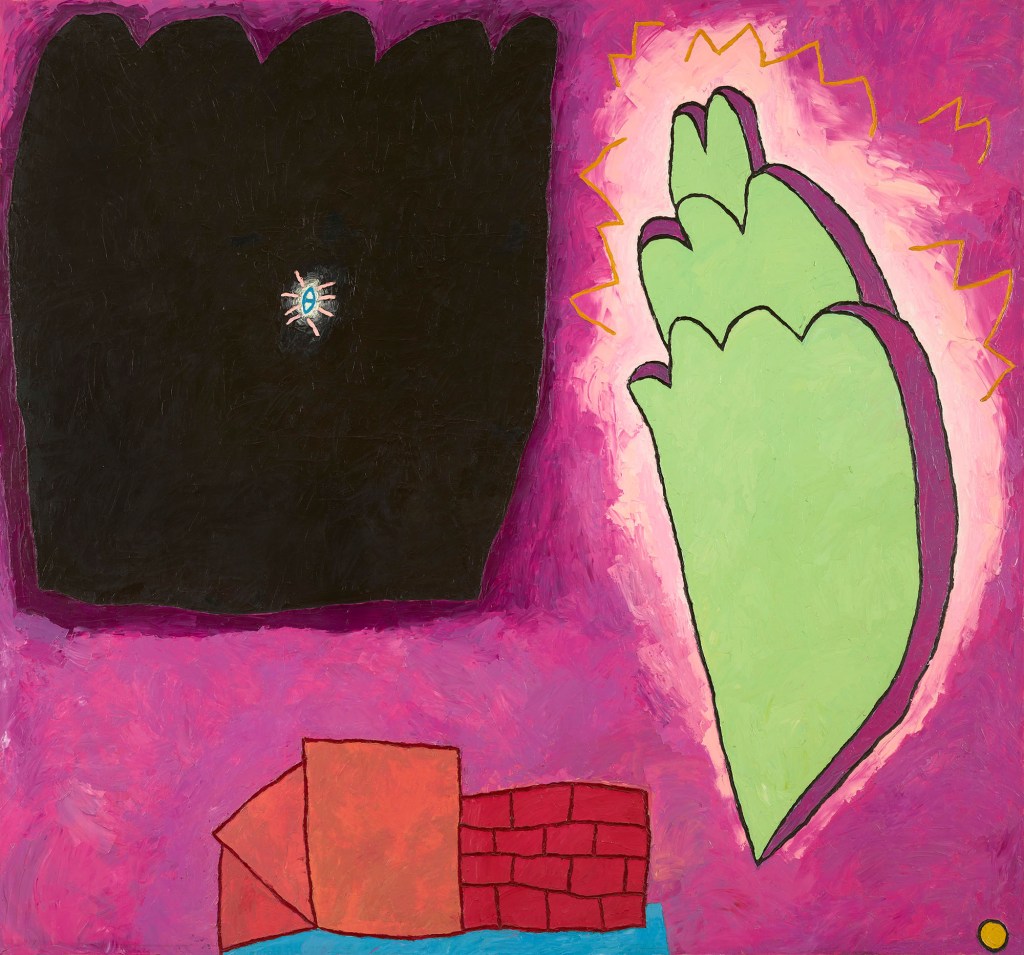
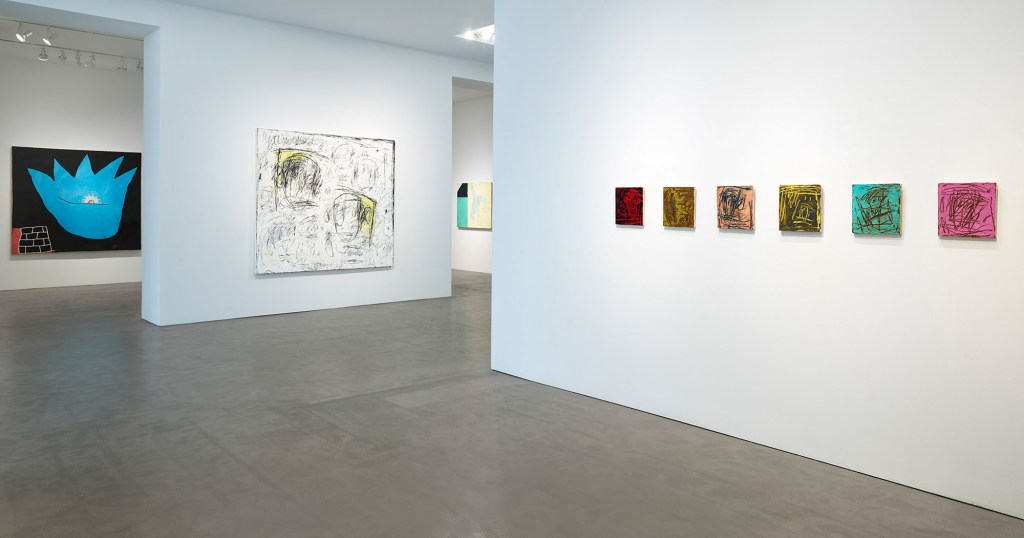
In Burning Bush, Chase addresses a subject that is at once deeply personal and archetypal. The title invokes a biblical moment of revelation in which the divine appears as fire that does not consume. Chase does not illustrate this narrative directly but rather abstracts its symbolic thrust with funky colors troweled on thickly with a palette knife. Juxtaposed with a glowing green field are a black expanse featuring a blinking eye, a brick wall rising from a blue pool, and a tiny orange rune placed lower right as if, as one critic once described it, pulled from “the bin marked Post-Modernist Miscellany.”
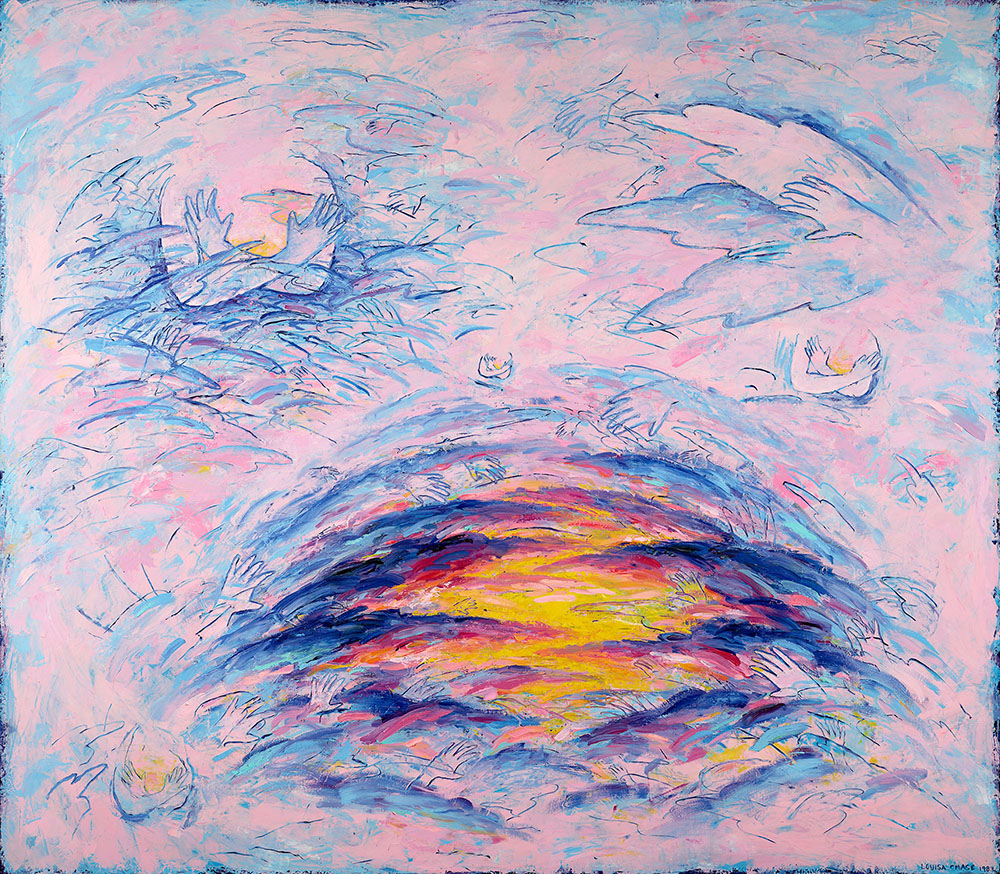
The color, texture, and scale of Chase’s work bears more on the immediate impression it makes than on its content. Sunset Grip equates the visual pleasure of a setting sun with that of warm self-hug. Like a printmaker, Chase etches a scene into the surface of the paint as it dries. A flutter of open hands and billowing clouds seductively converge. As these elements hover, fall, and dissolve, they impart the porous boundary between body and world. Earnest rather than cynical, the title may be a play on Sunset Strip, which is just minutes from the gallery – Margo Leavin – where she had begun to exhibit.
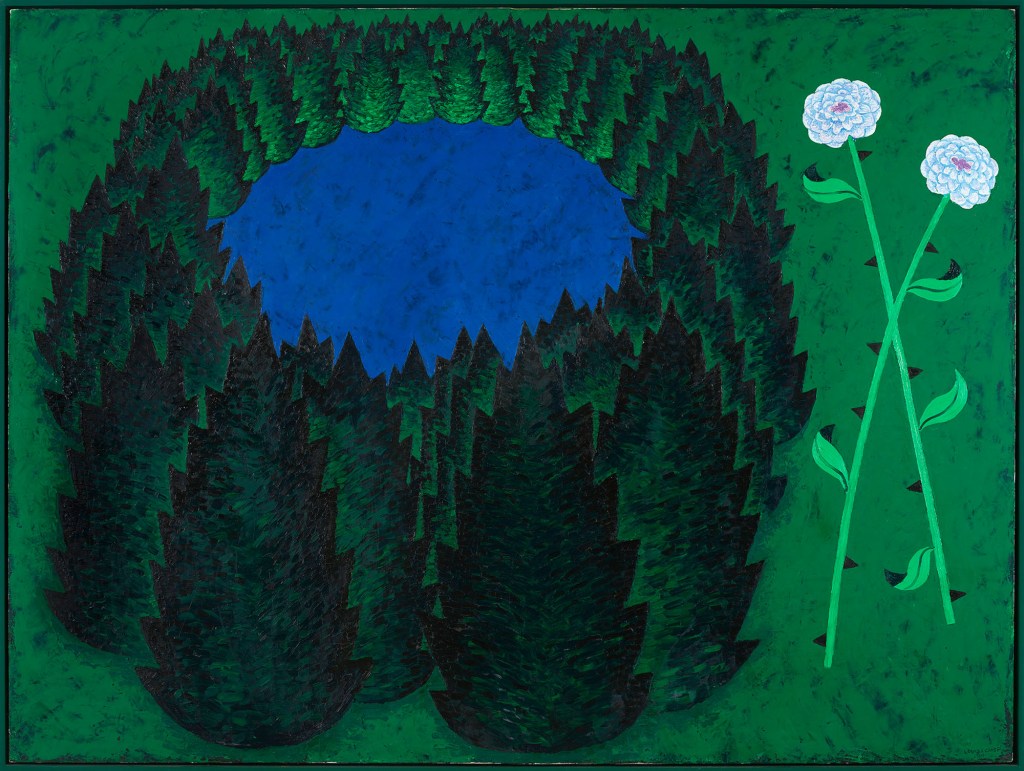
In Pool, Chase turns to landscape not as a site of calm observation but as a charged psychological field. The central image – a deep blue pool encircled by evergreen trees alongside two entangled hydrangeas with thorny stems – appears almost idyllic. Yet, as with much of Chase’s work, emotional intensity disrupts ostensible serenity. The pool reads as an interior space, analogous to consciousness. Chase thought of painting as a way to “hold a feeling tangible,” and frequently linked landscape to internal states, insisting that “the location is inside.”
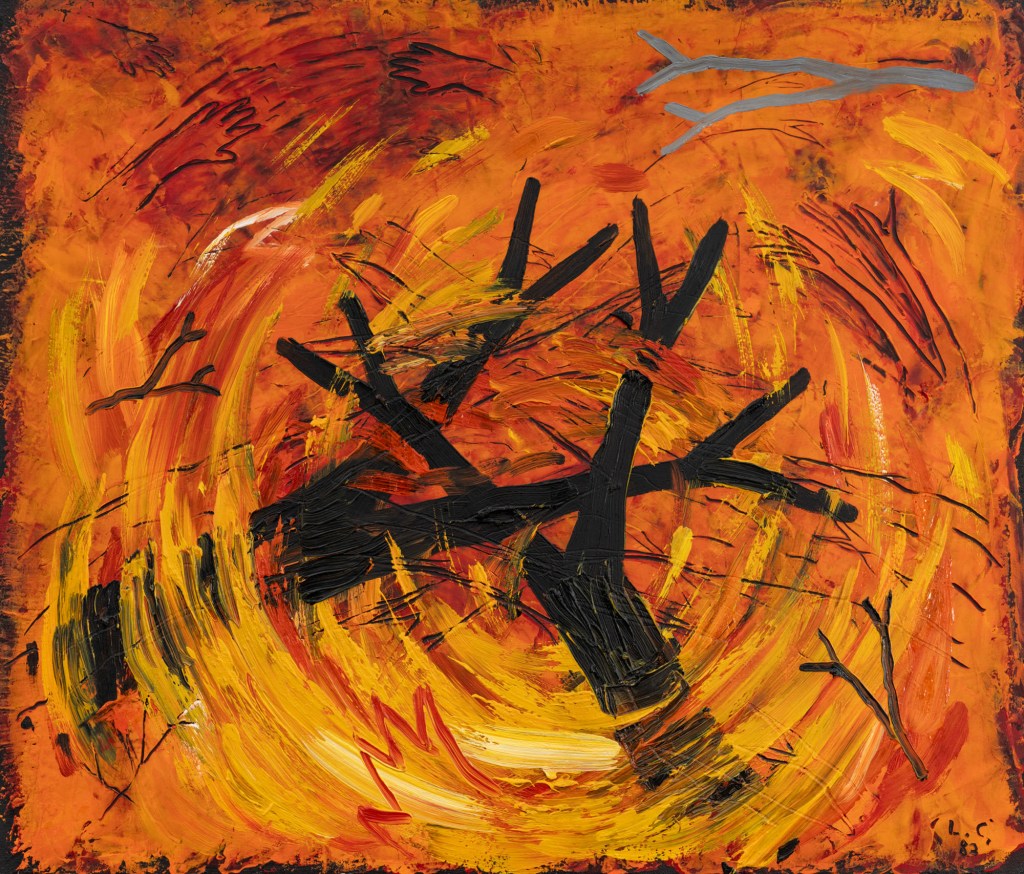
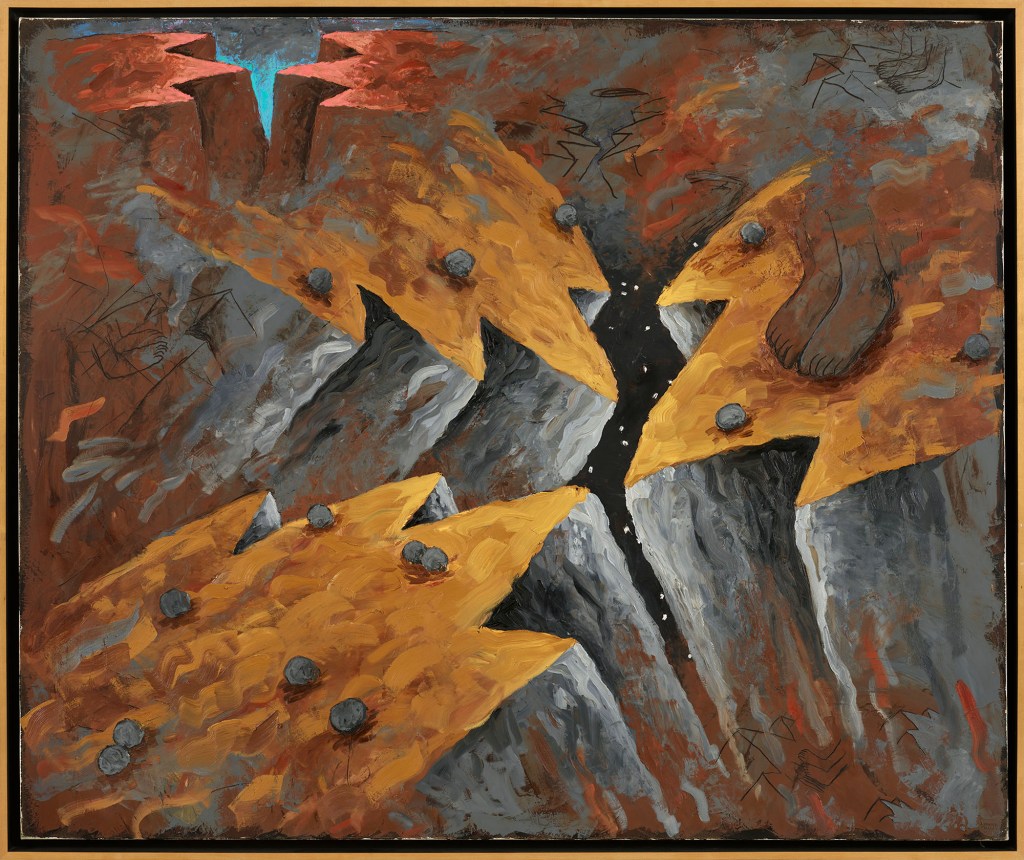
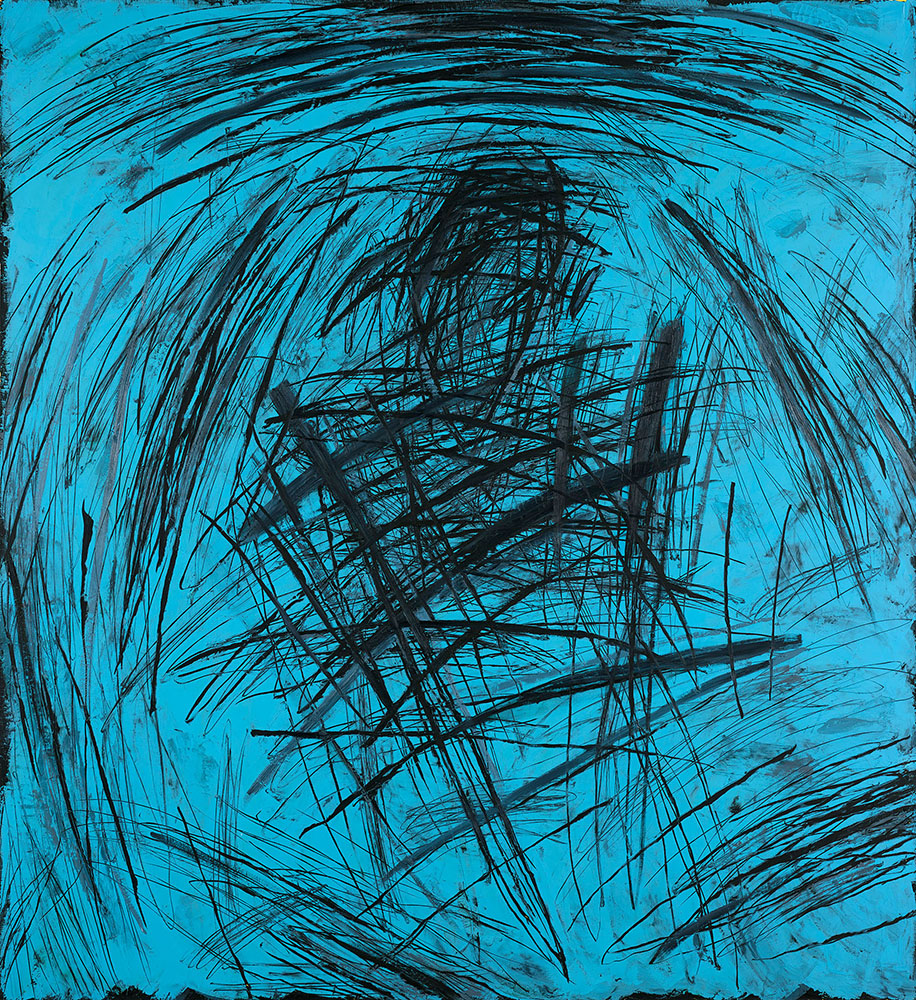
Psychological turbulence can be felt in nearly every work. Paintings like Yellow Storm and Untitled (Fire Study) translate inner turmoil into gestural strokes and saturated color fields suggesting exuberance and unease. The ominously mechanical Crevice depicts a pair of chunky faux-naïf painted feet at the edge of jagged cliffs, tapping into the sense of standing at the proverbial edge. Chase notably depicted cliffs with gaping chasms that would swallow even the loudest cry. The refusal to resolve the tension between the playful and the catastrophic is quintessential Chase. By the mid-1980s, figure and landscape in her work had dissolved into marks incised and dragged across the surface. Whereas the image had once served as her central element, now, in this selection, it is obliterated, the mark effacing the self.
Asked by BOMB Magazine in fall 1982 to select artists whose work she found provocative, Elizabeth Murray included her friend Louisa Chase – the only well-known artist of the cohort. Murray said she was drawn to Chase for the deeply personal, “sometimes goofy and sometimes sad fantasy” in her work, which Murray sought and valued in her own. Beyond the goofy and sad fantasy, Chase does not seek coherence but insists on contradiction and in particular the simultaneity of joy and dread – an imperative that feels freshly urgent today. This show is a reminder that painting, at its most vital, is a site of psychic risk.
“Louisa Chase: The Eighties,” Berry Campbell Gallery, 524 West 26th Street, New York, NY. Through May 30, 2026.
About the author: Jason Andrew is an independent curator and writer based in Cypress Hills, Brooklyn. Follow him on Instagram: @jandrewarts