Contributed by Bill Arning / Sometimes the architecture of an exhibition space draws out qualities in an artist’s work that might remain latent elsewhere. Katherine Umsted is a familiar presence in the Hudson Valley art scene, known for an overflowing aesthetic of massive, boat-like vessels on the verge of collapse, constructed from rough-and-ready materials that could evidence a 2026 reincarnation of Arte Povera. It is hard to imagine a less suitable setting for such work than Hudson’s Philip Douglas Fine Arts, with its three demurely scaled second-floor rooms above the bustle of Warren Street. The gallery’s aesthetic is refined, even hushed, and Umsted’s work initially seems as if it might make the building buckle. One recalls the politely scaled delicacies often shown here and is tempted to search for similar qualities in these sixteen constructions. Yet Umsted’s presence does not rupture the program so much as recalibrate it.
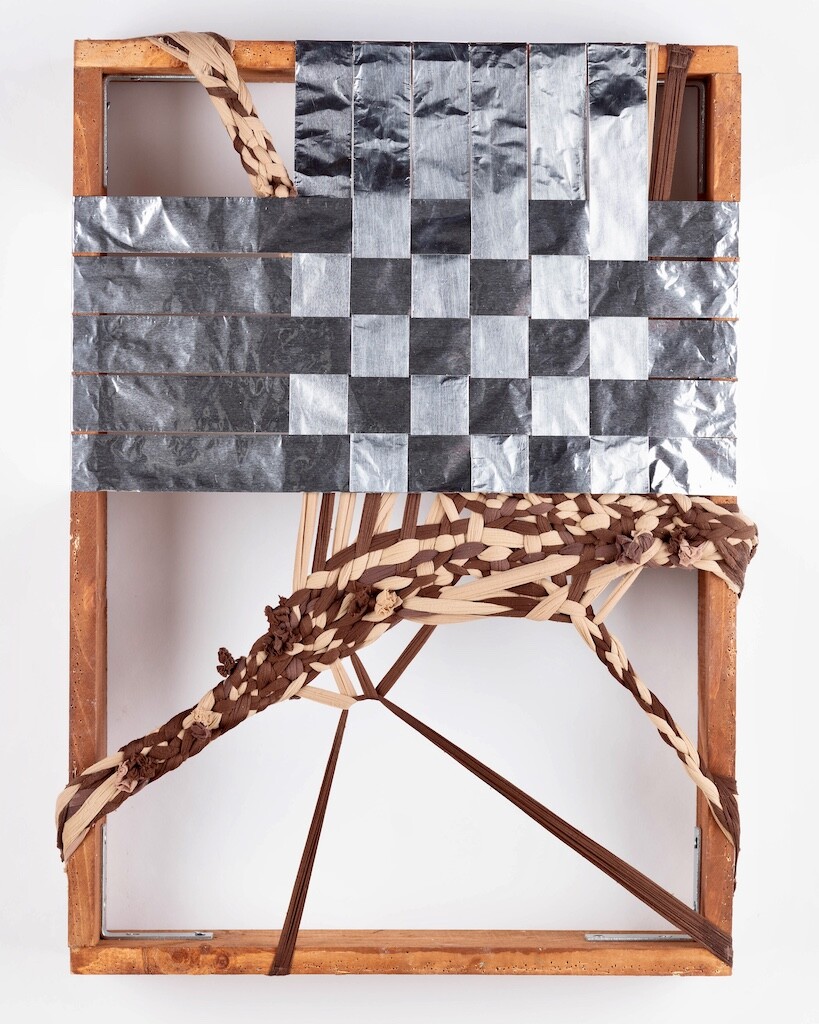
The disjunction proves unexpectedly fruitful. Umsted has created a series of wall works built around constructed wooden boxes, visibly cleated together – clearly handmade, though suggestive of found objects. Around each, she has woven pantyhose in varying hues with the patient, cumulative attention of a grandmother hooking a rug. The material’s elasticity introduces an immediate tension – a bodily effect, as if these works were skins stretched over armatures, evoking our own flesh-bound passage through time.
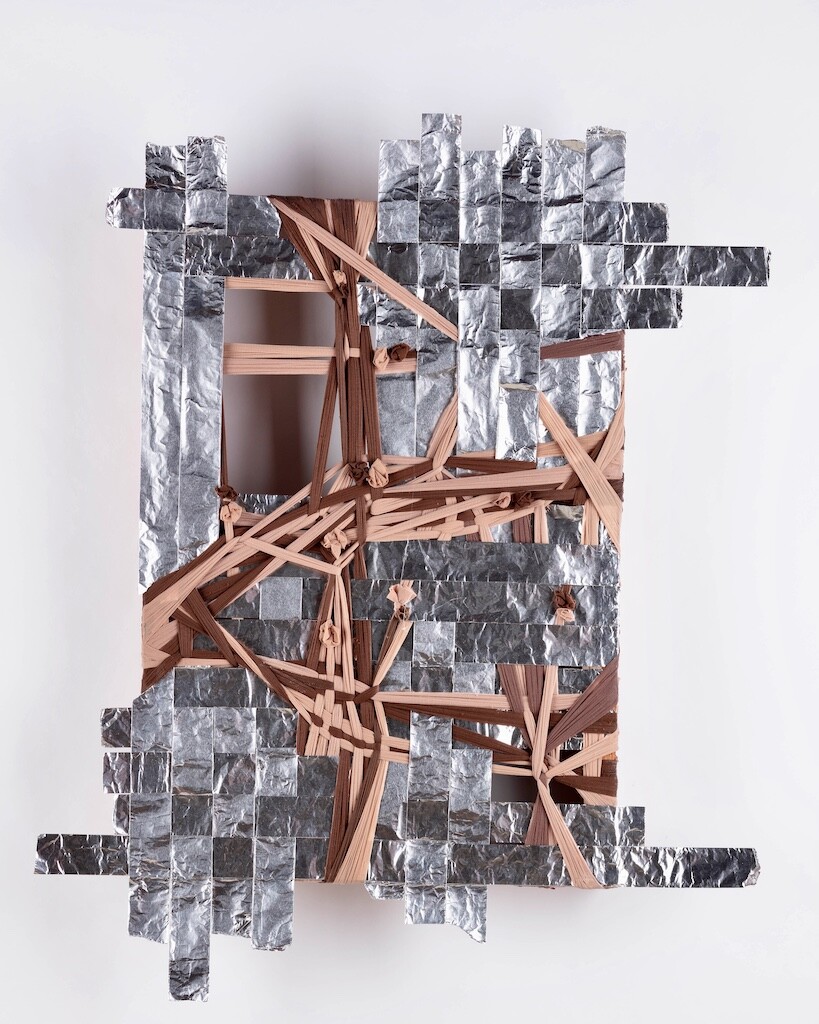
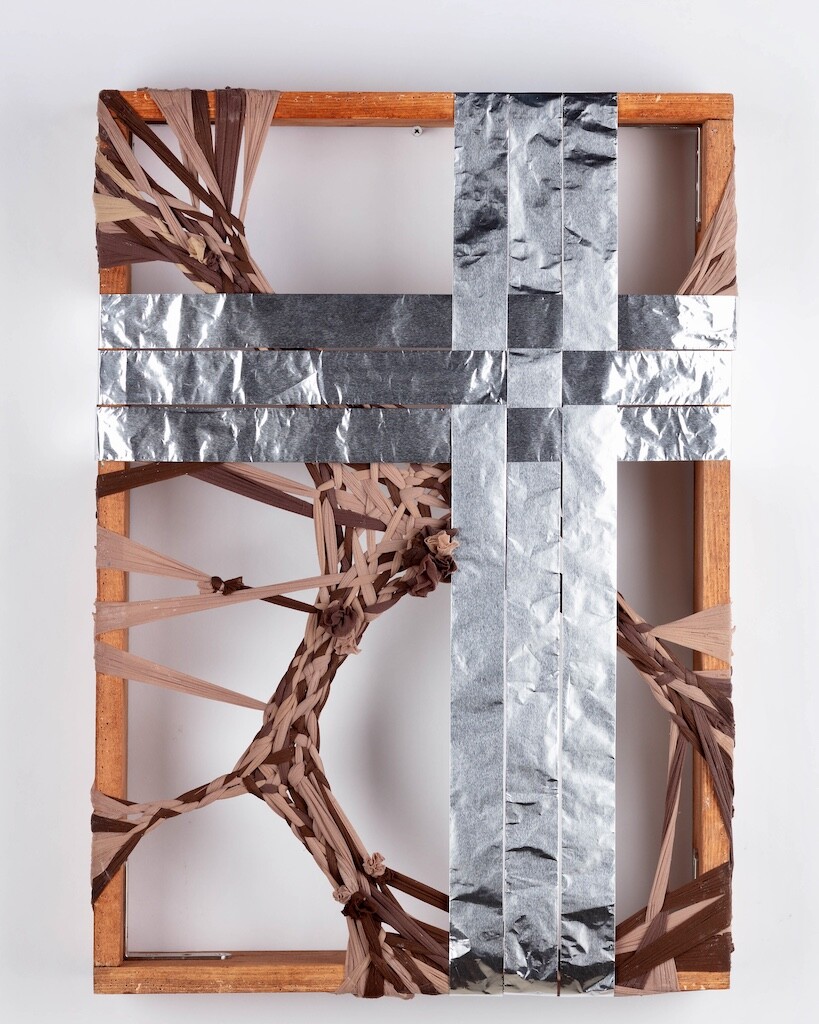
Across these surfaces, Umsted pins geometric strips of thick aluminum foil. The foil’s muted silver geometry sharply contrasts with the yielding, fleshy hosiery. One might fleetingly think of the cliché of tinfoil hats warding off psychic intrusion; here, however, the foil reads less as paranoia than as armor. Yet the armor is partial, covering less than half of each construction, leaving conspicuous gaps. Protection becomes gesture, modesty short of defense. The pairing of materials – bedroom (hose) and kitchen (foil) – forces two intimate domestic registers into uneasy coexistence.
The gallerist PD Heilman has wriiten am unusually literary – almost poetic – essay suggests that these works are ambiguously psychological self-portraits. This aligns with the trajectory of Umsted’s earlier exhibitions, which grapple with how we share the planet amid the relentless friction of social encounter. Referencing her last solo show during the depths of COVID shutdown, Douglas reminds us that re-entry into public life has been anything but seamless. The exhibition’s title, “Take Cover,” implies that even after years of enforced isolation, the knowledge that safety lies at home lingers.
Douglas also invokes the under-recognized artist Sal Scarpitta, whose wrapped sculptures conveying motion, always exciting to find in museum collections, resonate here. Other wrapping-based artists – Joseph Beuys, Christo, Louis Zoellar Bickett – hover, suggesting wound care and improvisational survival. Umsted’s use of pantyhose further conjures Senga Neng Udi and Ernesto Neto and their sensuous, tensile evocations of the body.
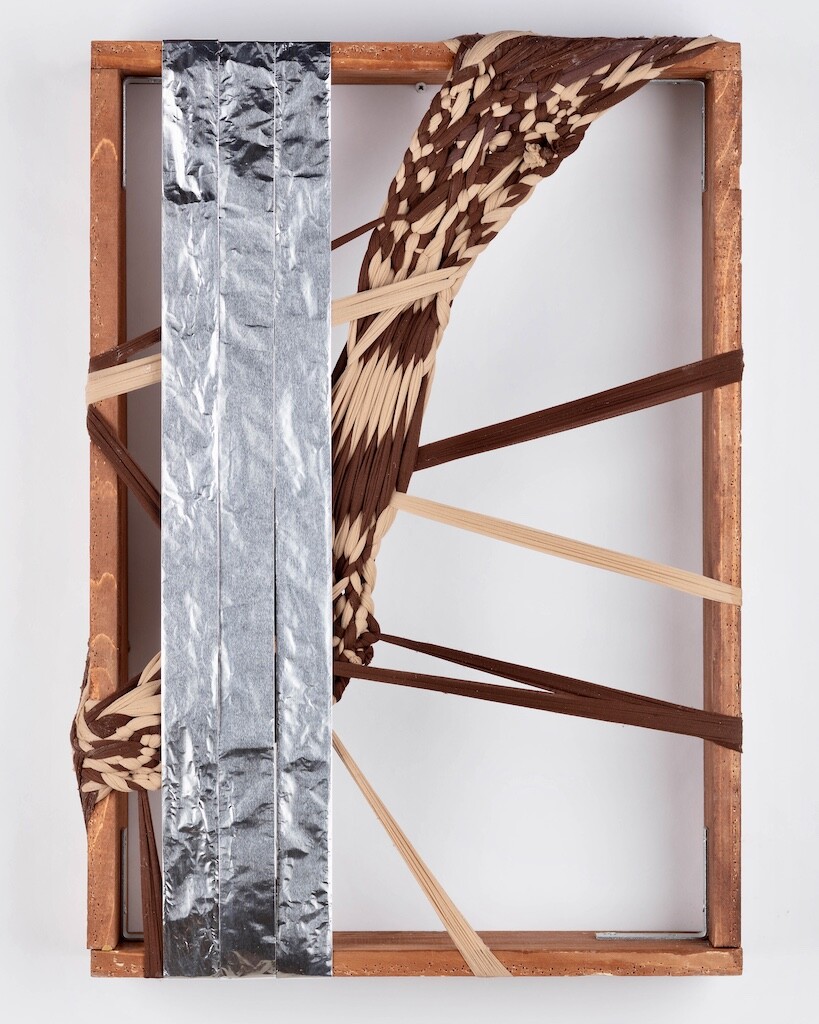
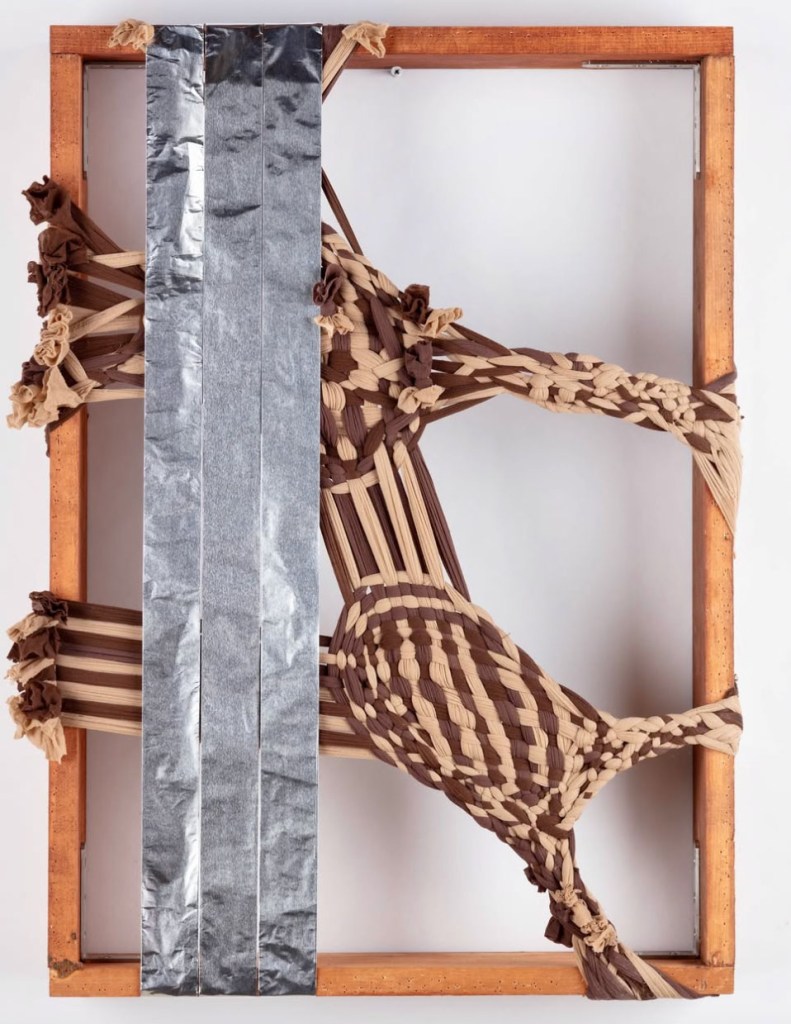
Most striking, however, is Umsted’s distillation of Kurt Schwitters’ work. Museums now often represent the Dadaist creator of the aggressively material Merzbau with his exquisite collages, the scandal his use of detritus caused almost forgotten. Today, those works seem almost as decorous as Elizabethan verse – a reminder that radical gestures can, over time, become aestheticized. If Schwitters can be domesticated by the weight of art historical canonization, virtually all transformations become possible. Three slightly earlier works are unruly, with foil elements jutting beyond the frame, testing the limits of the rectangle, and suggesting imminent collapse. By contrast, the most recent pieces are restrained, allowing more air, more wall, less density. Yet even the most punk-inflected works resolve, upon reflection, into something unexpectedly refined.
Douglas notes a shared Southern heritage between artist and gallerist, drawing on a culture of restraint and secrecy. But like the wounded figures in a Flannery O’Connor story or a Tennessee Williams play, Umsted’s work reveals itself obliquely. Through coded, materially charged gestures, she offers a quietly devastating account of what it feels like to be alive now.
“Katherine Umsted: Take Cover,” Philip Douglas Fine Arts, 545 Warren Street, 2nd Floor, Hudson, New York. Through June 7, 2026.
About the author: Bill Arning is a curator, critic, advisor, writer, and itinerant maker of pop-up shows based in Old Chatham, New York.