Contributed by David Humphrey / The gallery in question is Alyssa Davis Gallery, which featured Olivia Drusin’s solo show “DUMMY” from March 7 to April 19, 2026.
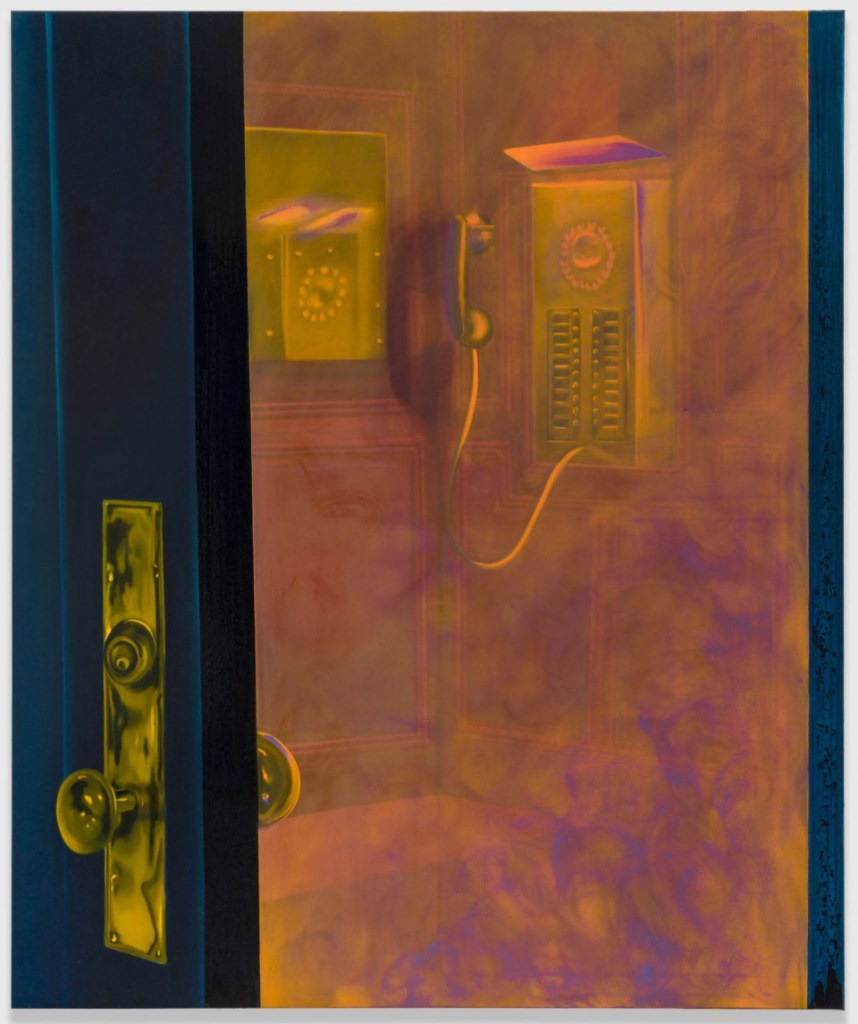
David Humphrey: I’m going to improvise some questions, and we’re going to go around and talk about your paintings. One of my favorite things is to look at a painting and have a conversation with it. But of course you are with me, which makes it more complicated. One of the things that interests me about painting generally is its tactile character, that the whole work was made at arm’s reach by touching the canvas over and over. You make that into a theme. If you paint a doorknob, as in Foggy Interpose, even if it’s disorientingly larger than life, it establishes a connection between looking and touching. Or the little intercom phone with buttons inside the vestibule that needs to be picked up and poked to get into the building. But a new dimension of your work in this show that’s harder to put our hands on is the atmosphere. The purple haze is a kind of affect-saturated air that is almost breathable. If touch is one form of contact, breath and taking in air is another form of intimacy. So that’s my hello to this painting.
Olivia Drusin: I like thinking of painting as always about thresholds. Foggy Interpose pictures a doorway that subdivides the space into various screens and is also an underhand joke about painting being flat and having various layers imbued in the surface. The space inside the painting is marked by those divisions and a glossy black line. The inside of the painting is the pungent space of the foyer of an older New York apartment building. It is part phone booth, part intercom system. I was thinking about flat Northern Renaissance or medieval painting with this one, seeing the whole scene spread across a singular plane and having shiny, kind of gross, drippy barriers be the subdividing lines for these screens of interaction.
DH: So, presumably, the person on the other end of that line, when you hit the correct buttons, will let you in.
OD: Yeah. [laughs] If you can get there. There are a bunch of incongruent spatial things happening as well. The doorknobs don’t match. There’s a shifting in scale. Even though this area supposedly goes back in space, it’s still all at the forefront of the painting. There’s a weird push-and-pull happening so that the purple smoke becomes another screen.
DH: There’s an almost mystical dimension. I feel like the doorknob, the thing that you need to grab in order to get to the pungent interior space, is a votive figure. It’s spooky. Maybe you’re suggesting that lurking beneath all the banal hardware of our life is this possibility that things can transform into other things.
OD: I once heard a description of why Antonioni films are psychedelic, and it’s not because they are like an acid trip with crazy visuals; it’s the small shifts that change our experience of a mundane situation that is psychedelic. I want these scale shifts to do that in my paintings. That’s how I am thinking about it.
DH: I like the connection with film because these works do imply a before and an after like a movie still. But the before-and-after is something left to us.
OD: Totally. When we were placing these two paintings at the front of the show, we were thinking about echoing the elevator door. The elevator would open onto these other openings.
DH: The paintings seem so friendly to contextualizing within architecture; they act like they are an illusory part of the building. I like how the images present themselves as features of the solid, built world, but then, thanks to the conditions of light and your painterly touch, they become spectral.
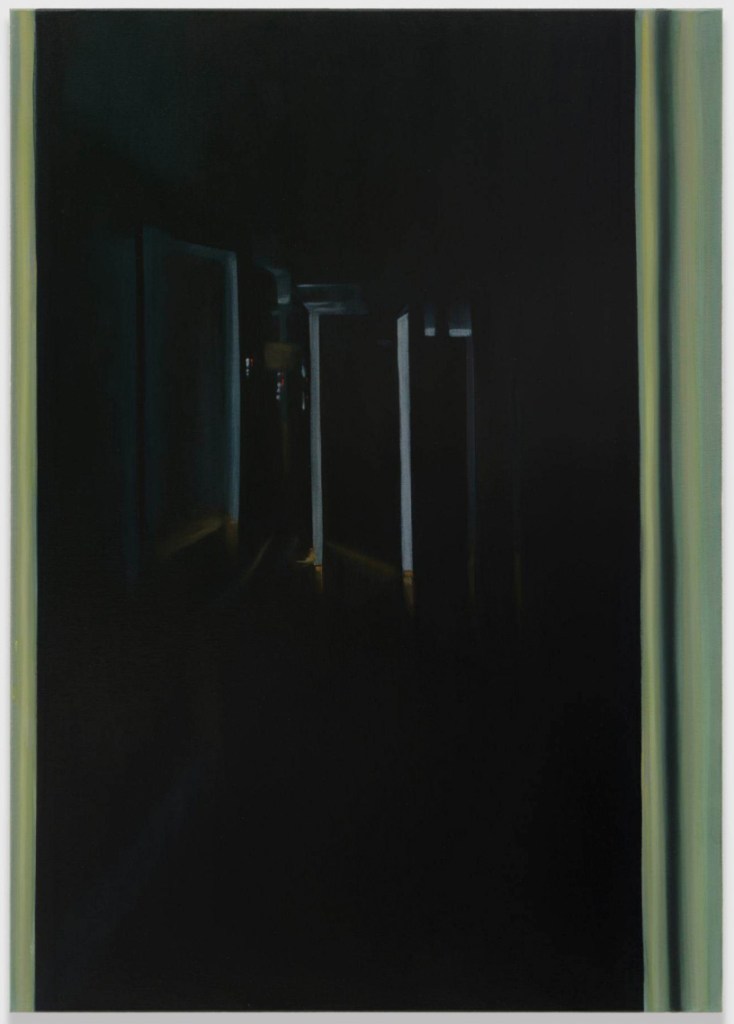
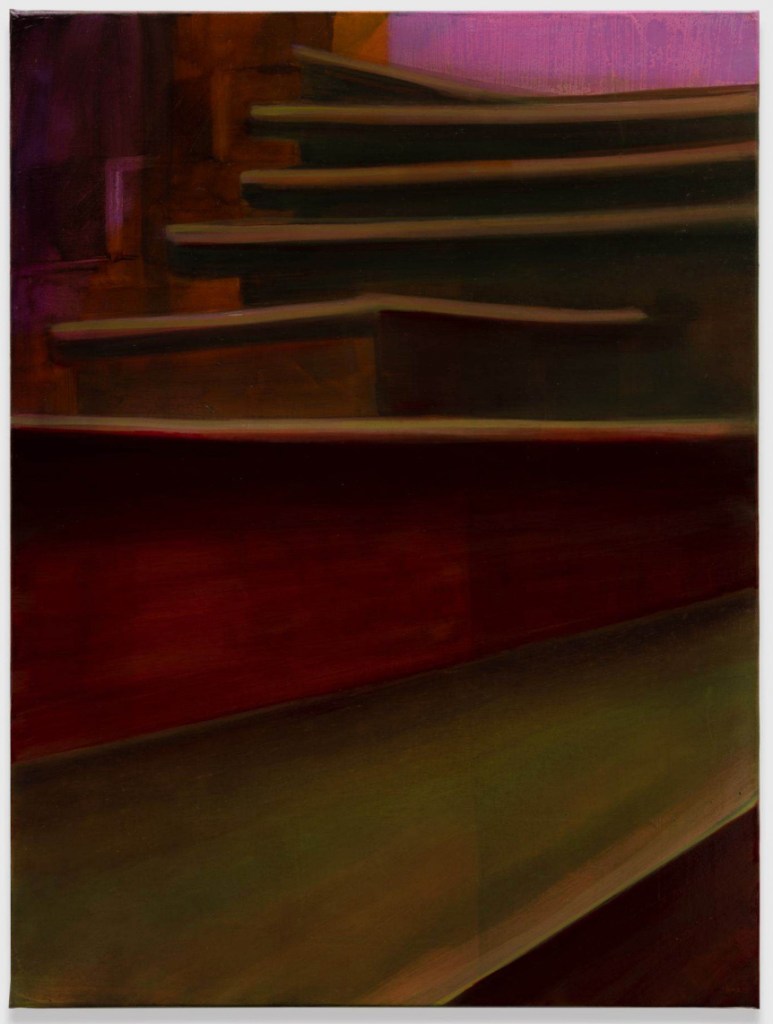
OD: This is definitely a show about light. Greeting addresses that directly; it’s looking down a pre-war New York City apartment entrance hallway, but it’s actually a reflection of that hallway caught in a bunch of different surfaces of a door frame. The threshold that you’re supposed to be able to walk through is de-materialized, it can’t quite be located.
DH: My impulse is to psychologize that.
OD: Oh, yeah. [laughing]
DH: But I won’t.
OD: Well, it’s a painting. It’s purely surface.
DH: I sometimes joke that I’m not entirely real. People look at me like I’m real.
OD: But are you? [laughing]
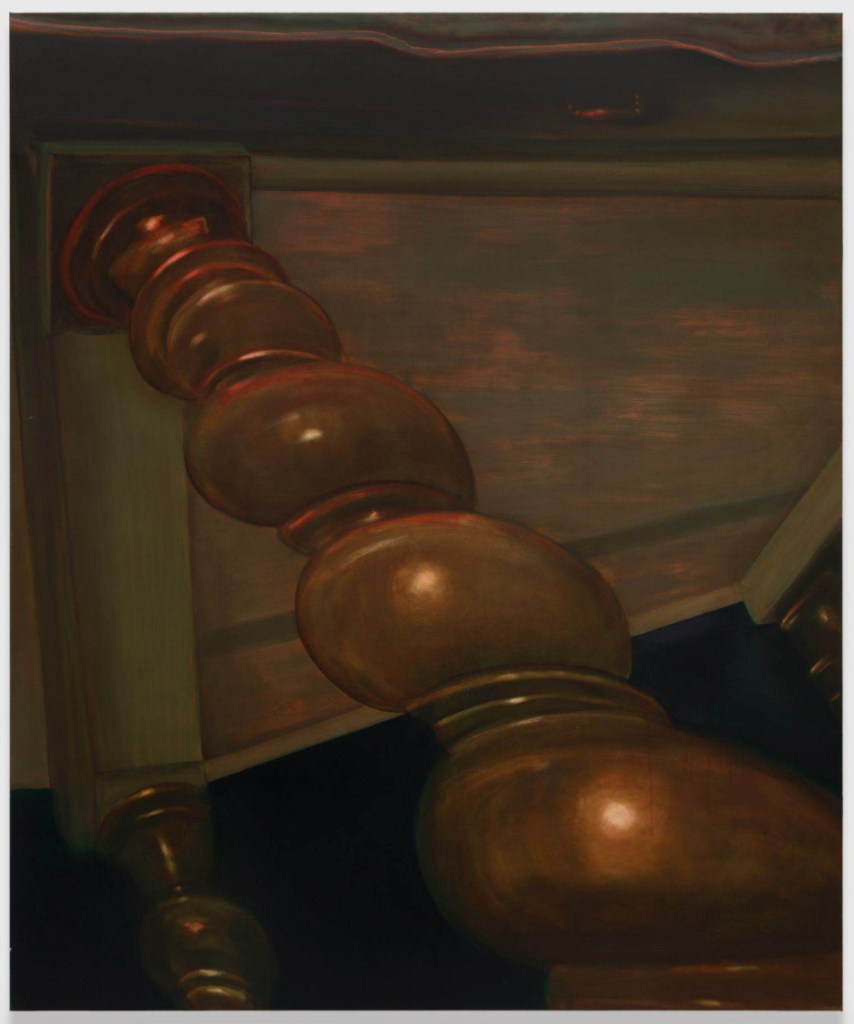
DH: I feel that some of these paintings have a sense of displaced agency. What is the point of view? Who is doing the seeing? It’s often dislocated – under the table in Pitching Surface, too close to get up the stairs in Close Ascent.
OD: Yeah, how do you get up the stairs? It’s impossible. All the paintings are based on photographs I’ve taken. They’re all real places, and the weird perspectives reflect how I moved my body to get the right shot, so that I can get the right sketch, so that I can make the right painting. Untitled (2026) is actually from an Upper East Side gallery that at one point was a private mansion and has now become semi-public. It confuses public and private. It’s a space that informs the type of threshold that it creates. It’s a spiraling, almost demonic, staircase that seemingly never ends.
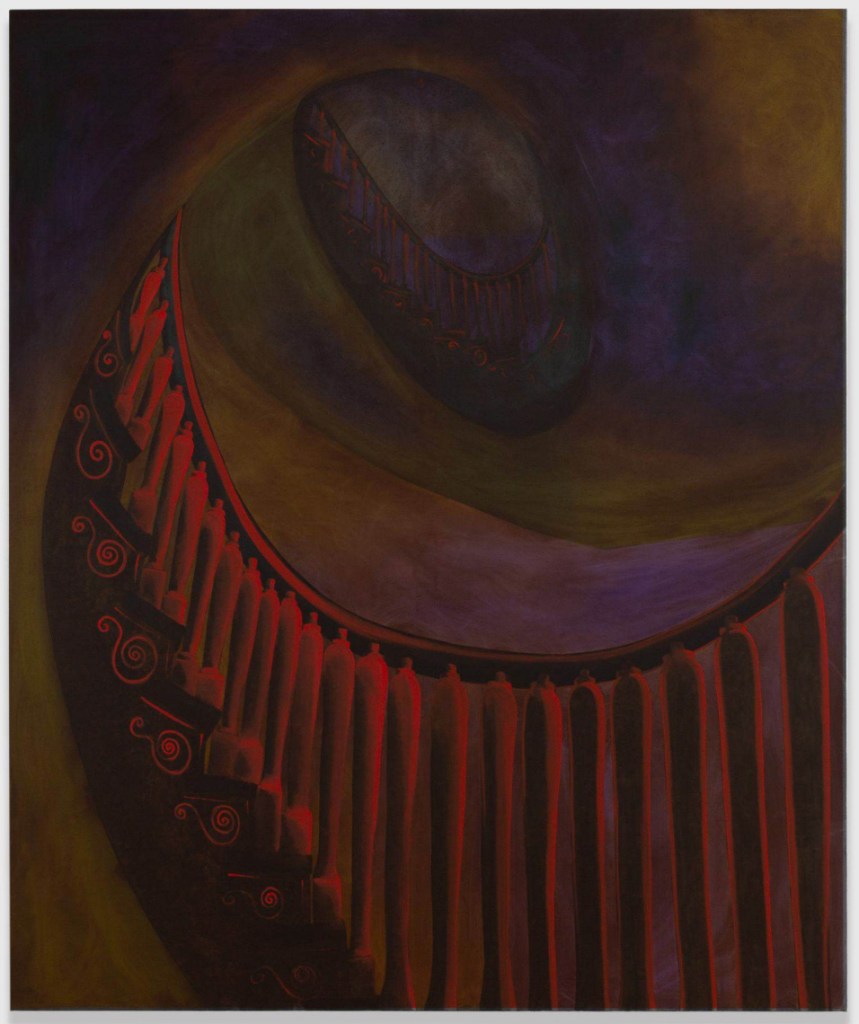
DH: I’m having a sorcerer’s apprentice association. The railing posts are like little soldiers that the sorcerer has lost control of.
OD: They’re breeding.
DH: Untitled feels a little looser than some of the others, as though the vortex you’re articulating gave you permission to let the purples, greens, and atmospheric elements break away from their descriptive role.
OD: Part of the thought process behind the light of this show is that all the paintings are grasping for an image in a dark space, so it takes a minute for your eyes to adjust. There was a NASA study that showed that it takes 15 minutes for your eyes to adjust properly to darkness, and in the meantime, you see traces of the electricity in your brain moving around. Then an image starts to emerge out of nothing. In making these paintings, I wanted it to feel like these objects or spaces were emerging out of weird sludge. But to do that I started with bright paintings that I’ve glazed a hundred times to make really dark. The old masters would paint an earth-tone underpainting followed by a grisaille, and then all the color would be thin glazes in various layers. So instead of starting from a place of no color I start with ultra synthetic high-key color that gets glazed down into the dark murkiness.
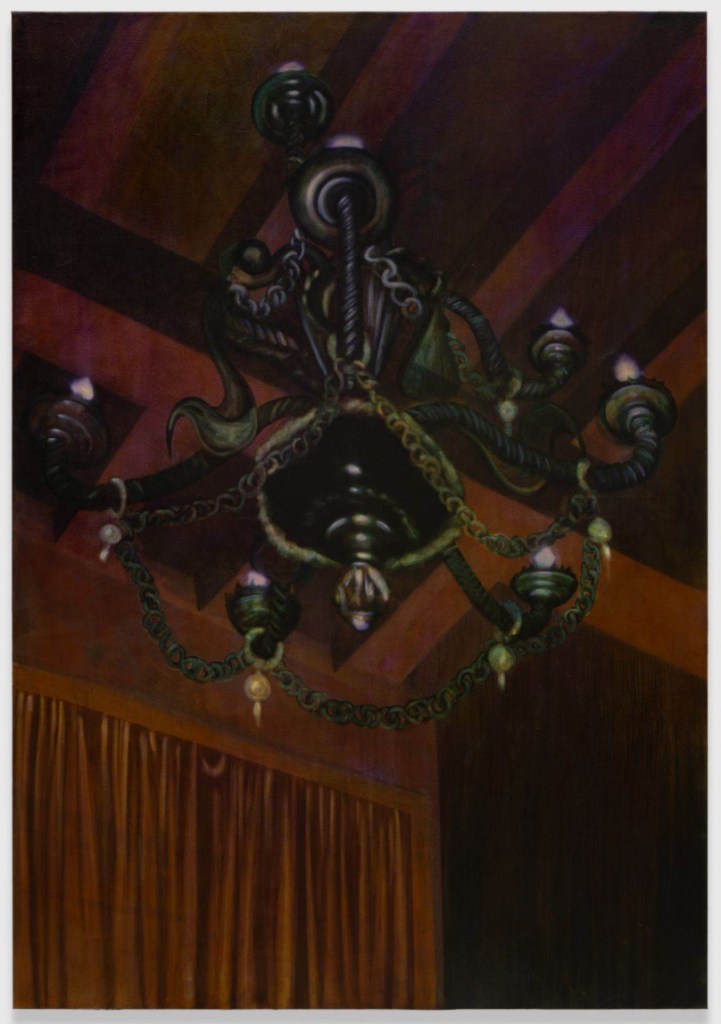
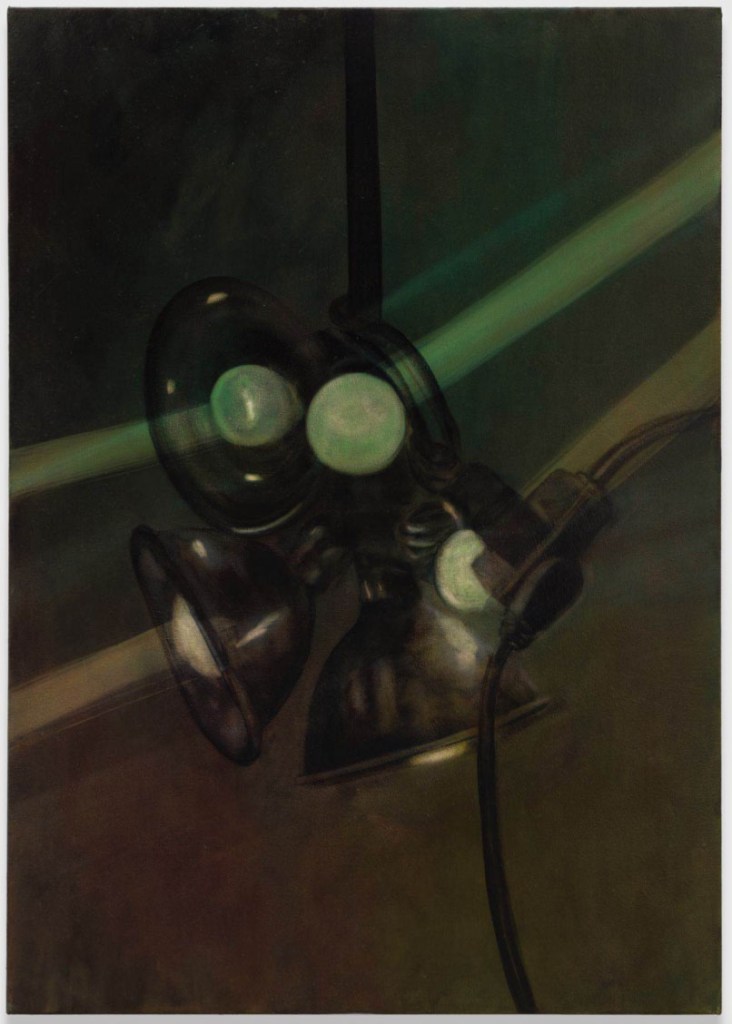
DH: Your process enacts a tamping down of the super bright thing. I like thinking that the vivid image is still there, but buried. de Chirico’s Clutter pictures a light source, a chandelier, that doesn’t illuminate.
OD: It’s lit by a light source outside the frame.
DH: de Chirico’s Clutter celebrates the weakness of the object in delivering light. It also has a science fiction dimension in the way it looks like an octopus suspended in the air.
OD: Definitely. It’s from a photo I took in de Chirico’s apartment in Rome. It’s another private space that has become public, in line with the liminality of the painting itself. It’s a Murano chandelier that I’ve created a monster out of.
DH: So it’s fancy glass.
OD: It was originally white, and then I made it not that. It’s loosely based on an idea that I read in The Ecological Approach to Perception, where J.J. Gibson says that a world without clutter is a place where life can’t happen. You need clutter in order to exist properly. My paintings are staunchly not cluttered; they’re very reduced because there are no humans in any of them. I thought that this would be an interesting case study of someone else’s clutter.
DH: Let’s talk about the curtain in your chandelier painting. All the clutter is hidden behind that curtain – repressed, let’s say.
OD: Or perhaps where the person lives.
DH: The thing that struck me about de Chirico’s apartment when I saw it in Rome was how much his wife seems to have put her stamp on it. She had a really big bedroom and he had a little one across the hall.
OD: …his tiny little monastic zone.
DH: …a little dog bed. [laughs] with posters of his work hanging beside it.
OD: …down the hall from his studio where he would remake his paintings.

DH: Let’s talk about your process and its relationship to photography. I’m wondering what the process of de-vivification does for you?
OD: The way I’ve been thinking about color over the last couple of years has been that, aside from the illusionary tricks that a painter can employ, color is the hottest psychological framework that you can use. I was interested in tertiary tones specifically for this show. Close Ascent is the most gestural of all of them. The worm’s eye view or crawler’s eye view reveals the structure of the staircase, but then the rest of it falls away. Even though you’re grounded by the perspective, it still becomes a pretty atmospheric and strange painting. It’s also the third painting on this surface.
DH; There’s other paintings buried under this one?
OD: That’s why it’s so shiny – there’s just a lot more paint on it.
DH: But maybe that layering brings qualities of memory, subjectivity, affect, or other associations. It’s not just an analytic architectural study.
OD: They’re a lot more emotional than the paintings I used to make. [laughs] The perspective of Pitching Ascent is from a photo I took underneath a Dutch Golden Age table.
DH: from a museum?
OD: No. It was at a place where I was allowed to lie underneath. [laughs] I was thinking about it being a looming art historical figure, like de Chirico’s chandelier, that almost feels like it’s falling on top of you.
DH: And presumably what we can’t see is a full-blown Dutch still life sitting on top of this table.
OD: Yeah. Definitely. [laughs]
DH: This painting makes me very woozy. It has an undulating, spiraling set of turns that aren’t strictly consistent. They seem to change as they get to the very top and are perhaps not capable of holding the table up.
OD: Yeah, the wrongness of the drawing and perspective was meant to make the feeling of falling be a little bit more palpable. It becomes a violent image, even though it’s a somewhat mundane object.
DH: It also becomes a space for dreaming, as if you are under the table looking to escape.
But I feel you’re a kind of a truth-teller in your work. You don’t make things up and don’t go in for exaggeration or distortion. Within your dreamy associations, we know that a table was built with these cross pieces and other pieces of wood; this part was turned on a lathe. Within the strict boundaries of truth telling, you find very peculiar ways to escape.
OD: I think something that I used to do wrong with painting was to try to force it to do what I wanted it to do. The truth-telling would be a little bit too intense – I could paint the same thing endlessly until it became correct. But I think with this show I leaned more into responding to – or having a conversation with – the painting surface. I took more time to actually look at it and see what made sense as opposed to exactly rendering the photographic image. The works could themselves become painted objects.
DH: That’s cool. It feels like there’s a dance of multiple selves going on. There’s the self that moves through the world with your camera, always alert to possibilities, taking pictures, doing research. Then there is the picture editor self, deciding what is worthy of becoming a painting. And then there’s this other self that makes the thing. And I guess there’s yet another self that is open to all the complicated and uncontrollable associations.
OD: I think it’s been very helpful to lean into not knowing what the painting will look like when it is over.
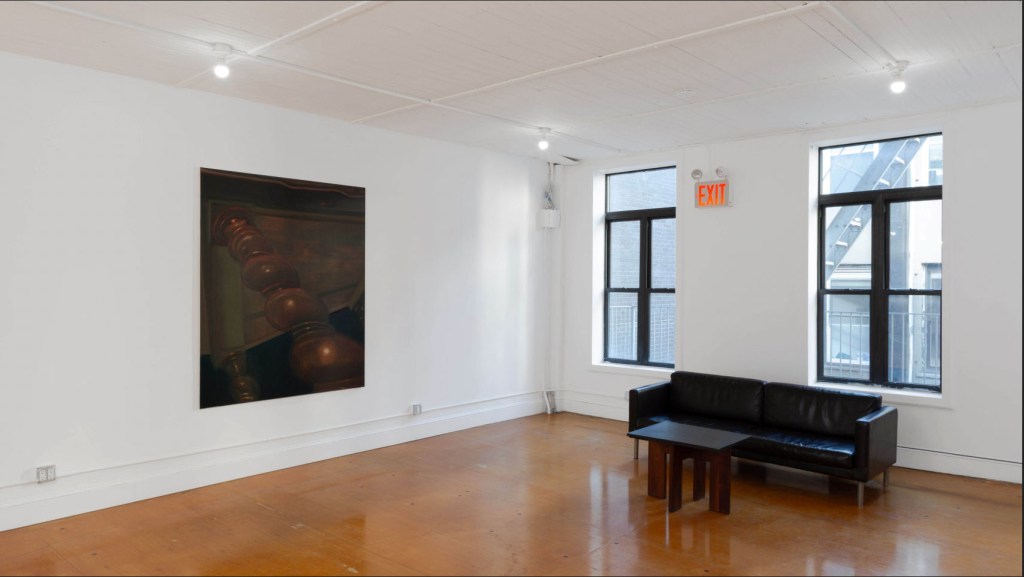
“Olivia Drusin: DUMMY,” Alyssa Davis Gallery, 28 Warren Street, Floor 4, New York, NY. March 7 – April 19, 2026.
About the interviewer: David Humphrey has been the subject of nearly 50 solo exhibitions at venues including McKee Gallery, NY; Sikkema Jenkins, NY; Kate Werble Gallery, NY; Fredric Snitzer Gallery, Miami; and the Contemporary Art Center, Cincinnati. His work is in the collections of several museums and public collections including Walker Art Center, Minneapolis; Carnegie Museum of Art, Pittsburgh; The Metropolitan Museum of Art, NY; the Museum of Fine Arts, Boston; and the Saatchi Gallery, London. He currently teaches in the MFA program at Columbia. He was awarded the Rome Prize in 2008. Humphrey has had six solo exhibitions at Fredericks & Freiser in New York City. He currently has a solo show of drawings on view at Kate Werble Gallery in Soho.