Tag: Adam Simon

Solo Shows

Fran Shalom: Merging vernaculars

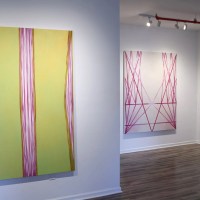
Contributed by Adam Simon / I’ve been aware of Fran Shalom’s paintings for a while and have been interested in how at times they seem like a comic version of abstract painting. She excels at what I would call formal wit, eliciting not a belly laugh but a knowing smile from those familiar with the vernacular. Her humor is a foil of sorts, providing cover for a serious investigation into the way shapes can carry associations and embody feelings. Looking at one of Shalom’s paintings can be as psychologically charged as an encounter with an eccentric person. My assumption is that the paintings are arrived at, as the title of her current show at Kathryn Markel Fine Arts, “Everyday Improvisations,” suggests, through trial and error.

Solo Shows

Paul Gardère’s prescient eclecticism

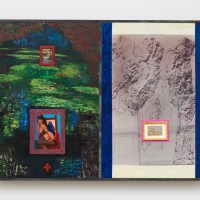
Contributed by Adam Simon / Paul Gardère (1944–2011), whose work is now on view in “Second Nature” at Magenta Plains, is known for a unique version of combine paintings, incorporating assemblage, found objects, photography, dirt and glitter into works that critique the legacy of colonialism in Haiti and its diaspora. The problem with this narrative is that it undersells how formally innovative his work was in its time, the degree to which it stems from his own biography, and how it anticipated our current multi-screen reality.

Public Art

Conversation: Adam Simon with Lisa Hein, Liza Phillips, and Bob Seng

Contributed by Adam Simon / One of the most evocative and lyrical artworks I’ve experienced recently was not located in a gallery or museum, but in the woods on the western edge of the Catskills, behind the Catskill Water Discovery Center in Arkville, New York. To be clear, mine was not the ideal encounter. I was aware of the project, “Headwaters,” and set out to find it.

Gallery shows

Bettina Blohm and Don Voisine: Affect as subject

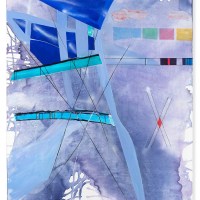
Contributed by Adam Simon / Two galleries with a focus on abstract painting, a short walk from each other in downtown Manhattan, currently have exhibitions that share a vocabulary of basic geometric forms, directional brushwork, and an emphasis on color relationships. Both shows present the rectangle as a primary condition of most painting and the dynamic interplay of forms within the rectangle as a drama unfolding. Yet these two shows couldn’t be more different. Seeing one after the other, as I did, was a study of how affect itself, manifested through color choices and paint application, becomes a subject for abstract painting, analogous to but different from a subject for representational painting.
Solo Shows

Curtis Mitchell’s powerfully oblivious dogs

Contributed by Adam Simon / I tend to rail against art openings. Few attendees of a crowded art opening ever get to really see the show; the glimpses they’re afforded are more like scrolling Instagram than anything approaching contemplation. I felt differently at the opening of Curtis Mitchell’s pop-up show “19 Black Dogs” at the untraditional talent agency called No Agency on Bowery. The work does lend itself to contemplation, but at the opening of this show, Mitchell’s sculptures – stuffed dogs he purchases on the internet and then abuses in various ways – were contextualized by a young, hip crowd, connected I assume to No Agency rather than to Mitchell. Some appeared to be fashion models. 

Studio Visit

In Bed-Stuy with Cathy Nan Quinlan 

Recently, Adam Simon visited his longtime friend Cathy Nan Quinlan at her Bed-Stuy studio to see the latest paintings, inspired by Nicolas Poussin’s Bacchanalian Revel Before a Term (1632–1633), which hangs in London’s National Gallery. During the visit, they talked about The Temporary Museum, the Talking Pictures blog, and the salons Cathy has hosted in her home.

Solo Shows

Barbara Friedman’s exquisite grotesquery

Contributed by Adam Simon / The modus operandi behind much of Barbara Friedman’s work, including her current exhibition “All Rude and Lumpy Matter” at Frosch & Co., has a name, pareidolia, which refers to finding images within abstraction. Think of the age-old pastime of finding faces in clouds.

Museum Exhibitions

Call it Orphism

Contributed by Adam Simon / At a Four Walls event in Brooklyn in the early 1990s, Erik Oppenheim, at that time a young artist, stood up and said, “I’m starting an art movement. Anyone who wants to join, meet me in the back after the show.” It was a hilarious and audacious gesture, in part because no one joins an art movement on a whim, like a list-serve or an exercise class, but also because there hadn’t been any artist-initiated movements for a very long time. They proliferated in the late nineteenth and early twentieth century with the advent of Impressionism, Surrealism, Futurism, and Dada, and enjoyed something of a resurgence in the 1960s with Fluxus in the United States, Supports/Surfaces and Zero in Europe, and the Gutai Group in Japan. Most of what we consider movements were proclaimed by an outside observer, usually a critic or curator, looking to group artists who had similar concerns and made work that fit the designation. For the artists themselves to rally around a specific cause, even an aesthetic one, was not required. 
Solo Shows

Lisa Hoke’s visual rodeo

Contributed by Jonathan Stevenson / Information overload has understandably been a popular theme for artists, and many have explored it poignantly….Lisa Hoke is one – a game and capable bull rider in a visual rodeo. In her solo show “Relative Uncertainty” at Kathryn Markel Fine Arts, she meets the challenge with consummate skill, persistent wit, and, not least, a kind of stoical grit that firmly rebuffs any attempt to cast her outwardly joyful approach as sheltered or clueless, utopian or oblivious.

Art Fairs Interviews

Jennifer Dalton and William Powhida: The ZERO interview

Contributed by Adam Simon / This year’s Upstate Art Weekend (July 19 – 21) included a most unusual venue. The Zero Art Fair exhibited the work of over seventy artists in a barn in Elizaville, New York, owned by Manon Slome. All the work was available to take home and none of it was for sale once the fair began. Surprisingly, or not, many of the artists that were included normally sell their work for prices that would have been out of the question for most browsers at UAW. Yet here those browsers were taking art home for free. The Zero Art Fair was scheduled to last for three days but by the end of the second day almost nothing was left. The following is a Two Coats of Paint interview with Jennifer Dalton and William Powhida, the two people primarily responsible for the Zero Art Fair.

Solo Shows

Adam Simon: Jostle, flux, and instability

Contributed by Jonathan Stevenson / Brooklyn-based conceptual painter Adam Simon is known for his cagey synthesis of the graphic symbols and tropes of commerce and civic life into elegant visual statements about the zeitgeist and, more grandly, the world as a whole. He can use text to penetrating effect, as in the small paintings he made a few years ago superimposing the edict “STEAL THIS ART” on the vintage silhouette of a policeman. In one not-quite-Hoffman-esque line and an evocative image, he captured the ambivalence and limbo of the art world between the establishment and the counterculture, having himself cultivated a live community in that space by organizing, with several other artists, the collaborative “Four Walls” events in Hoboken in the 1980s and Williamsburg in the 1990s. In “Great Figures,” his solo show now up at Osmos, he has continued in a searchingly ironic vein, now with a bemused fretfulness that affords it epochal resonance.

Interviews

Larry Greenberg’s circular path

Contributed by Adam Simon / With a solo show at Rosebud Contemporary, work on view at Slag, and an upcoming two-person show at 490 Atlantic, Larry Greenberg is having a moment. After stepping away from the art world to raise a family, now, at the age of 73, he’s back. We talked about why, after a decades-long hiatus, he returned.

Solo Shows

Mary Carlson: Timelessly medieval

Contributed by Adam Simon / I happened to visit Mary Carlson’s exhibition “Garden” at Kerry Schuss Gallery the day I finished reading Titus Groan, the first of Mervyn Peake’s Gormenghast novels, written in the 1950s. I’m not usually drawn to fantasy fiction – this book was a gift – but Peake’s dreamlike rendering of a forbidding castle with clinging ivy and bizarre inhabitants had me in thrall, primed to receive Carlson’s medieval world and its symbiotic relationships between plants and people. One of the characters in Titus Groan uses the ivy to scale the castle walls, while two others take tea on a tree that grows horizontally out one of the windows. While not exactly ivy, vines fashioned from copper piping figure prominently in “Garden,”often dwarfing the mostly female glazed porcelain saints that sit on modest carved wooden shelves. The untamed power of the natural world, and humanity’s marginal presence in it, is an underlying theme in “Garden” and very like the world described by Peake.