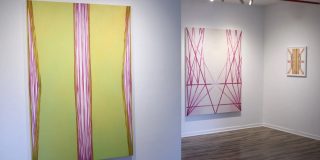
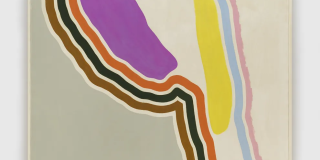
This wide-ranging conversation took place on April 27, 2026, between Kerry Downey and Julián Kreimer at Sarah Lawrence College Heimbolt Center for Visual Art during Kreimer’s exhibition, “Yuyo.” The exhibition was on view April 2-May 8, 2026.
 Award-winning NYC blogazine with a focus on painting
Thursday, October 15, 2026
Award-winning NYC blogazine with a focus on painting
Thursday, October 15, 2026
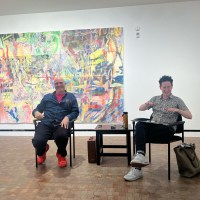
This wide-ranging conversation took place on April 27, 2026, between Kerry Downey and Julián Kreimer at Sarah Lawrence College Heimbolt Center for Visual Art during Kreimer’s exhibition, “Yuyo.” The exhibition was on view April 2-May 8, 2026.
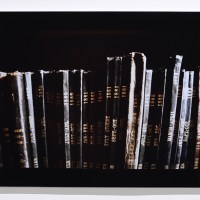
Contributed by Adam Simon / If I had walked into Kerry Schuss Gallery knowing nothing about the two artists on display, I would have thought the pairing unusual, elegant, and extremely interesting. One group of works consists of Michael Maul’s 11 x 8.5-inch ballpoint pen and colored pencil drawings on ledger paper depicting row after row of almost identical figures, rendered in a diagrammatic shorthand. Interspersed among these, are four 20 x 24-inch photographs of books taken by Tim Maul. The photographs are one of a kind Cibachromes, produced by printing directly from 35-millimeter slides; the method was discontinued in 2013. Cibachromes are long-lasting photographs of exceptionally vivid colors. All four of the photographs were shot in the 1990s but not printed until 2000. Two depict books open to what appear to be the blank pages preceding the title page. A third book is similarly splayed but face-down. The fourth photograph is of a shelf of books that appear to be journals or compiled records with dates on the spines ranging from 1859 to 1863, shot on commission at a library in Ireland.

Contributed by Will Kaplan / In her solo show “Solarium” at Picture Theory, Lauren Clay compresses different scales of time into tight, enchanting wall sculptures. In modernizing the timeless form of the archway, her work reflects the structure’s progression from functional to aesthetic. The series of torso-sized works foster an intimate viewing experience, comparable to an altarpiece. Traditionally, altarpieces hover behind the altar itself. The faithful kneel beneath them for their sacraments, like the Eucharistic transformation…

Contributed by Saul Ostrow / When Ted Stamm’s career was cut short by his death at age 39 in 1984, he had already begun to attract attention in the United States and internationally. Critics including Edit deAk, Peter Frank, Robert Morgan, and Kay Larson recognized Stamm’s ability to bridge formal rigor with playful urban references. In 1975, deAk wrote in Artforum that “Stamm’s work confounds its own apparent simplicity; the shape’s tense complexity and stubborn definition of itself make it totally the artist’s like an insignia. The color is equally personal, and the painting’s presence is quietly assertive. This is certainly not the elegant nihilism of reductive solutions.” Conceptual endeavors were central to his ambition of making the border between art and everyday life porous.