Tag: Agnes Martin

Artist's Notebook

Zombie Formalism vs. Paul Brown’s abundant abstraction

Contributed by Becky Brown / Living through a changing zeitgeist is a trip. Now into my forties, I see that conditions, styles and ideas that loomed as colossal in one moment can fade into obscurity in the next. My parents are octogenarians in the art world, and they’ve told me artistic and theoretical trends are always cycling; now I’m seeing it happen. When the essays on “Provisional Painting,” “New Casualism,” and “Zombie Formalism” emerged, I was in the throes and early aftermath of a graduate degree in painting from Hunter College. Like many, I thought they articulated something I was seeing and feeling but hadn’t yet named. I did not imagine that within a few years, abstraction would be on the margins of contemporary painting, with figuration taking center stage. Was this backlash related to those critiques or just part of a natural cycle?

Museum Exhibitions

The Nihonga avant-garde’s cultural outreach

Contributed by Kenneth Greiner / On a recent trip to Japan, I visited Kyoto City KYOCERA Museum of Art. Behind the museum’s massive burnt orange Torii gate, in the Higashiyama Cube, is its special exhibition, “Nihonga Avant-Garde: Kyoto 1948–1970” which, in the cube’s labyrinthine interior, encompasses three of Kyoto’s significant 20th-century avant-garde art movements (Pan Real, Cella Art Association, and the Sozo Bijutsu), propelled by a disaffection with traditional Nihonga painting. 

Group Shows

Michael and Tim Maul: Art as antidote and refuge

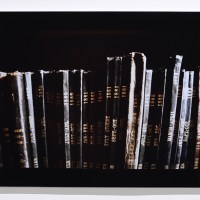
Contributed by Adam Simon / If I had walked into Kerry Schuss Gallery knowing nothing about the two artists on display, I would have thought the pairing unusual, elegant, and extremely interesting. One group of works consists of Michael Maul’s 11 x 8.5-inch ballpoint pen and colored pencil drawings on ledger paper depicting row after row of almost identical figures, rendered in a diagrammatic shorthand. Interspersed among these, are four 20 x 24-inch photographs of books taken by Tim Maul. The photographs are one of a kind Cibachromes, produced by printing directly from 35-millimeter slides; the method was discontinued in 2013. Cibachromes are long-lasting photographs of exceptionally vivid colors. All four of the photographs were shot in the 1990s but not printed until 2000. Two depict books open to what appear to be the blank pages preceding the title page. A third book is similarly splayed but face-down. The fourth photograph is of a shelf of books that appear to be journals or compiled records with dates on the spines ranging from 1859 to 1863, shot on commission at a library in Ireland. 

Solo Shows

Betsy Kaufman: The more you see

Contributed by Jacob Cartwright / At first blush, Betsy Kaufman’s self-titled show at Bookstein Projects, a concise survey of work made from 2008 to 2025, seems simply to present a handsomely cerebral group of paintings and drawings. In time, it becomes clear that the work smuggles in something more. Kaufman’s output is a kind of two-sided coin that can oscillate between her embrace of bold, saturated color and strategies of stark reduction.

Solo Shows

Jacqueline Gourevitch: Skying abstraction

Contributed by Jason Andrew / Jacqueline Gourevitch’s resilience stems from restraint and slow observation. From her first solo exhibition in 1958 to the current striking survey of 21 cloud paintings dating from 1965–2018 at Storage Gallery in Tribeca, the nonagenarian has shown that sustained attention to a single subject can yield infinite and dynamic variations.

Conversation Gallery shows

Drew Shiflett and Carter Hodgkin on the creative process

Contributed by Riad Miah / In conjunction with their two-person exhibition, The Shape of Things, at the John Molloy Gallery, I had the opportunity to engage in a conversation with artists Drew Shiflett and Carter Hodgkin about their materials and unusual creative processes. At first, their pairing seemed unexpected, as their visual languages appeared quite distinct. However, after seeing the exhibition firsthand, I came to appreciate the deep connections and underlying commonalities in their work.

Ideas & Influences

Artist’s notebook: Nate Ethier

On the occasion of “Heavy Light,” Nate Ethier’s second solo show at David Richard Gallery, Two Coats of Paint invited him to share ten ideas and influences that inform his complex, pulsating abstractions. He is keenly interested in kinetic motion, precision, and repetition, and credits Agnes Martin for the sense of happiness and innocence that suffuses his paintings. Most importantly, he reveals a penchant for close looking: “You can learn a great deal about light and color from a slow walk in the woods.” The show includes twelve stunning paintings and is on view through June 27.