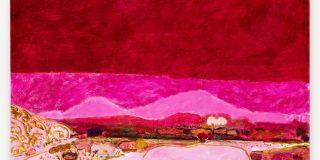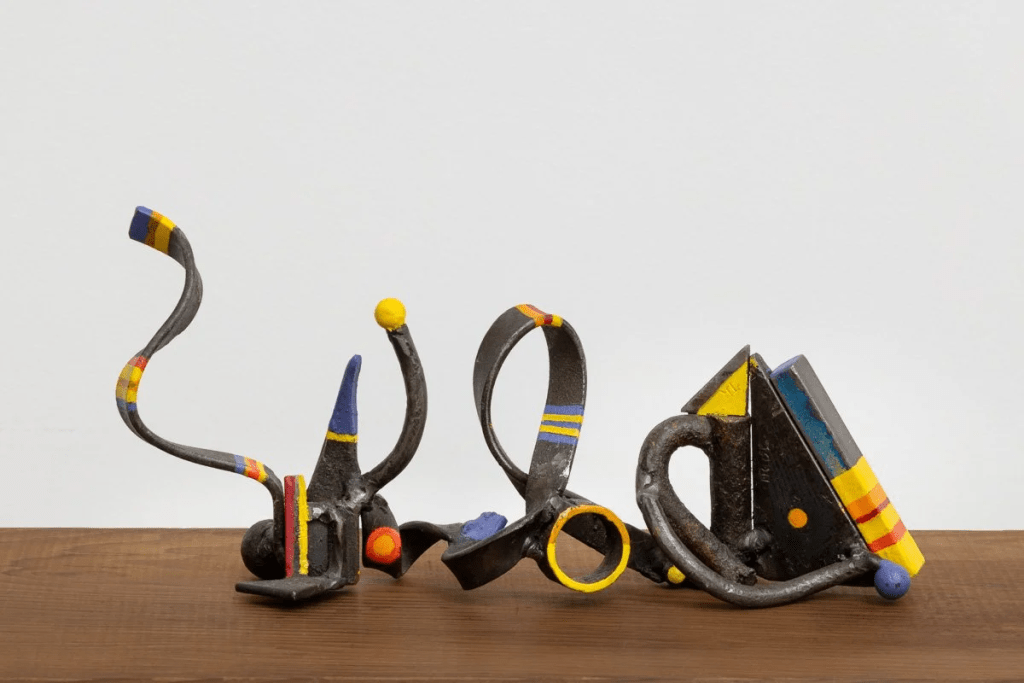
Contributed by Lore Heller / Paint on sculpture can disrupt our spatial savvy, challenging habits of looking we bring to the interpretation of form. Lee Tribe plays with them in a variety of ways in his current show “Catching the Sun” at Victoria Munroe Fine Art. As a sculptor, he’s played the long game. Trained at a young age as a welder in the shipyards of his native England, Tribe later studied at St. Martin’s College of Art with Anthony Caro and William Tucker, a long-time friend and mentor. After moving to the United States, he immersed himself in painting, noting how marks move the viewer through the composition of an image. He also studied African art and the work of David Smith, Picasso and Julio Gonzales. Tribe honed his craft within a formalist tradition and has stretched that lineage in surprising directions. His work gains rigor through a set of tensions – density and airiness, weight and weightlessness, formal structure and narrative suggestion, the frontal spatiality of painting versus sculpture’s full engagement in the round.
FIVE MORE DAYS! Please click here to contribute to the Two Coats of Paint year-end fund drive
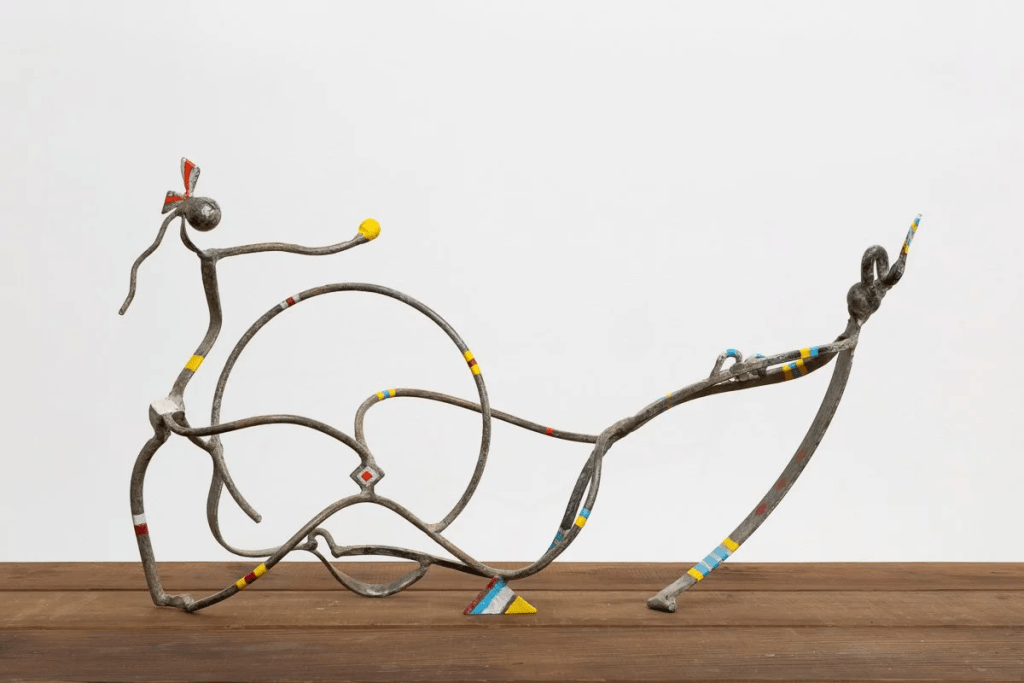
On entering the gallery, my eye was immediately drawn to Sign Above the Line. This remarkable small sculpture has a muscular presence. The steel proceeds with the fluidity of calligraphy, part signature, part graffiti. Paint articulates the form in multiple ways. It defines planes, as in the top yellow section of the cylinder; it distinguishes elements – the yellow sphere – from the whole; and it challenges our grasp of form with stripes and circles. Color directs us through the piece, like yellow lines on a highway. It reaches us at different perceptual speeds. In painting, color can be used as an illusionistic device, but sculpture already exists in non-illusionary space. With color, Tribe implies distance; with form, he creates it. While literal space governs near and far, Tribe accents these parameters with colors that feel closer or more distant. The tension between the two ways of understanding space produces a kind of joyous friction: a flat yellow dot hides along the bottom while a yellow sphere presides triumphantly from the top.
The bulk of the show consists of lyric sculptures that form a loose narrative arc from Tribe’s childhood memories of family holidays on the Thames estuary and Essex coastline. He renders the pleasure of being a body in space with a fluidity of line paradoxically created in the most rigid of materials – steel. His pieces depict scenes while using depth to merge abstract and narrative forms. Like David Smith’s Hudson River Landscape, a dynamic narrative of line and volume based on his train ride along the Hudson River, Tribe’s sculptures synthesize memory into shapes that feel both personal and universal. And, like Thomas Nozkowski’s abstract paintings, they present a finely tuned personal iconography, mysterious yet accessible.
In his statement, Tribe describes the memories that engendered his penchant for color: “a hand painted world of bright, garish, exciting and at times beautifully harmonious colors that tickled, tweaked and teased one’s senses.” The stripe motif recalls the thrill a child might feel at the sight of brightly patterned deck chairs while also nodding to non-representational painting: “Mums rented brightly striped deck chairs while keeping a watchful eye on the children splashing and plunging, playing in waves.”
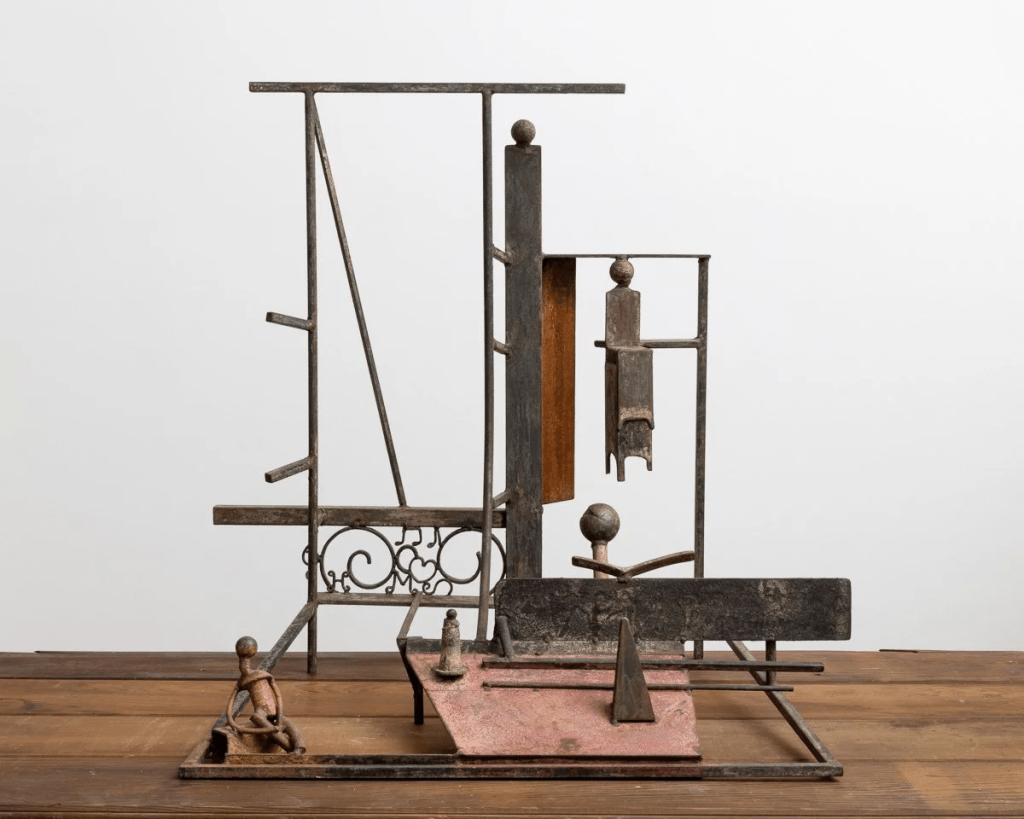
Tribe has audaciously transcribed a painting – Matisse’s The Piano Lesson – into steel. Like the previous works, this piece probes the boundaries between categories. As a child, I spent many hours losing myself in this painting, savoring its illusion and imagining the space as if it were my own invention. There is a particular pleasure in entering such an illusion, a kind of complicity with the artist. To encounter the elements of Matisse’s painting in actual space was thrilling, like hearing a cherished song covered by an intriguing new voice.
An important lesson I drew from studying painting was to create space that is ambiguous, not ambivalent. It is especially compelling to see where Tribe’s spatial decisions align with the painting and where they diverge. Many correspondences are clear: the piano, the child, the window, and the surface objects. But Tribe also invents a new spatial logic. The small figure on the left – diminutive in the painting – feels even smaller here. In real space, proximity would enlarge her, but Tribe reverses this expectation. He suspends the mother-like figure behind the child’s enlarged head from an invented scaffolding. The green rhomboid – perhaps in the painting a patch of grass – has become a triangle extending the sculpture. Matisse is confined by the canvas’s edges; Tribe is not. So why shouldn’t he let it expand? Still, he is building a three-dimensional version of an iconic painting, and the power of his piece depends in part on the viewer’s memory of The Piano Lesson and on the ambiguous – but never ambivalent – gap that emerges between the two.
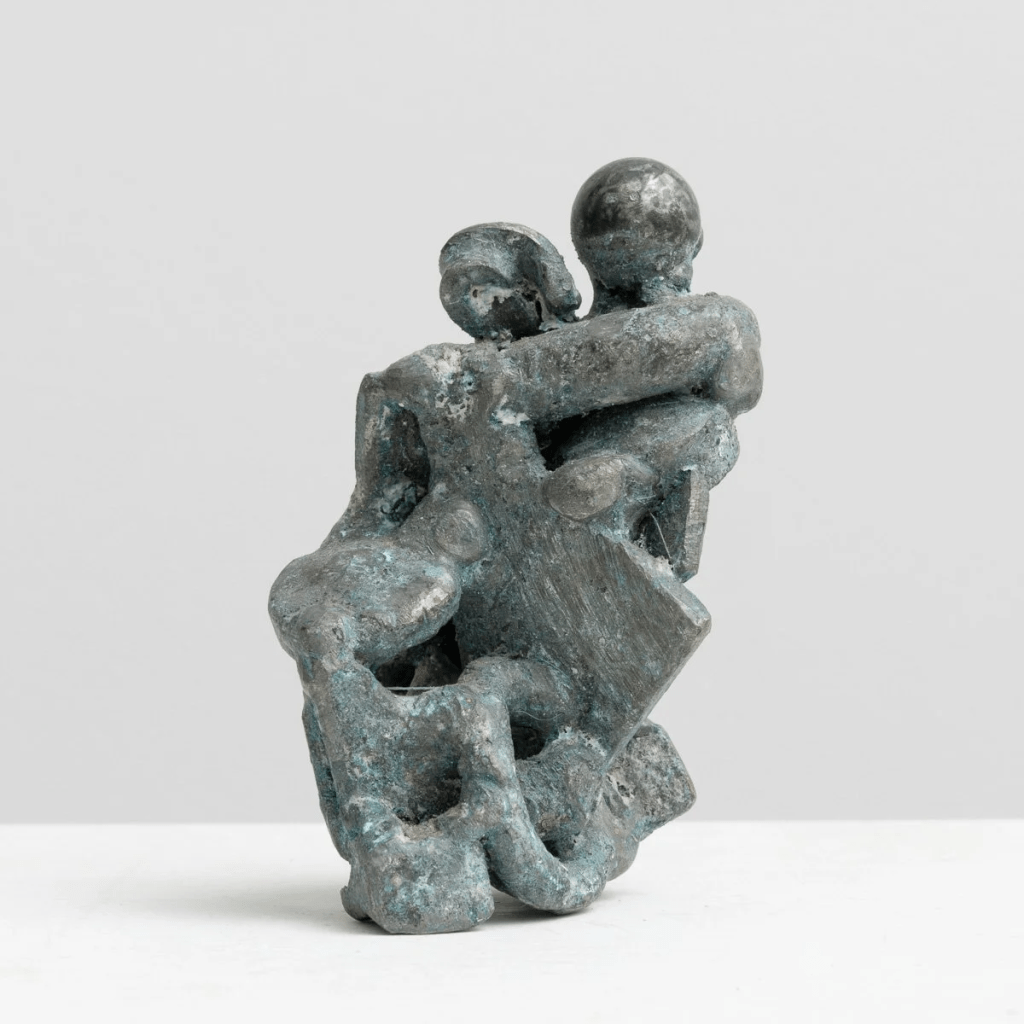
The four dense palm-sized monumental works operate in a more traditional sculptural mode. Rumba-ba feels larger than life and impossibly compact. Despite its condensed form, it seems to compress and propel space upward. I felt a diagonal sweep heavenward and was reminded of the way Tiepolo organizes and intensifies space in his ascending compositions. These works speak intimately, establishing a personal relationship with the viewer. They share sensations drawn from Tribe’s memory and quietly, yet exuberantly, create something genuinely new. The “painted sculptures” operate simultaneously as paintings and sculptures, shifting the terms by which each medium is understood. Crossing and recrossing the boundary between non-representational and representational, abstract and narrative, the works quietly undo the hierarchy that typically separates them.
“Lee Tribe: Catching the Sun,” Victoria Munroe Fine Art, 67 East 80th Street, #2, New York, NY. Extended to January 6–9, 2026.
About the author: Lore Heller (aka Laurie Heller Marcus) is an artist and poet working in Long Island City. She has had online solo exhibitions with Jason McCoy Gallery and Planthouse Gallery.
Please click here to contribute to the Two Coats of Paint year-end fund drive