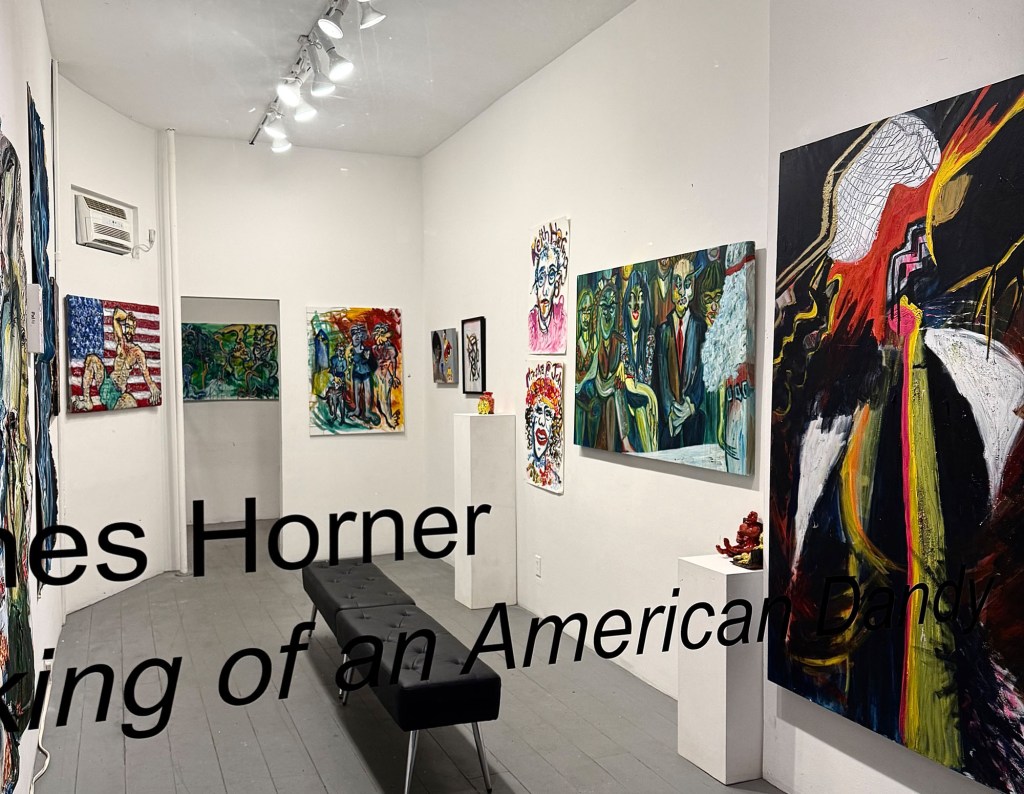
Contributed by Nathan Storey / James Horner: Making of an American Dandy at Amos Eno Gallery looks back across forty years of the artist’s life and practice without tidying the record. The works in the retrospective are bruised and glamorous, horny and grieving, and above all, alive.
Horner is a New York-based artist whose practice widens the space for LGBTQ+ life to be seen on its own terms. His art is built from lived environments — nightlife, friendship, lovers — and from an ongoing attention to how private and public spaces shape us, a sensibility he traces back to his upbringing with a psychiatrist father. The psychological charge of a bedroom, a corner of the city, a party: these become stages where identity is revealed.
Across disciplines, Horner returns to a question that feels newly urgent: what does it mean to come of age, and come into identity, as a queer American across decades of cultural rupture? Horner’s work refuses a clean arc, and instead moves through eras of oppression and liberation, sexual freedom and devastating loss, and the complicated afterlives of queer icons.
The exhibition’s title frames Horner’s key persona: the “American Dandy.” The Dandy treats gesture and self-presentation as a way to write oneself into the world. The figure is political: a self-fashioning against inherited identity and an assertion of individuality. After Oscar Wilde, the Dandy became inseparable from queerness in the popular imagination, with style, artifice, and pleasure recast as deviance. In the United States, where masculinity and productivity are treated as civic virtues, the Dandy’s refusal becomes especially charged. He recodes masculinity through glamour, exaggeration, and camp.
The Dandy is not a costume. Before Stonewall, he offered a legible way for queer people to find one another. The Dandy never disappeared; he simply learned new tactics. Today, the American Dandy is armor in an era of anti-LGBTQ+ legislation, transphobic panic, and queer history erasure. The American Dandy insists: I will be seen, and I will define how.

Horner’s figures groove through the decades — abstracted, sometimes grotesque, often humorous —staged in intimate scenes that feel theatrical. His pop-influenced abstraction relies on strong lines and sharp silhouettes, drifting into the dreamlike, as in Chill Guy, while insisting the ordinary is never just ordinary. He asks us to cherish what we overlook: a scene of two sleepers or the strange beauty of a late night.
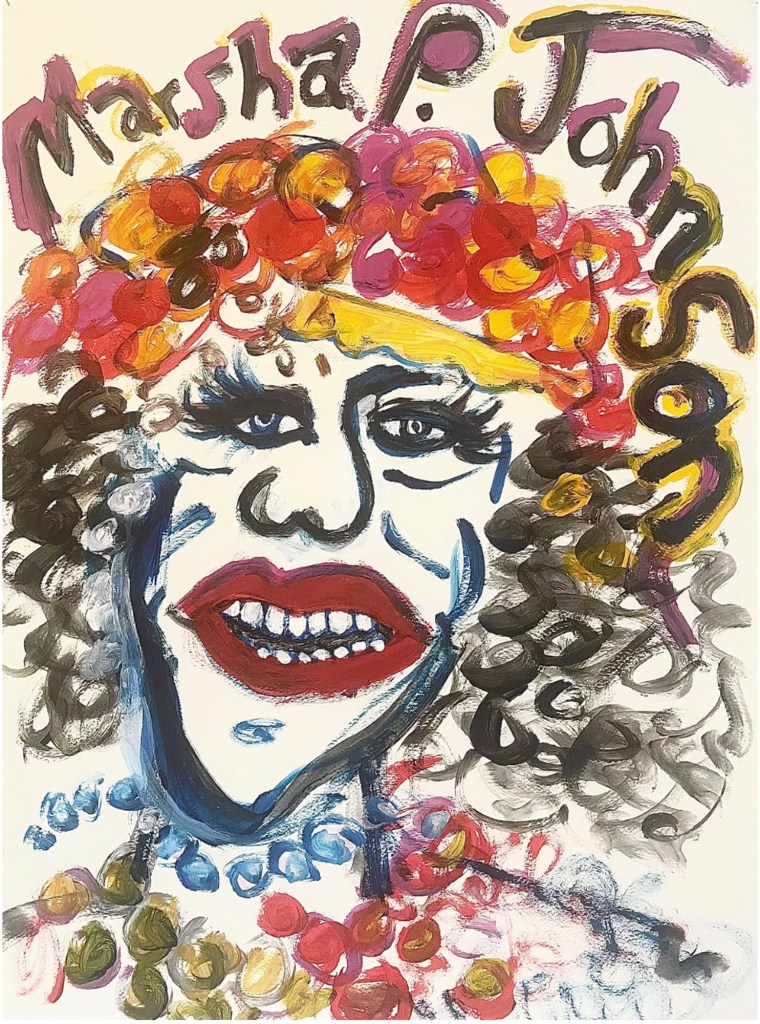
30 × 22 inches (76.2 × 55.9 cm)
Horner’s queer world moves between lovers and the mythic figures in his Queer Icons series, including Keith Haring, Marsha P. Johnson, and Cookie Mueller. Horner’s icons act as a living archive: people whose art and activism crystallized 1980s New York, where culture and catastrophe unfolded side by side. The work is preservation as practice: keeping the temperature of that time legible, so contemporary queer audiences can feel lineage, recognize what was at stake, and carry its lessons forward.
As a survivor of the AIDS crisis, Horner witnessed the devastation of a generation, and his work memorializes vanished spaces and loved ones as a refusal of erasure. That insistence deepens in works made after the 2021 suicide of his partner, Chris Hamilton, where portraits of love and aftermath render grief as a queer condition, private, communal, and political at once. Horner suggests visibility alone does not protect us; it must be met with care, community, and a culture that insists queer life is worth living.
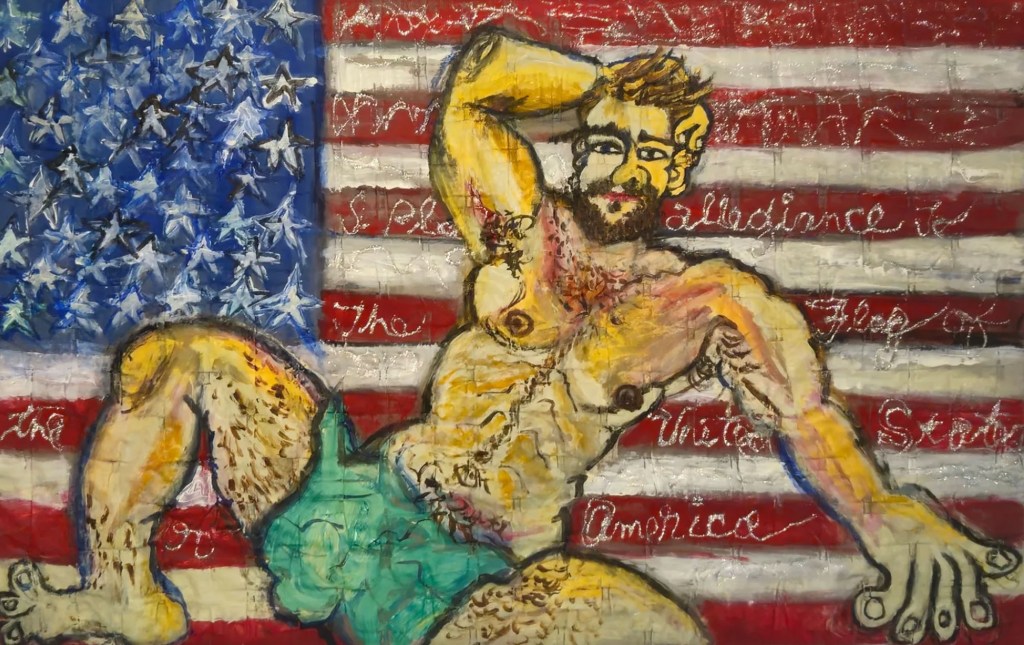
The exhibition’s political edge sharpens in I Pledge Allegiance, where Horner turns to a ritual ingrained in many of us from childhood: standing in school, hand over heart, reciting loyalty to the flag before we’re old enough to understand what that loyalty asks for or withholds. Horner revisits the pledge, asking what “liberty and justice for all” means when “all” is still unevenly granted to people of color and queer communities. His intervention is erotic: a shirtless beefcake sprawls over the flag, desire pressed onto the national icon. The gesture reads as camp and critique, an insistence that queer bodies belong inside the frame of America.

At the heart of the retrospective is Horner’s Wall of Decades, an archival installation that makes his method explicit: life and work are inseparable, and the archive functions as evidence and invitation. Ephemera allows viewers to trace Horner’s evolution through scattered but consequential moments: a life built in and for art and queer culture. An etching from 1986, Last Night at Club Area, hangs in proximity to a 2024 print, Monster Mash-Guernica, making both continuity and change legible across forty years. Elsewhere, a New Year’s Day party invitation (1993) Horner designed sits alongside Ladies of the Night (1996), a small C-print of Horner and friends in drag. These artifacts are a record of how queer life accrues through the everyday labor of staying visible. The Dandy becomes a way of surviving, remembering, and choosing how to be seen.
“James Horner: Making of an American Dandy,” Amos Eno Gallery, 191 Henry Street, New York, NY. January 8 – February 8, 2026. Reception on January 3, 6-8 pm. All artwork is available on Artsy.
About the author: Nathan Storey is an interdisciplinary artist, curator, art historian, facilitator, and educator based between Brooklyn, New York and Boulder, Colorado.