
Contributed by Natasha Sweeten / A few winters ago, in a small town upstate, I met my neighbor, the artist Susanna Tanger. She’d invited me for tea, and as we got to know each other I felt grateful to have a kindred spirit nearby. Her paintings seemed to grow from concentrated, layered planes of light, the soft colors humming and communing with river vistas framed by her studio windows. Our neighborship was brief. Susanna returned full-time to her Soho loft, where she’s lived and worked since 1975. But her short biography seemed compelling: she’d arrived in NYC in her early twenties to a burgeoning art community, maintained a studio practice, and raised two children as a single parent. I had the urge to learn more about her.
Although Susanna often uses a specific moment of her life as the starting point for a painting, she focuses on how experience, emotion, and thought meet. She takes cues from direct observation in nature and considers New England, where she spent her childhood, her pictorial origin. Before landing in New York with her then-partner, also a painter, she lived in Europe, and later widely exhibited there. She began showing in the early 1970s. Her work was included in the 1975 Whitney Biennial, the inaugural show “Rooms” at PS1 in 1976, and, most recently, in “Beauty is a Blast” at Art Cake in Brooklyn.
In late October I stopped by Susanna’s loft to see her recent work and ask a few questions. Here is a brief, edited extract from that interview.
______________________________________________________________________________

Natasha Sweeten: You came to live in New York City in a vibrant time, the 1960s. I’m totally jealous! I would loved to have been a young artist in the ‘60s and ‘70s, in downtown New York. I think of Matta-Clark, Eva Hesse, Ree Morton, Rauschenberg…
Susanna Tanger: I was very interested in recently composed music, in experimental film and theater. I met Ree Morton in the 1970s. She brought me to see a play produced by Mabou Mines and for a while I joined in, with Ree and actors of that experimental group in what was called a laboratory effort to form a curriculum for teaching in colleges. Their plays were very innovative. In the 1960s, I was still grappling with the ideas of Post-Impressionism, especially with the late work of Cézanne. Regarding the innovative ideas of visual artists whose paintings were being shown in New York, I was very cautious, often dubious. I remember going to see Barnett Newman’s paintings. I had read or been told that he wanted to pull the viewers into the painting. He was an extremely influential artist. I felt drawn into his large canvases, but I thought, it’s more like an embrace than a revelatory experience.
NS: Did it seem like a new kind of painting?
ST: It didn’t seem so new or nearly as powerful as what I felt with things that I saw in nature or heard in music. Yet it seemed to be a new way of approaching spiritual, experiential meaning. As the historical context changes, certain aspects of thinking about art change. When printing was invented it had an enormous effect on politics, on the Reformation in Germany during Luther’s time. When photography and film were invented, pictorial artmaking changed. When America became a dominant power after World War II, when New York City became the most vibrant art scene rather than Paris or Berlin, there was a major incentive for artists and the art market to take the lead. The wars in Korea, in Vietnam, the recent incursions in the Middle East, the increasing prevalence of a war economy in America has had an enormous effect on how art is made, and on how it has been distributed.
NS: Were you showing your work then?
ST: Very little at that point. Friends were coming and seeing my work and they shared ideas. More experienced artists gave me encouragement and that was enough. I didn’t feel ready to show until the mid-1970s. I had two small children and, for a woman, that takes time and energy. It also gives an artist great knowledge about herself and about what is real in her life. I was painting and thinking and quietly maturing as both a person and as an artist. Most young artists were not so involved in showing at that time. It was a less commercial, less status-seeking atmosphere then. There was less pressure to attend the right art school, or to build a network of opportunity.
NS: I looked at some of the older paintings online. You used to do more hard-edge paintings, right?
ST: I have never known what the term “hard-edge” means. I guess it meant geometric painting. I was very interested in the history of sacred geometry and its relationship to nature. I was always working on imagery that related to landscape, but it is the way spiritual presence is experienced within the material world of nature that really interests me. It is often in changing light that we experience a kind of sudden awakening. I did not want to limit myself to a prescribed style of painting. It is interesting to read what Harold Rosenberg writes in his critical essays published in “The De-definition of Art.” He was troubled by the way artists were overly influenced by the work shown in galleries, by what some aesthetic critics were writing about instead of going through the long, difficult work of making their own way, in their own artistic evolution into their own unique understanding of how to represent what was in their hearts and minds.
NS: Can you talk about this latest body of work that’s here in the studio?
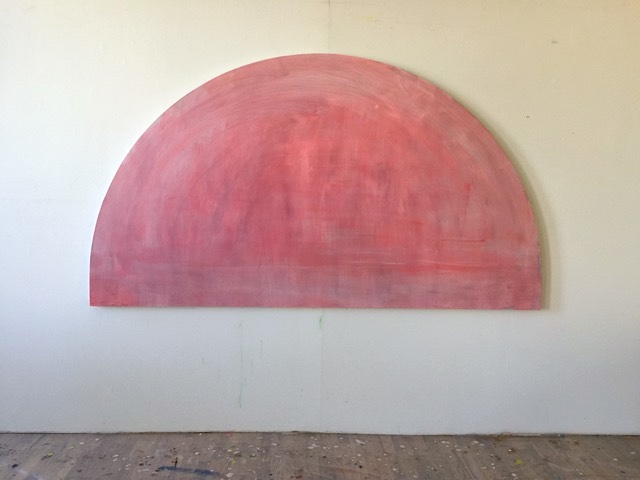
ST: I’ll show you an arc-shaped, seemingly abstract image, Arc/Cherry Blossom. The arc is like a treetop in blossom. I simply used the form itself to define the shape of a cherry tree in bloom. Another very recent painting was made when I returned from a week at a beach in Mexico. I stayed in a room with a porch about 200 feet from the ocean. There was a full moon and the ocean was rough. I liked listening to it. When again in my studio I made a painting called Listening to the Ocean. The ground is made with Mars Black over Oxide Red to give the sense of the dark ocean at night. I superimposed a rectangular outline of the bed that I slept in. This became more like a stage – the painting is both abstract and figurative.
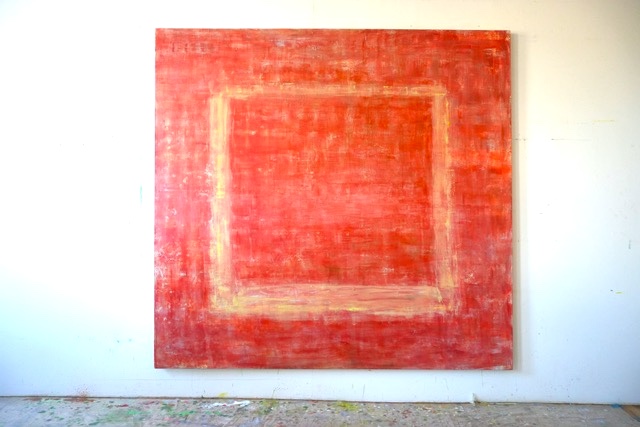
NS: Can you share your process of painting Stage in a Red Field? You told me you struggled with this for months.
ST: I began working on a slightly vertical rectangle that was 84 by 80 inches. I wanted to represent time and the transformation of life when we pass away. My brother was in hospice at that time – he was dying. In making the painting, I was both with him in spirit and mourning the loss I was facing. He was only a year older than I was and when small we were, at times, like twins. I made a form in the center that referred to his physical existence. I changed its color many times. I painted a pale gray-white border all around it to signify a quiet and peaceful place. After much work, I was satisfied with the painting. My brother had passed away. He had not wanted visitors as he was dying. After looking at the painting for many days, I suddenly grew impatient with it. I should have waited. But I got to work making a new painting over the painting about mourning my brother. I turned the canvas around so that it was now a horizontal rectangle. I began by covering the first painting with glazes of green oil mixed with yellow. When this glaze was dry, I used Fauchon Red mixed with Carmine Red painted in a fairly thick coat over the field of green and yellow. I removed some of the not-yet-dry red paint while searching for a rectangular form in outline, which to some extent echoed the shape of the stretched canvas. But I wasn’t satisfied with the forms I was finding until I made it into a stage-like presence. It became more three-dimensional, but with only enough depth to suggest a figure-like form. I felt that I myself was then there in the painting.

NS: Supposedly Bob Dylan once confessed he didn’t recognize the person who wrote his early songs, that he didn’t know who that was and he couldn’t do it again. I’m curious – how do you see that young artist who stepped into a new world in the ‘60s? Is there any advice you would give her today?
ST: I would tell my young self to trust herself. A part of me was swayed by all the New York City art fanfare. I met interesting people when we came in 1963, but I’d also met wonderful people in Europe and elsewhere. I would have been happy to stay in Italy. But New York City felt like my real home. When I was about eight years old, I read Dr. Seuss’s book And to Think That I Saw It on Mulberry Street. I decided that I would go to live on that street in New York City when I was grown up. My loft is just a few blocks from Mulberry Street and I have been here since 1975. So I ask myself what, as a child, I found so appealing in the Dr. Seuss story? It was an openness that allowed anything that was positive to happen.
About the author: Natasha Sweeten is an artist who most of the time lives and works in upstate New York.









Direct, personal and special interview. It’s so moving and inspiring to learn from our strong, lifelong artist peers. Thx, Natasha!
Wonderful, I’d really love more!
No mention of Lucio Pozzi who was married to Susanna and father of her 2 children. Perhaps not relevant.