
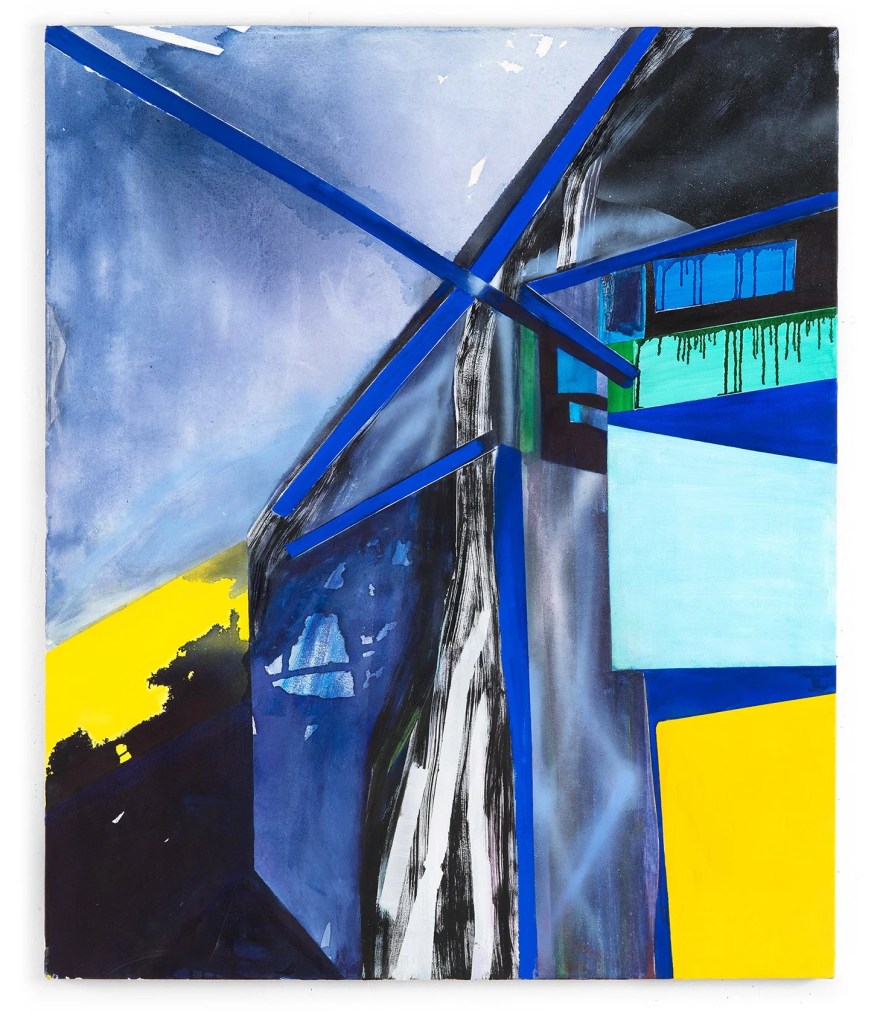
Contributed by Adam Simon / A photographer friend once asked me why painters are always talking about the space in a painting. He wanted to know what this term “space” meant. I talked about the different ways paint on a flat surface could be made to suggest depth, and how the challenge for modern painters was to create depth while also reaffirming the flatness of the support. I probably referred to the elusive concept of the “picture plane” and how simultaneously maintaining mutually exclusive ideas – flatness and depth – could produce a poetic or even a mystical dimension in visual art. Most abstract paintings present shallow space, keeping depth to a minimum. This type of painting is usually non-hierarchical; nothing feels more essential than anything else. The viewer’s eye tends to scan. If you want to both represent depth and reaffirm flatness, shallow space is going to be easier to handle than deep space.
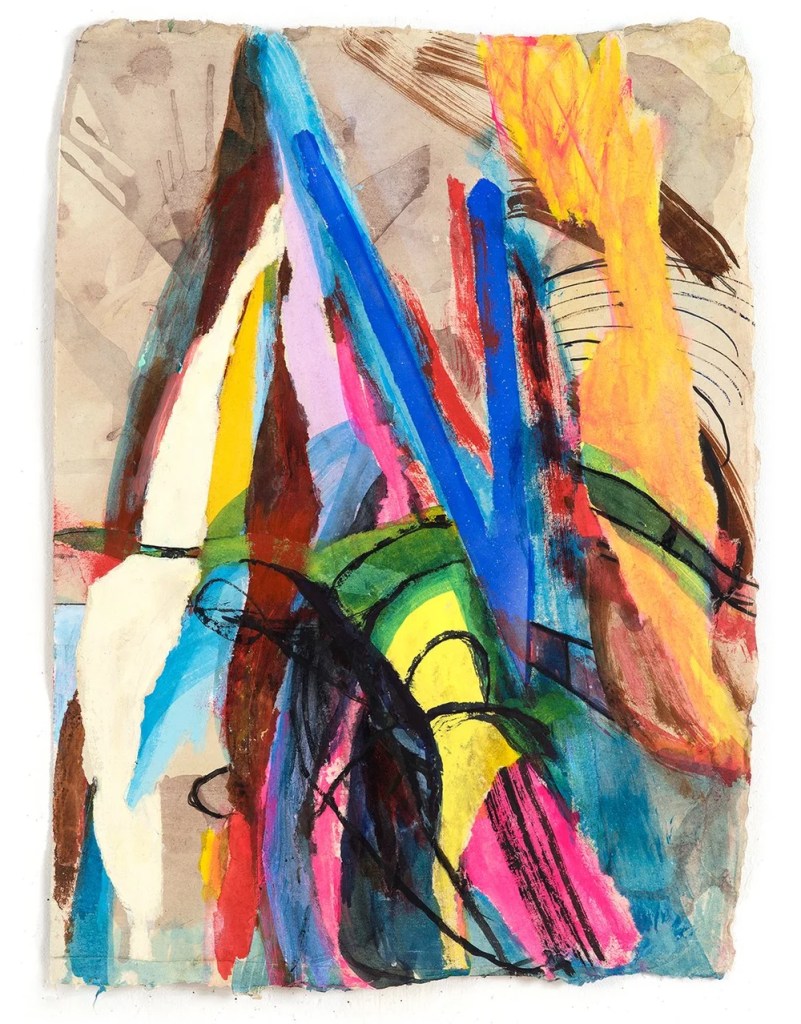
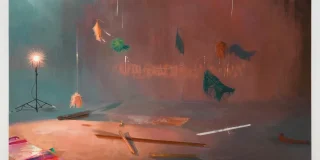
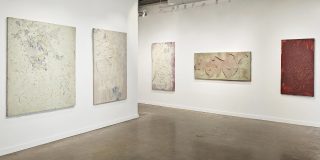
Laura Newman’s current exhibition “Out There” at Satchel Projects includes several works of this kind. Most are modest in size, done on Wasli paper. Multicolored jagged forms, including torn paper shards, interact with washes of color and drawn lines against more muted grounds. There’s a manic energy to these works but also a high degree of control and an extensive repertoire of incidental mark making. Newman uses novel combinations of materials – acrylic and oil paint, flashe, spray paint, and ink – in a way that suggests delight in all the possibilities painting can encompass. These works are exciting examples of controlled improvisation. But I also see them as consistent with what I have come to expect from abstract painting generally.
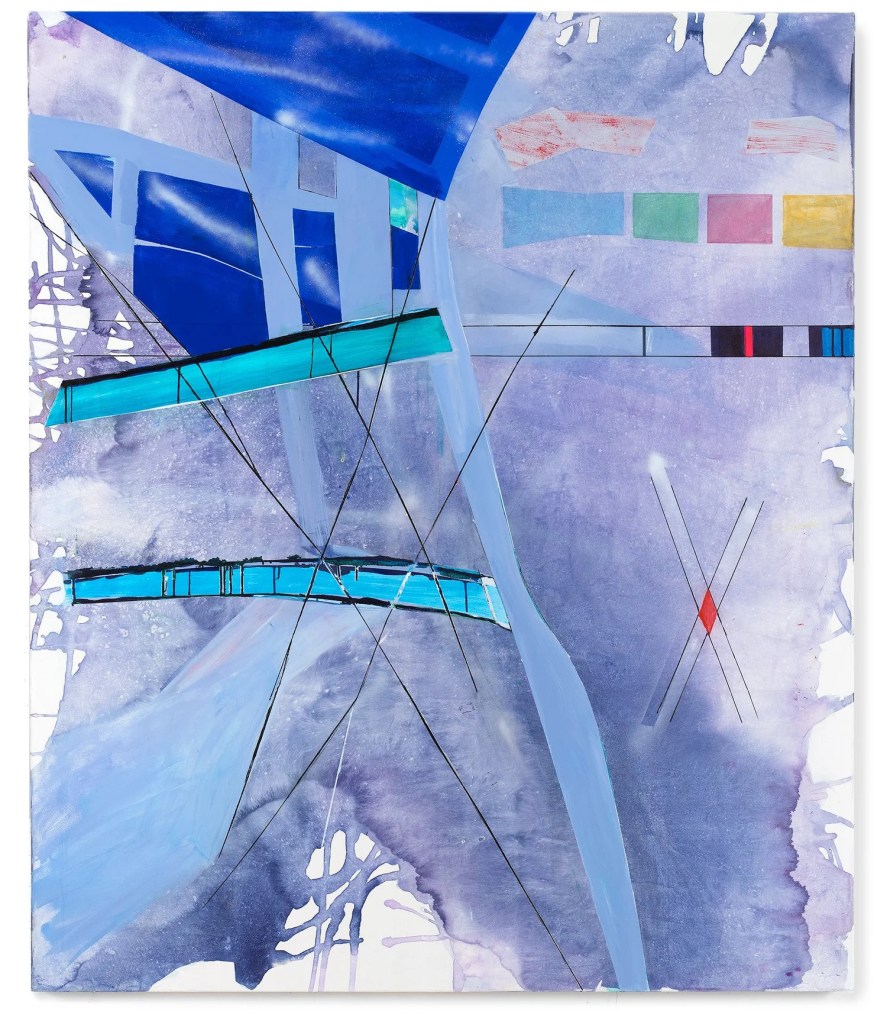
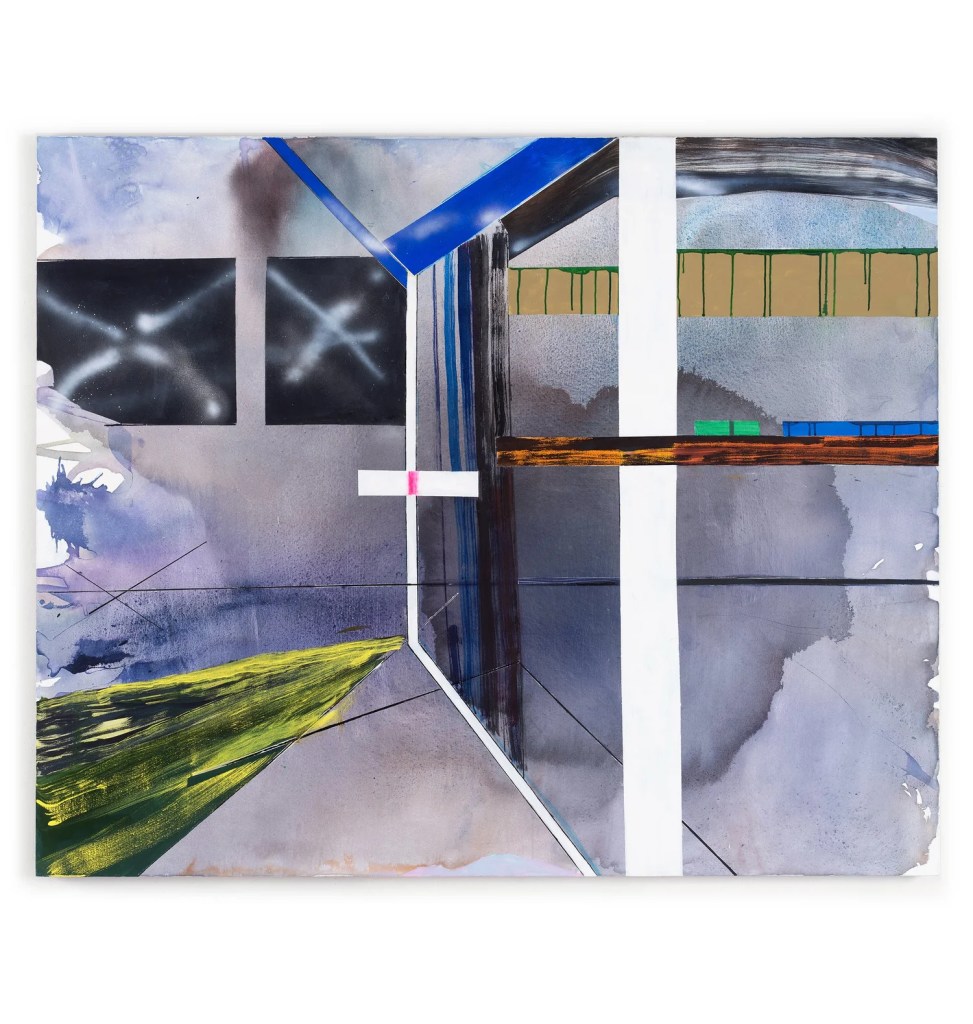
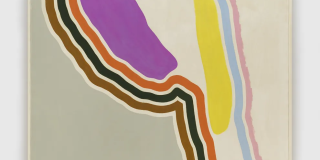
The exhibition also includes two larger paintings, Slate and Japanese House, which offer something different. They conjure a different sense of space. This space recalls the early days of abstract painting – as seen in last year’s Orphism exhibition at the Guggenheim – and departs from what I consider current abstract painting orthodoxy. Both paintings play horizontal, vertical, and diagonal lines as well as geometric shapes against diluted washes of poured paint. Here Newman is combining pictorial elements that exist at opposite ends of an aesthetic spectrum: hard, angular, and directional against amorphous and yielding. The pours suggest limitless depth while the lines and shapes direct the viewer’s journey. This combination feeds both an architectural reading and a non-referential one in which forms are presented as if on parallel scrims.
Key to the large paintings is the sense that they have been meticulously worked. The space is not just articulated but excavated. Even when the paint is poured or sprayed, it feels precise. A line is never of uniform thickness. A white band in Japanese House that extends vertically from the top to bottom edge of the painting bends slightly in the middle, establishing it as a form rather than a mere dividing device. Behind it a horizontal line that suggests a floor plane doubles in thickness as it moves from left to right, thus becoming a dynamic shape that pushes forward, both reasserting and contradicting a white diagonal that could read as part of a glass wall. In Slate, crisscrossed lines vertically spanning much of the painting reinforce the frontality of a smaller X form with a red triangle at its center. Together they establish a plane between the viewer and everything else in the painting. One sees through this perceived plane to the undulating spectral area of deep blue at the top left. We move back and through the painting while also experiencing it on a single plane.
Newman’s marriage of abstract and representational space is different from the conjunction of abstraction and representation that has proliferated recently. Simply embedding figurative imagery in abstract paintings reflects the pluralism of the current moment, in which distinctions between genres cease to matter. In her two large paintings, Newman instead imparts space in a way consistent with an earlier connotation of the word “abstract,” as something distilled from the visible world. I think this is a bid for complexity and a certain kind of mastery. There is something almost athletic at work with respect to spatial articulation, like a pole vaulter placing the bar incrementally higher. One might question how significant this is. Spatial complexity may not address a world run amok. But on a metaphorical level that acknowledges a need for complexity, it matters that there are modes of expression that convincingly present something and its opposite, flatness and depth, in a single image.
“Laura Newman: Out There,” Satchel Projects, 526 West 26th Street, #913, New York, NY.
Through February 7, 2026.
About the author: Adam Simon is a New York artist and writer. His most recent solo painting show was at OSMOS in 2024.




A well-articulated, thoughtful look at a very impressive body of work.
Beautiful paintings.. thanks for the considered look at them
Insightful thoughts on an impressive body of work that I was very drawn to. Kudos to Laura and thanks Adam!
Congrats Laura on your show and the comprehensive review.