
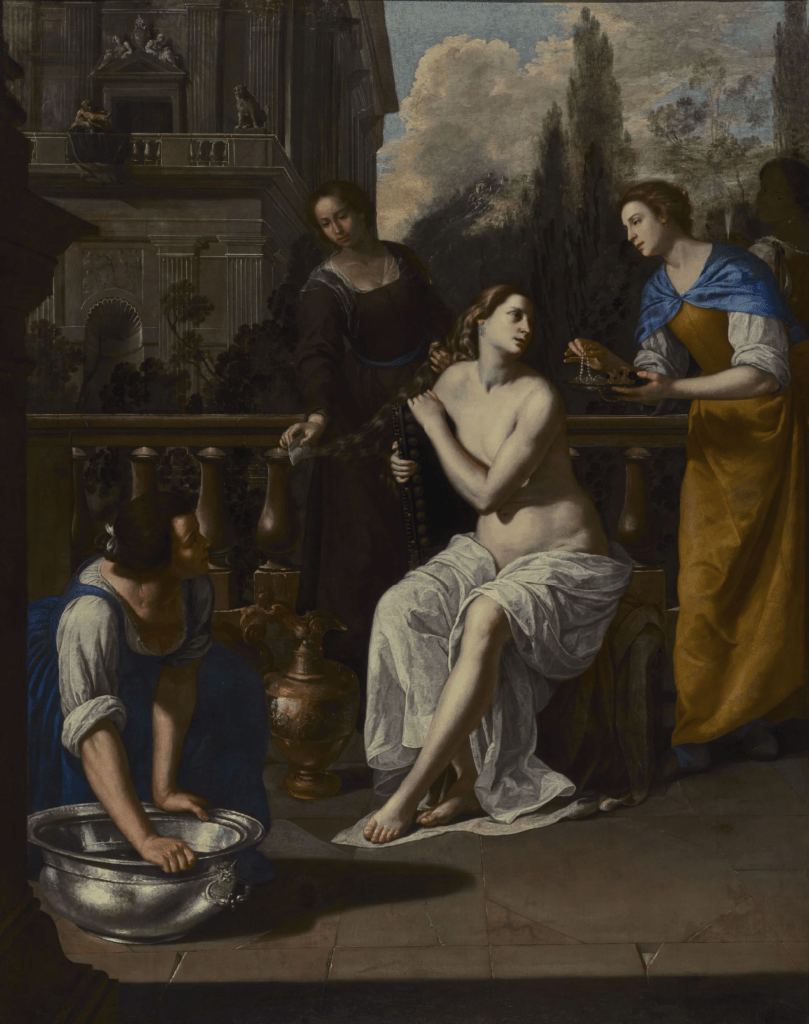
Museum Purchase, Schumacher Fund.
Contributed by David Carrier / Artemisia Gentileschi (1593–1654) has been much celebrated for two generations, in a now vast critical literature. And she has had numerous museum shows, some large. Both the intrinsic quality of her paintings and her difficult and extraordinary life as a female Italian artist warrant the praise and attention are warranted. How then could the Columbus Museum of Art, which owns just one Gentileschi – Bathsheba (1635–37) – duly highlight her achievement in its current exhibition “Artemeisia Gentileschi: Naples to Beirut”? The story is remarkable.
Alfred Sursock, a Lebanese art collector, wanted to make his Neapolitan bride feel more at home in Beirut, so he bought a large Neapolitan baroque painting of uncertain provenance with an unusual subject. Hercules and Omphale (1635–37) shows Hercules, sold into slavery by Omphale, forced to wear women’s robes, spin yarn, and perform female tasks alongside her maidens, while Omphale dons his lion skin and carries his club, embodying his heroic power. If you didn’t know the story, it would be hard to guess what’s going on. In 2020, when the painting was hung in Sursock’s museum, an explosion on a ship in the port of Beirut – one of the most powerful non-nuclear detonations ever recorded – killed 218 people, injured 7,000, and destroyed Sursock’s museum among many other buildings. The painting was heavily damaged. Months later, Gregory Buchakjian, a Sorbonne-educated Lebanese art historian, published an essay attributing this painting to Gentileschi, which prompted the Getty Conservation Institute in Los Angeles to restore it. It was then loaned to the Columbus Museum. It is presented in one large gallery, along with her painting Lucretia (1627), which is on loan from The Getty, some of her other works, documentation about the history of this restoration, and, for aesthetic context, works by her Neapolitan contemporaries, including Salvator Rosa, Jusepe de Ribera, and Mattia Preti (Il Calabrese).
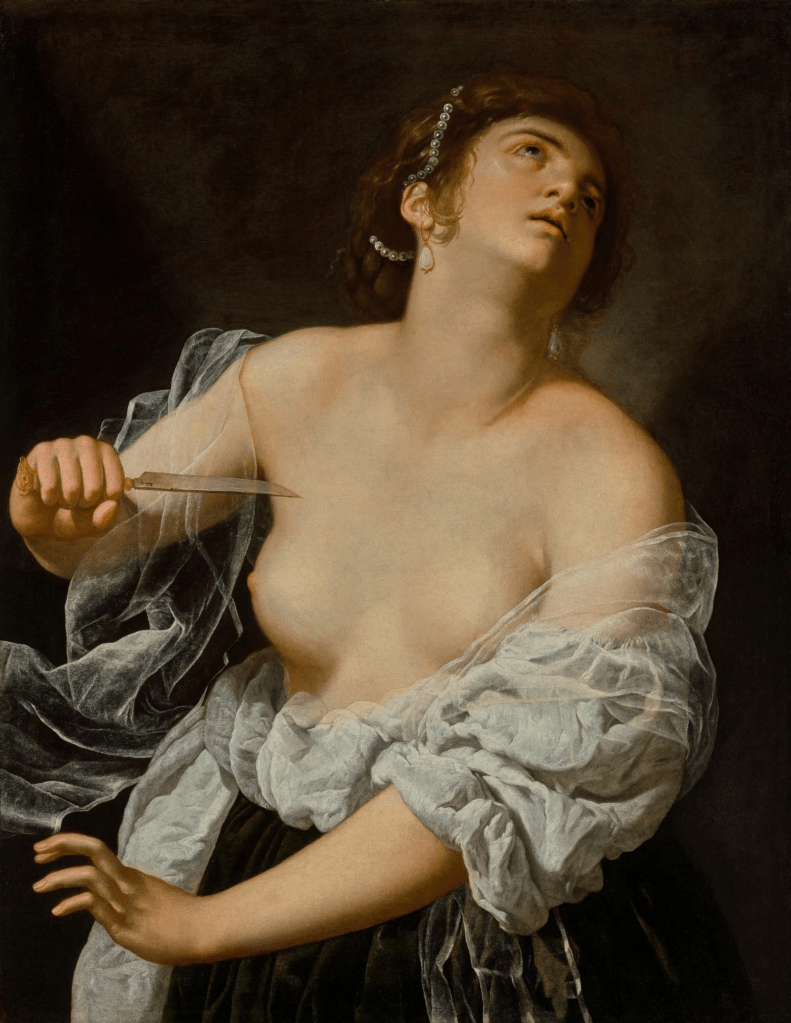

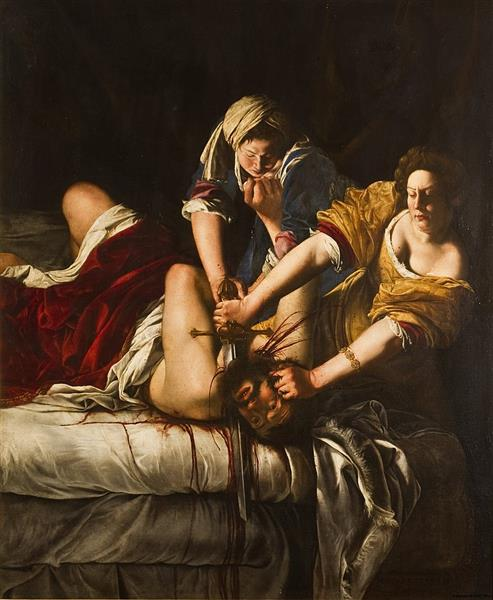
The surface of Hercules and Omphale on view in the museum does look heavily reworked, quite unlike the other works in the gallery. What has survived of the original, I would surmise, is just the basic composition. What we see is a well-restored fragment of a painting. This means attribution cannot now be an exercise in connoisseurship: given the picture’s present condition, it is too late to make an objectively reliable judgment. Context, however, seems to validate the painting. Gentileschi was raped by a fellow painter, a colleague of her father. In the ensuing legal proceedings, she was subject to judicial torture. In this light, it’s unsurprising that she painted such subjects as Judith Beheading Holofernes (1612), in which a woman decapitates a rapist, impressive and fitting that years later she depicted a woman usurping a man’s strength and that man behaving like a woman. Gentileschi’s incisively arch picture emerged sufficiently intact from a catastrophic explosion as, in real life, she survived her assault to excel as an artist. Before 2020, Hercules and Omphale was a major painting. After restoration, it is a pointed symbol of Gentileschi’s career. How it arrived in Ohio is as strange and fraught as the artist’s career. This marvelously daring exhibition asks viewers to reconstruct one inspiring story to understand another.
“Artemeisia Gentileschi: Naples to Beirut,” Columbus Museum of Art, 480 East Broad Street, Columbus, OH. Through May 31, 2026.
About the author: David Carrier is a former professor at Carnegie Mellon University; Getty Scholar; and Clark Fellow. He has lectured in China, Europe, India, Japan, New Zealand, and North America, written catalogue essays for many museums, and published art criticism in Apollo, artcritical, Artforum, Artus, and Burlington Magazine. He has also been a guest editor for The Brooklyn Rail and is a regular contributor to Two Coats of Paint.












I drove twice from detroit to see more artemisia it was very good witness.