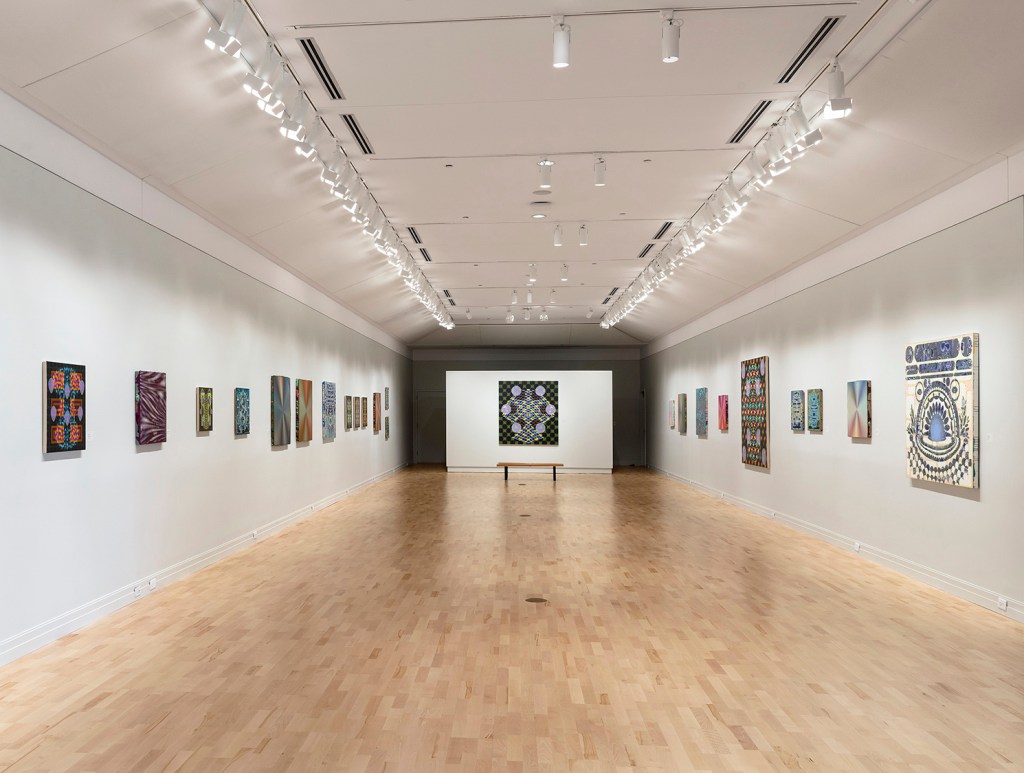
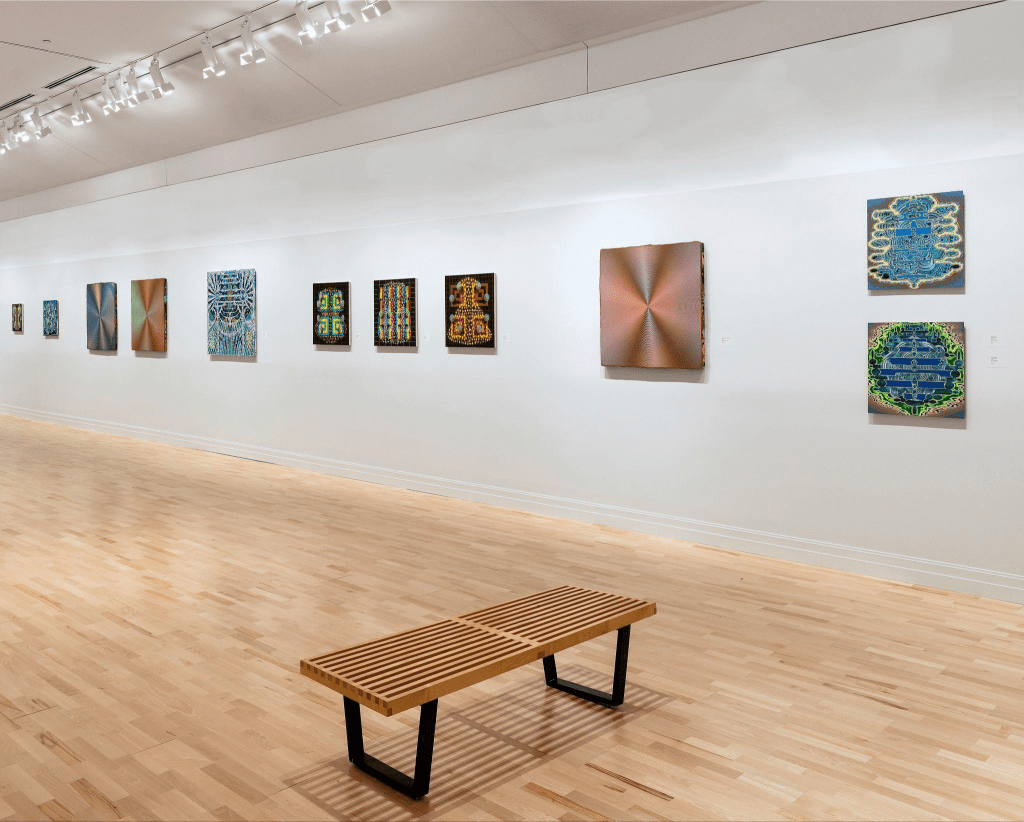
Contributed by Jacob Cartwright / True to its title, the group show “Precisely.” at Flinn Gallery is chockablock with precision-crafted paintings. There is an equal level of intensity across the three bodies of work—each artist delivers a jolt and seeing them together ups the ante. There are overlapping interests aplenty, centered around a shared investigation of brilliantly colored, pattern-based abstraction, with a flirtatious relationship to symmetry.
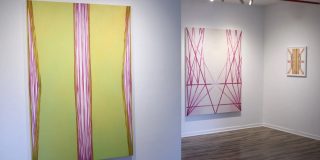
The installation intermingles the works so that you are always moving from one artist to another, which highlights the distinctions in the respective artists’ manner, method, and viewpoint. Seen in combination, these individual works can seem like corked terrariums or tidepools, each constituting a singular and self-contained ecosystem. Leaps from one to another are pleasantly bracing.
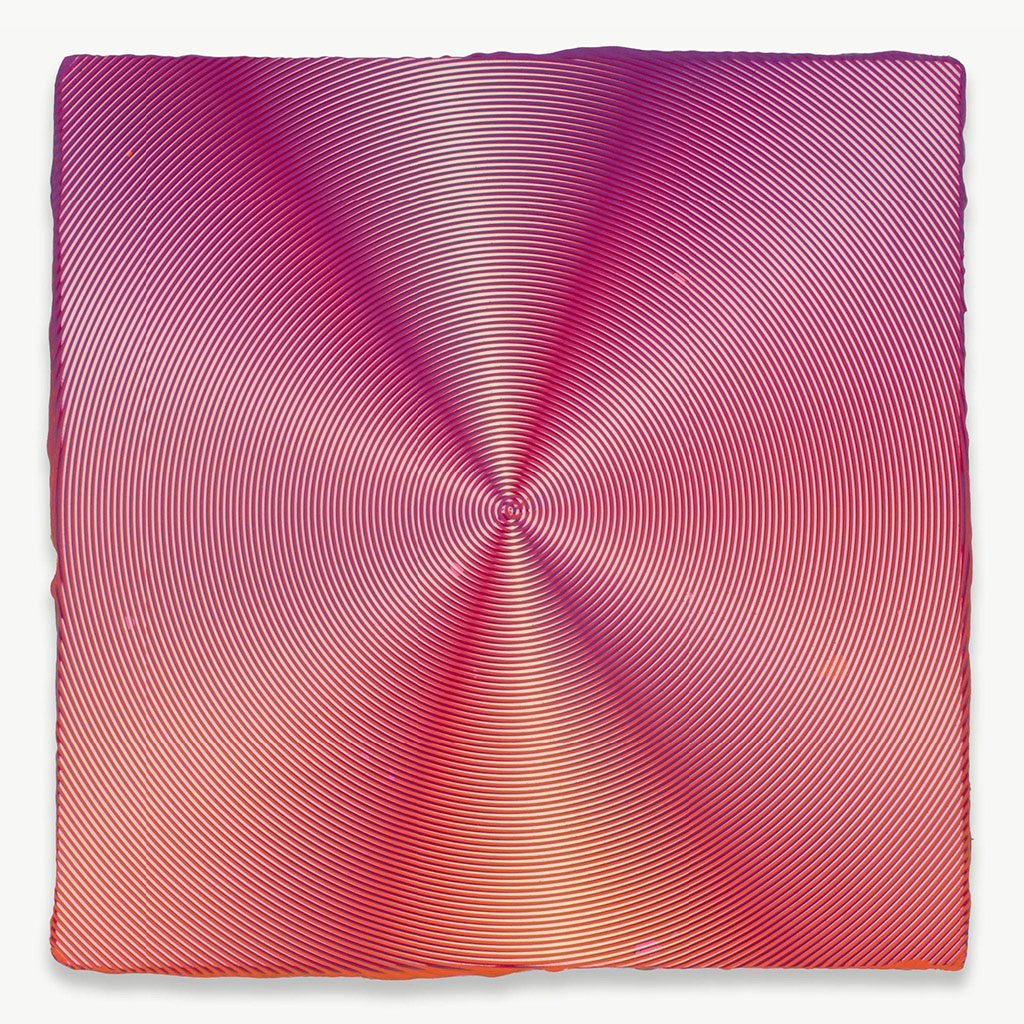
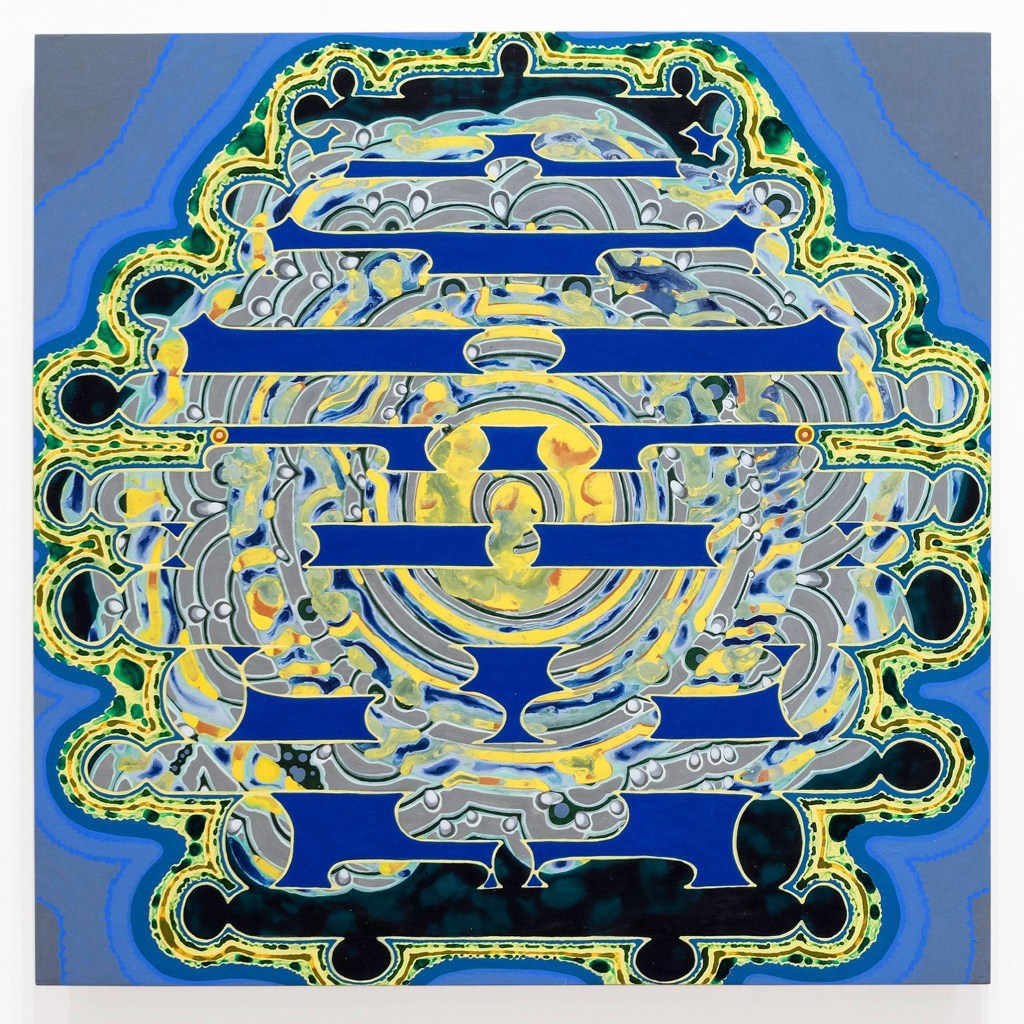
The collaborative paintings by David Driscoll and Anoka Faruqee overflow with sensuality. Literally so, in the way that paint is luxuriantly gooped up like excess cake frosting at their edges—a result of raking acrylic paint around the linen supports. Painting is always a play between materiality and opticality, but these works take that familiar duality to a new level. The paintings readily transcend their quasi-mechanical construction, nearly jumping off the wall and revealing different nuances at every distance. For all their exactitude, the artists clearly place high value in the blips, drips, and breaks in their concentric linework. The radiating interference patterns are surprisingly wedded to the materiality of the paint, in a manner that doesn’t erase the distinction between the retinal and the physical, but toggles between the two in compelling ways. Any suggestion that beauty is somehow retrograde is put to rest here, by demonstrating that beauty, in actuality, is an experience that is always both visceral and intellectually gripping.

Anoka Faruqee & David Driscoll, 2025P-03, 2025, acrylic on linen on panel, 23 × 23 inches
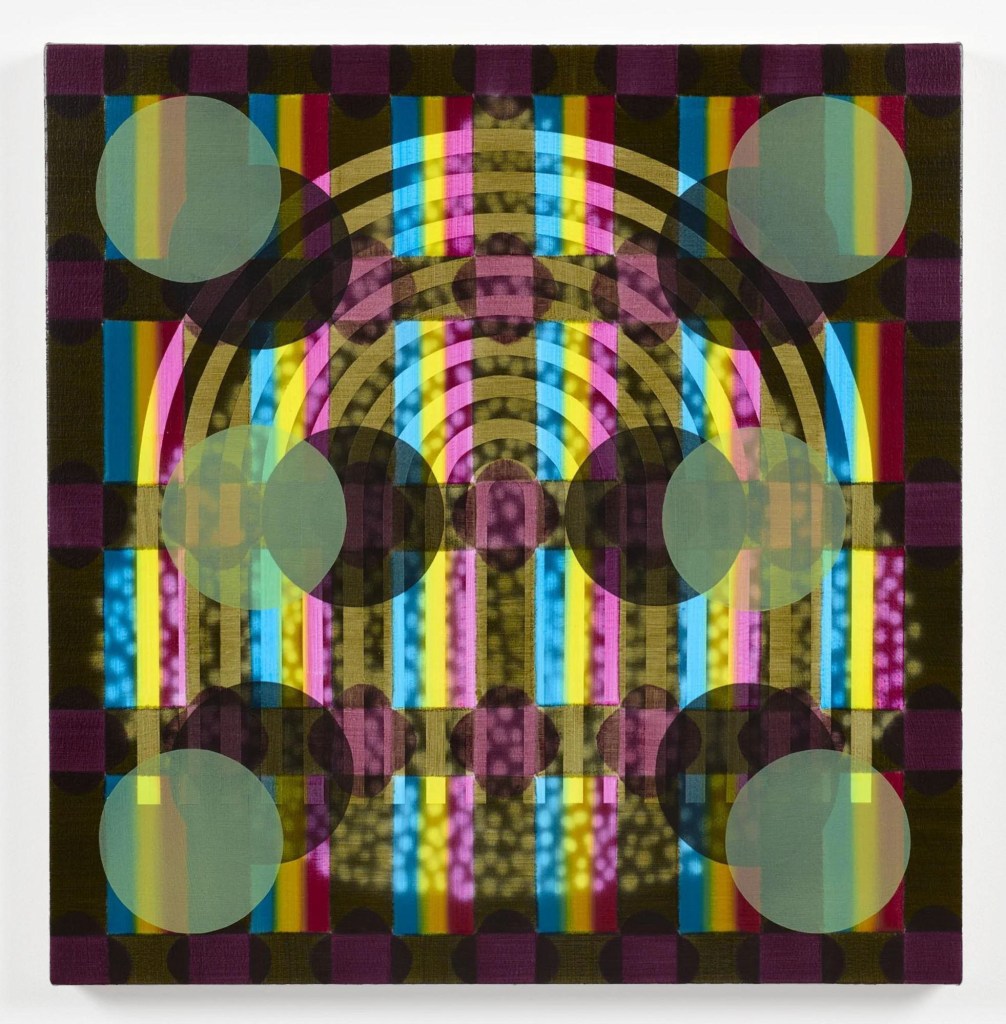
Nate Ethier’s paintings choogle along with verve, and an agreeably psychedelic disposition. Structurally, his work adheres to the rulebook of post-Minimalist painting, with stout compositions organized via pattern and seriality, but his preference for rounded forms and a vivid palette takes the vibe in a brightly buoyant direction of his own. His color sensibility is like a bowl of fruit-flavored hard candy in a sunbeam, with the appearance of dappled light that is tucked within shadowy expanses of layered color. While the transition between light and shade verges on feeling naturalistic, they are still works where the pleasure of squeezing pigmented color from a tube is never far from the mind. Ethier seems attuned to the generative (and regenerative) potential of light and color—energy itself could be considered his primary subject—and the paintings feel like they could charge up a battery. They also have moments of strangeness that add complexity. I can’t think of any painter who uses lime greens quite the way he does, and his more idiosyncratic color choices have a tang that contribute to a sweet-and-sour balance in the work.
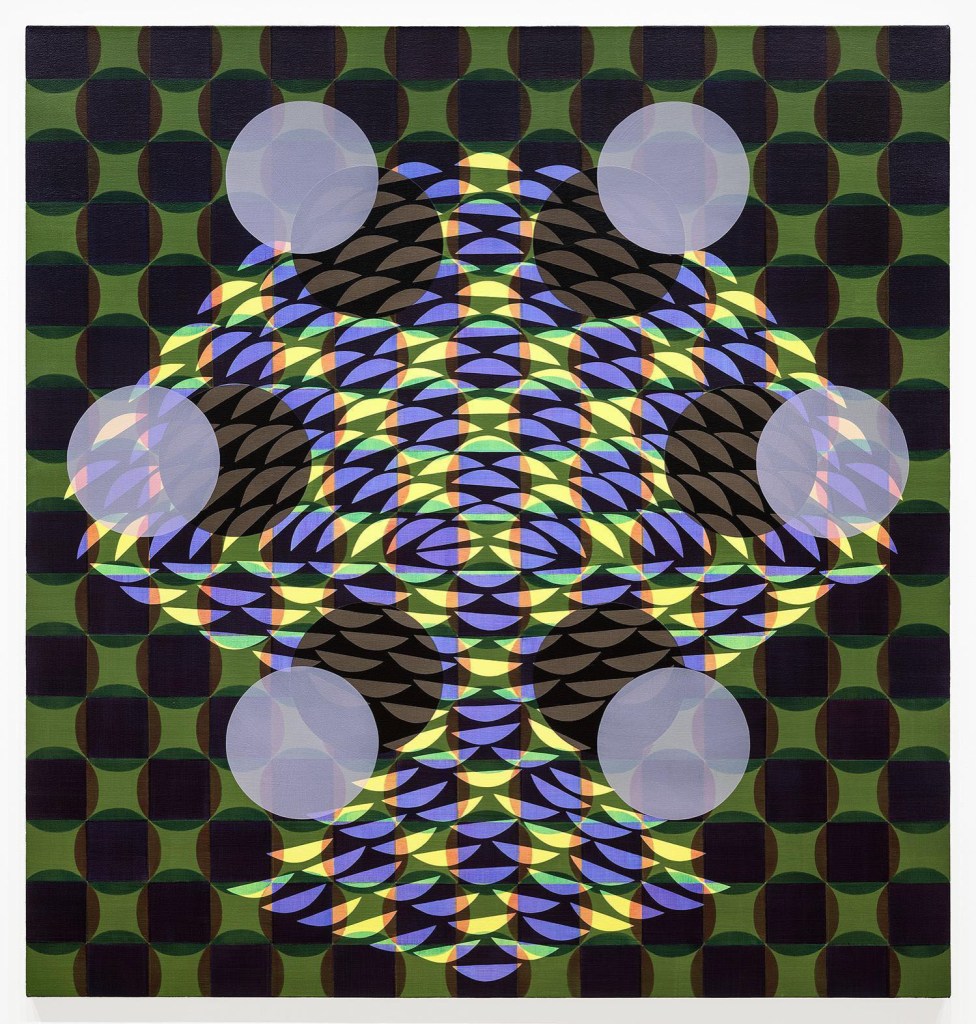

Sarah Walker’s paintings are like a dilated eye: they seem to let everything in. Her gusto for tightly packed detail yields images that read like MRI scans or the layers in cut agate. Her work reflects a sensibility, arising around Y2K, that is inspired by the proliferation of visual information as much as the history of painting. It is distinct from the approach taken by the Pictures Generation artists in its conviction that our technologically juiced-up culture of images has surged past interpretation or criticality. The paintings evoke vast amounts of data while avoiding overt technological signifiers: she has noted that her use of blue is tied to the even glow of LCD computer screens, and the paintings feel somehow aligned with the internet’s dissemination of pseudoscience, but these allusive associations are hardly didactic or prescriptive. Walker has a magpie’s eye for anything that looks interesting and cultivates her own kind of science fiction. She moves aqueous paint around her surfaces in a way that’s both free-flowing and highly guided, as if she is organizing petri dishes, or backlit screens, that are joined as leaded glass.
While the titular concept of the show refers most obviously to technique, its ultimate success turns on the clarity of voice that each of these artists demonstrate. These are artists who know what they are about. There is a freedom that comes with knowing where your deepest interests lie, and having the artistic chops to investigate those areas materially in a nuanced and convincing manner, by granting artistic impulses the mix of play and discipline that they require to flower.
“Precisely, ”Flinn Gallery, Greenwich Library, 101 West Putnam Avenue, Second Floor, Greenwich, CT. Artists: Nate Ethier, Sarah Walker, and David Driscoll + Anoka Faruqee. Curated by Chris Joy and Francene Langford. Through January 7, 2026.
About the author: Jacob Cartwright is an NYC-based painter and independent curator who writes about art.