

Contributed by Adam Simon / At one time I would have said the paintings of Lindsay Walt fell within the domain of Minimalism. It’s clear from her current show at Helm Contemporary that the designation doesn’t fit. More representative of that genre was the inspired pairing at the same gallery of Russell Maltz and Li Trincere back in June. By contrast, Walt’s atmospheric grounds paired with geometric forms don’t fit the austerity of Minimalism from the 1960s and 1970s. Instead, these works fuse opposites in a dialectic that tilts towards the infinite space and transcendentalism of an artist like Hilma Af Klint.
In fact, the designation Minimalism might have become even more questionable than it was when first coined and deemed a movement in 1965 and then rejected by some of those assigned to it, like Donald Judd. Other labels, including Ab-Ex and Pop, never fully represented the artists they purportedly described. There is no representation that isn’t in some way misrepresentation (my idea for a T-Shirt). Summarizing art in terms of styles or movements was a way of understanding art history as a linear progression in which one style or movement subsumed and surpassed another as the overarching cultural project moved irrevocably forward. Culture mirrored philosophy, art mattered on a grand scale, something universal seemed to be at stake.

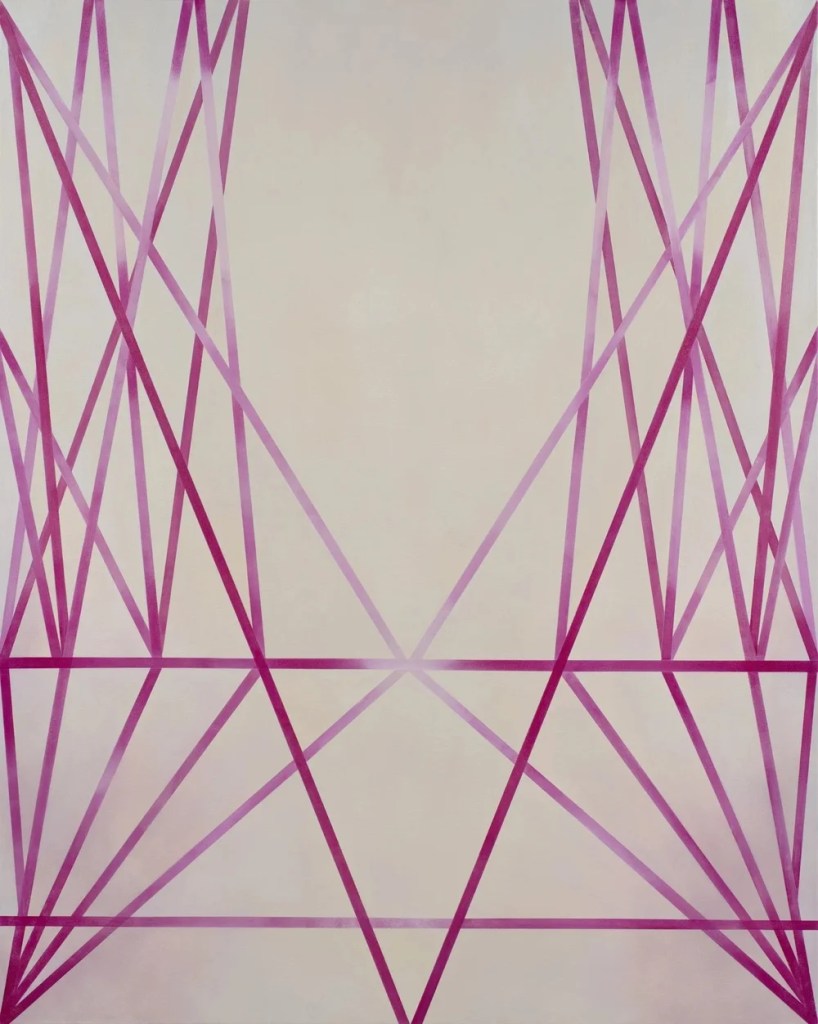
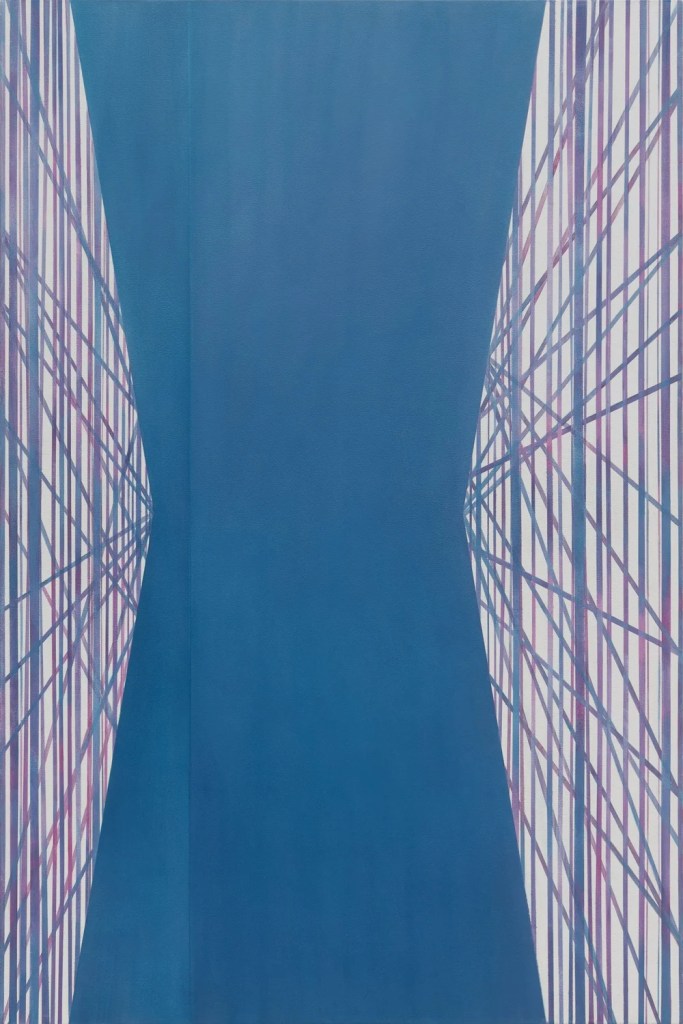
For contemporary visual art, those days are gone. Stylistic decisions then amounted to principled positions opposed to other ones: Minimalism challenged Abstract Expressionism and Pop. The shift away from the battleground of ideas and ideologies comes with a sense of loss and perhaps of freedom. Lost are clear criteria of merit and value other than money. Social media demonstrates that every style has a multitude of adherents and AI makes a mockery of intellectual property. An artist like Walt, though, may experience this change as a new sense of freedom. For her, a reductive vocabulary serves not objecthood or facticity, not what you see is what you get, but a desire for something poetic and ineffable, as it did for Af Klint.

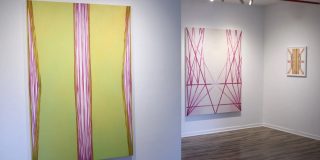
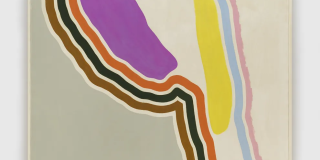
Most of Walt’s paintings at Helm combine expanses of saturated monochromatic color with areas of clustered vectors. In two paintings that, for me, warranted sustained looking, Anatomy of a Painting and Light in Time, the vectors are packed into what feels like too little space. This overcrowding gives them a manic, urban energy. It also helps disguise the fact that Walt uses line to direct the eye. The vectors frame and sometimes overlap the areas of solid color. Contained within triangular shapes, the vectors fix the areas of solid color in space. What’s interesting about this space is its ambiguity. Backward and forward become locations in flux and the mind of the viewer experiences a vertiginous slippage between the two. In In My Dreams, a diagonal vector moving from the bottom center to the upper right corner seems to completely break the picture plane and lurch into the viewer’s own space, like T-Rex in a 3D version of Jurassic Park.
In a November 2022 article in the New York Review of Books, Jed Perl lamented that artists no longer felt that they must choose between figuration and abstraction, and that painters as diverse as Gerhard Richter and Julie Mehretu would alternate between or mix the two. Lindsay Walt shares certain attributes with Minimalism while not adhering to any of the dictums or prohibitions that gave that movement a sense of shared purpose.
Most paintings today echo versions of something similar that came before, and the work of any painter is contextualized by the lineage their formal choices evoke. Matthew Herriot, in an article titled “Temporal Formalism” in Perseity Review, put it this way: “The major innovations of twentieth-century painting established the broad terms within which artists today still operate, making it difficult for contemporary painters to escape reference to twentieth-century artists who ‘did it first.’”
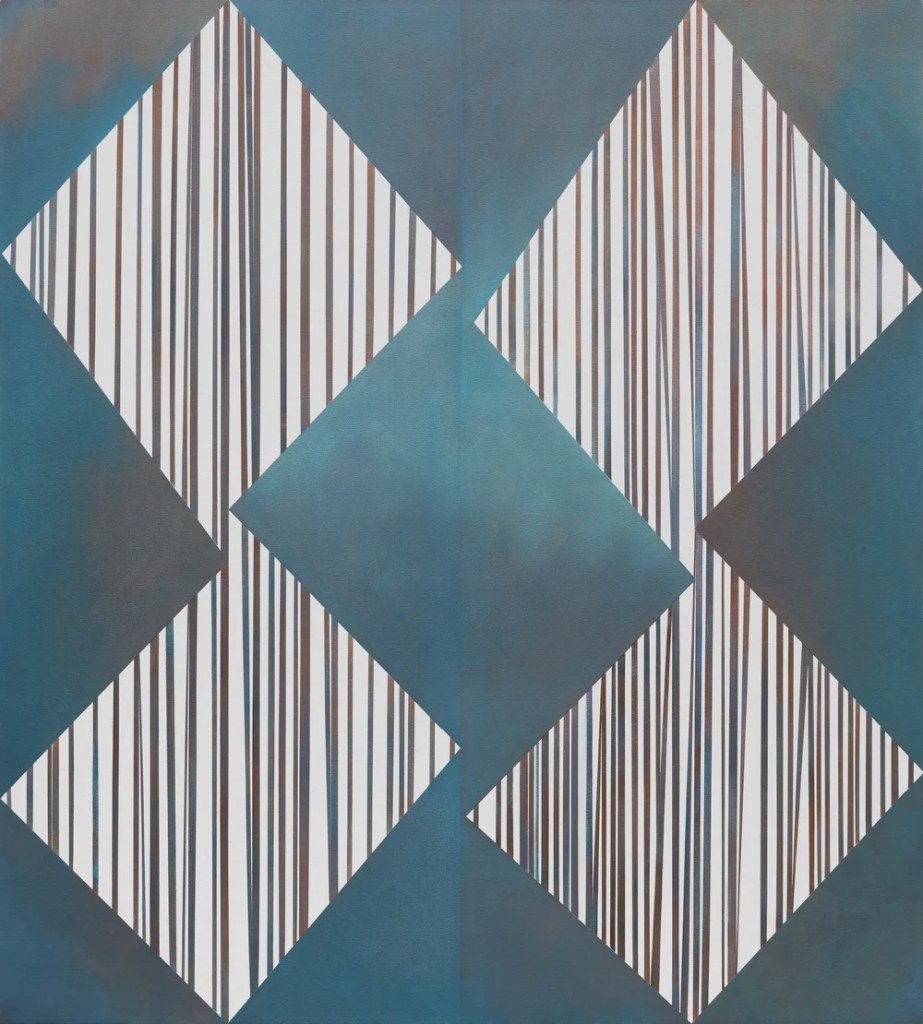
Abstract painting is more susceptible to this baggage than representational painting. Because it is non-referential, virtually all abstract painting in some way evokes the history of abstract painting. It is this history which guides a painter’s decisions and gives a viewer a handle on what they are looking at. One can have an experience with an abstract painting, either as creator or viewer, without knowing the history, but it is the history that provides the context needed to meaningfully process that experience. Anyone can appreciate the speed and beauty of fast-moving cars, but it is our history with moving cars that keeps us from being killed. Representational painters might have to deal with stylistic comparisons to other painters, but unless they choose to exclusively paint bottles on a table or lily pads or nudes descending staircases, their work is less likely to evoke a particular lineage.
If, as Robert Hughes wrote in The Shock of the New: Art and the Century of Change, the age of truly innovative art was already behind us by 1980, it is even more so now. Right now, in a political climate that smothers aesthetics, it seems unlikely that there will be other epoch-defining art movements. And yet, one could turn this around and say that while art is now more individualistic, it is also more important than ever. The possibility remains of engaging with what a given painting does and how, for example, it diverges from type and creates its own interior world. Lindsay Walt’s paintings comprise a compelling mix of geometric certainty and limitless atmosphere – enough to frustrate advocates for either aesthetic. This is their strength.
“Lindsay Walt: The Measure of Things,” Helm Contemporary, 132 Bowery, 3rd Floor, New York, NY. Through October 3, 2026.
About the author: Adam Simon is a New York artist and writer. His most recent solo painting show was at OSMOS in 2024.









So good. “A compelling mix of geometric certainty and limitless atmosphere ” is such a wonderfully concise reading of Lindsay’s work!
Thanks for such a great take on Lindsay’s work! I wouldn’t have thought it visionary until your review and I’m all in now!
Excellent review and writing on Lindsay’s paintings.
Good to read.