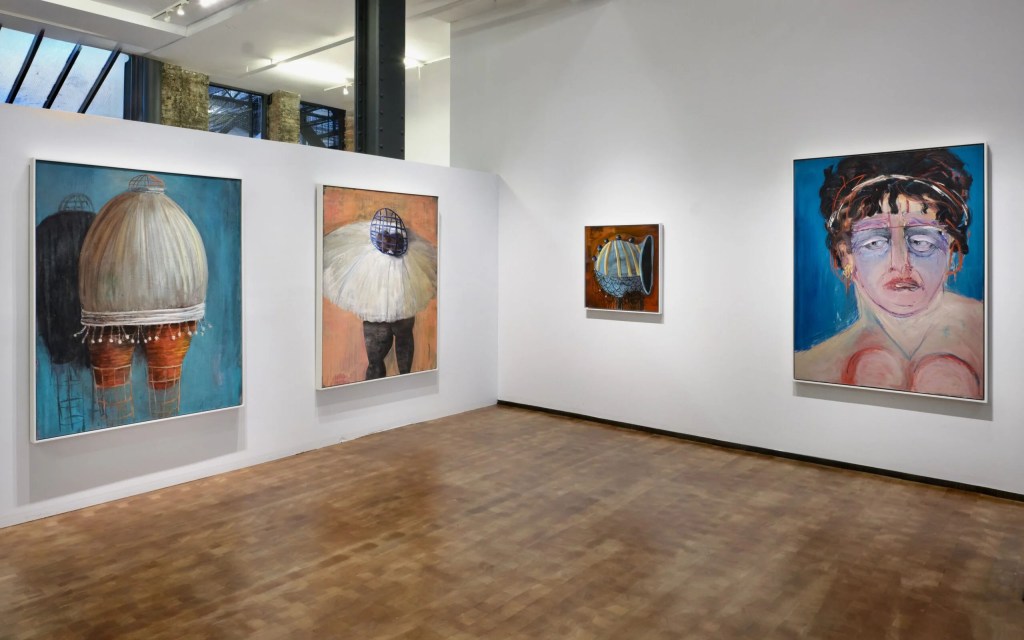
At Pen and Brush, painter Katherine Bradford met with Deborah Buck to walk through Buck’s exhibition “New Jewels,” which opens with a suite of crowned, open-mouthed, defiant women the artist calls her “bad girls.” Many of these paintings cost Buck her dealers in the 1980s and spent some forty years in storage before this show. Buck traces what shaped her, from a childhood on a Maryland farm and a teenage mentorship with Clyfford Still to a Skowhegan scholarship at seventeen. Along the way, the two painters talk about engagement rings, beauty pageants, film noir, and how Buck’s portraits reveal who they are only as she paints them. Here are excerpts from their conversation.
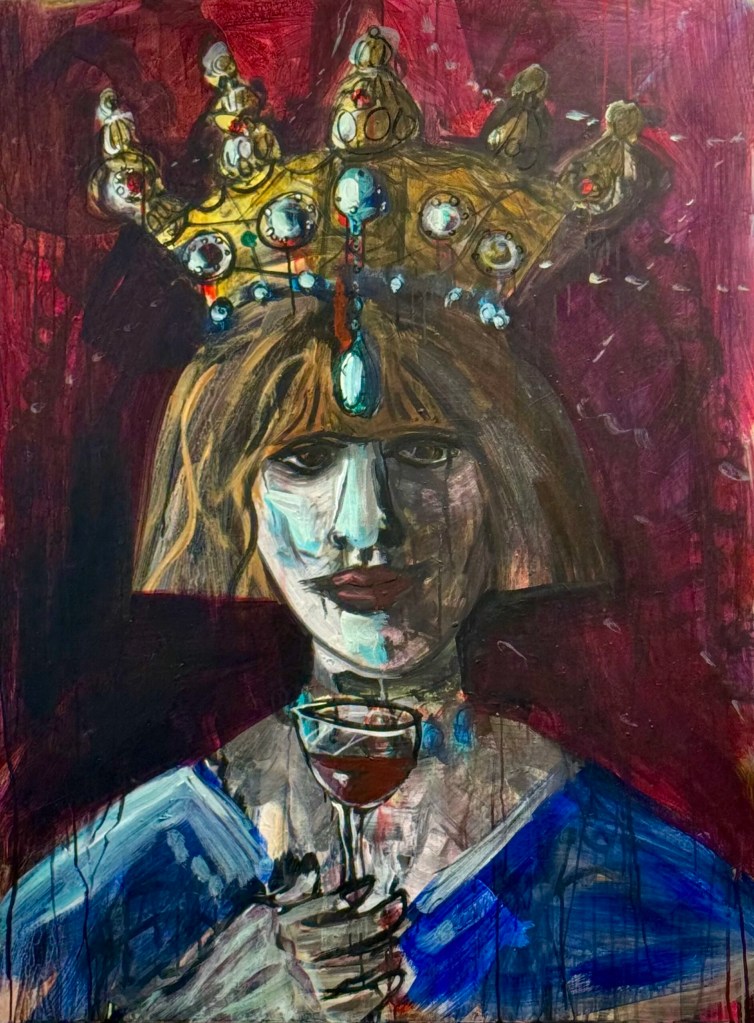
Katherine Bradford: Deborah titled her show “New Jewels,” and I thought, what a lovely title, because we name our paintings like our darlings, our jewels. But the painting you see as you come in is called New Jewels, and it has a very personal story. You see women with their mouths open. They’re almost confronting you instead of welcoming you. This woman has on a crown and a necklace. She’s naked. Deborah, why did you call that painting New Jewels?
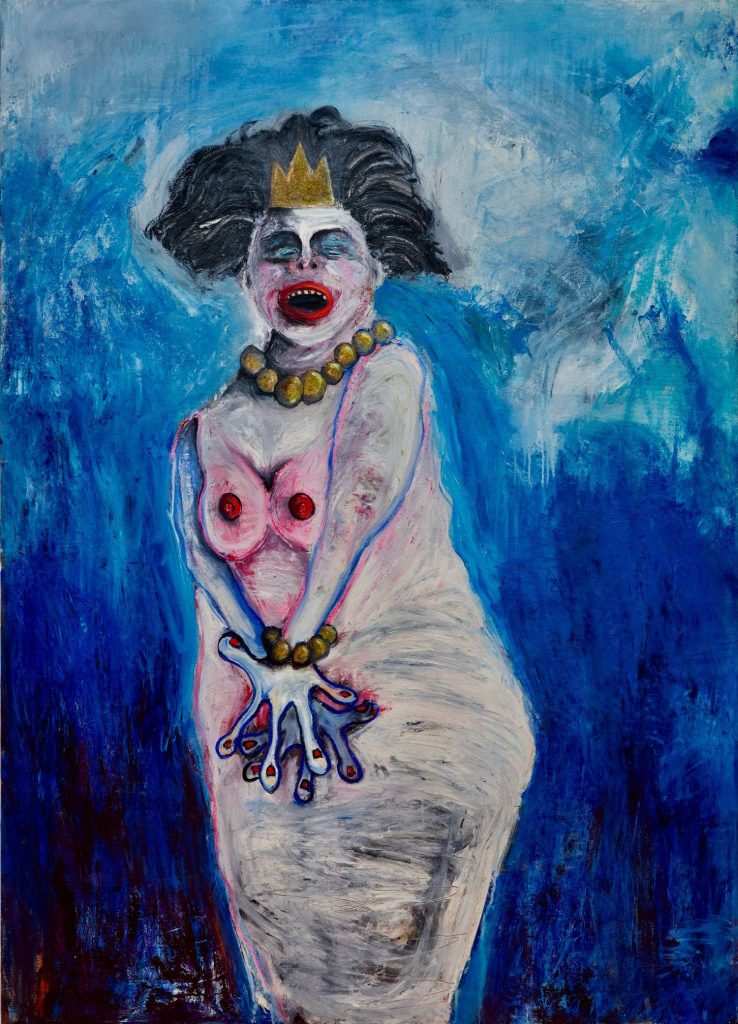
Deborah Buck: Let’s go back 40 years. I was newly engaged, and I was presented with this diamond ring, and I was surprised and scared. I kept thinking, I don’t want to wear this. Why does this change everything? Then I had friends who were given jewelry by their husbands when they had children. It was like as you lost the things that male society values about you as a woman, your looks, your weight, your figure, you get these jewels. It all led me to think about the objectification of women and how limiting that is.
KB: You told me that when you got your engagement ring, you felt you were being branded.
DB: Branded. Why do I have to wear this thing that tells everyone who meets me this very important thing about me?
KB: So Deborah painted a naked woman with a little crown and a necklace, and she’s screaming. Now you see how radical she is, because we’ve seen lots of movies where the sweetest moment is when the guy’s kneeling and she gets her ring and she loves it. Now you got Deborah’s take on that…
DB: No, I felt like she was saying: Ha! You think you got me? You think you got me all figured out? Ha!
KB: With that in mind, look closely at the suite of paintings that greet you as you come in here. I mean, each one is a woman full of presence, screaming. I was thinking of Francis Bacon, who gave the Pope this open mouth. Each woman in the suite that greets you is full of presence, screaming. I was thinking of Francis Bacon, who gave the Pope this open mouth.
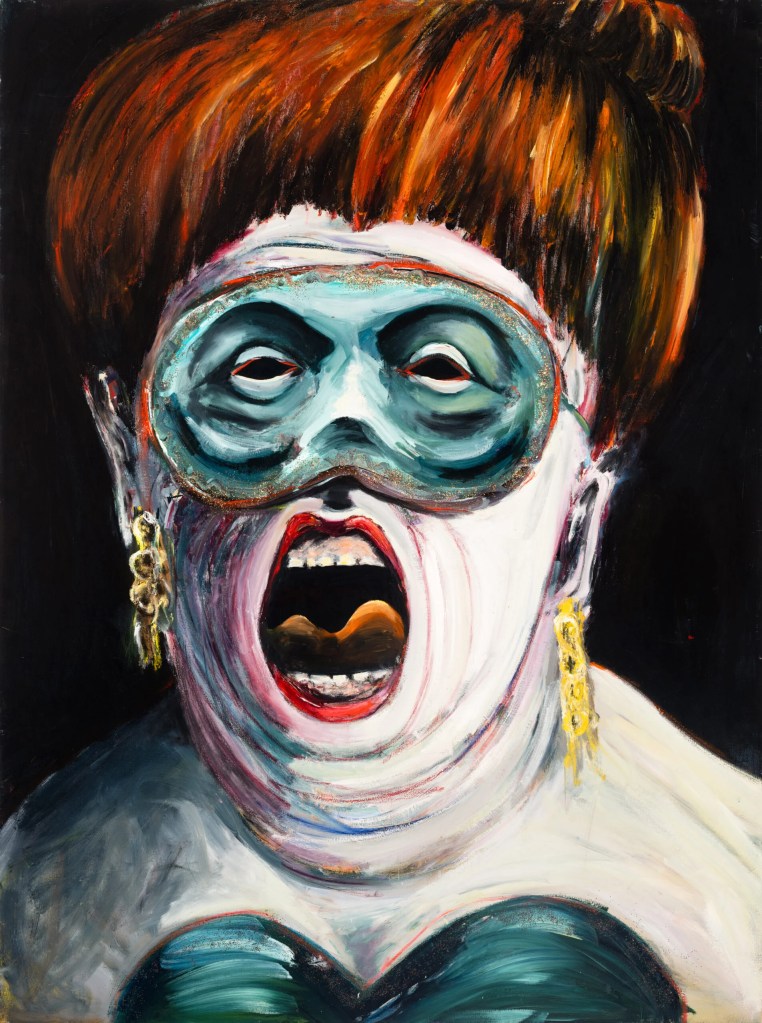
DB: Some of them are actually screaming because they’re frustrated. They are mad.
KB: I think it sets the tone for Deborah Buck’s show, which was very helpful for me. Even though when I walked in the door, I was kind of taken aback. And there’s one more right behind you of a woman with a crown who doesn’t look happy at all. I thought of Diana: you can get a lot in life as a woman, but it doesn’t necessarily fit.
DB: That’s Ambivalent Monarch. The crown is awful heavy. Supposedly she has all of it, the jewelry, the accolades, and yet she doesn’t know what to do with it. She didn’t even want it.
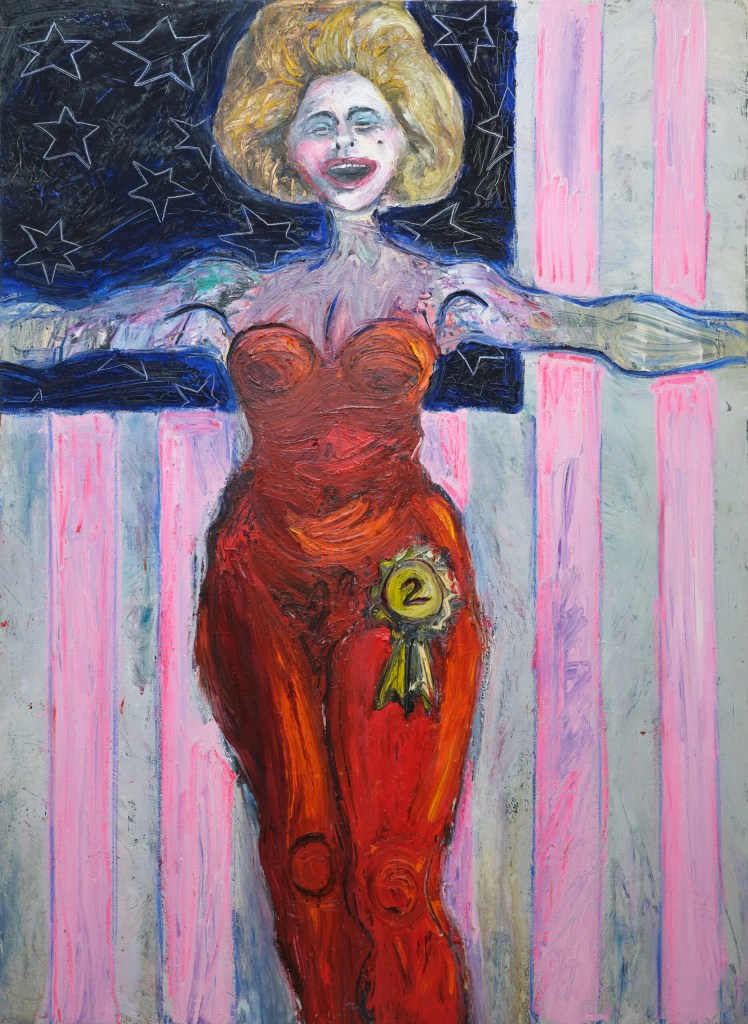
KB: How about the woman who is very thin and she looks like she’s been in a beauty pageant, but it says two on her. She came in second.
DB: That’s Number Two, the one to the left of her is called Runner Up. There was an Avis ad that went: “When you’re only number two, you try harder.” I don’t know if anyone remembers that, but I have always found beauty pageants to be perverse. Just an exceptionally perverse thing in our society.
It’s a conundrum to me that women are not allowed, or have not been allowed to partake of equality in our society, and yet we’re in this competition over hair and figures and bodies and molding yourself to this ideal that is unobtainable. We spend so much time and money and energy on beauty pageants. The president of the United States right now believes in beauty pageants.
It’s disgusting what it does to the women who partake in them. So, I did a couple of paintings about beauty pageants. That one is called Float, of the two women who are on a float and they are beauty queens.
Maybe they’re contestants, maybe they’ve won, I don’t know, but they look pretty dead to me. They’ve starved themselves. The one in the middle, the runner up, has starved herself. She looks very skeletal. For what? For what? Those are the things that made me mad and still make me mad. So, yeah, they’re screaming.
KB: Tell us about how you became an artist. We heard that you grew up on a farm outside of Baltimore, Maryland. What led you to become the artist that you are today?
DB: I really, genuinely believe that I came out of the egg this way. The first toys that I remember were a pencil and a brush. And as soon as I could hold the brush, hold the pencil, I was drawing, I was painting, and fortunately I had a mother who encouraged me. She would give me watercolor sets and that kind of thing.
I just really loved the act of drawing and painting what was around me, because that seemed like what art was. I figured out that I didn’t have to make it look like anything, that I could abstract that. That wasn’t until later, but the growing up on the farm was absurd.
There were just all these people coming and going, animals coming and going, and the seasons would change and crops would be lost. It was very dramatic; it was a very dramatic place. And yet I found myself, as a child, full of wonder, being in nature and with these animals, crops and plants. I was also terrified, really frightened, really frightened.
KB: But one of your neighbors was Clyfford Still.
DB: : Indeed. My father had decided to become a farmer. We had moved from New York where my father had worked for his father, and he had decided he wanted to be a farmer. This was in the late 60s, early 70s. He would have breakfast at this farmer’s roadside market every morning, and so did Clyfford Still. They were two guys in this very rural setting that were quite different from most of the other characters. They had both been catchers on the farm team baseball and they both loved cars. Somehow, they sort of struck up this friendship.
One day my father said, “I have a daughter and she’s an artist, and that’s all she wants to do. That’s all she’s interested in.” I think I was like 16 at this point. Still said, I’d like to meet her. So, it was arranged and I went to this restaurant and Mr. and Mrs. Still pulled up and we sat in a booth and he stirred his coffee for half an hour while Mrs. Still and I made light chit chat. Then he put his spoon down and he just started talking, and it was so passionate. And there was a lot of anger in him, as we all know, if you know anything about Clyfford Still.
I loved painting and I didn’t really know who he was, but I boned up from what I could. There was a Janson’s History of Art that fortunately had some of his paintings in our house. My mom loved art history.
And I just got it. I just felt energy in his paintings, and then there was so much energy in this person. When he was speaking about painting and the art world and some of the people who he felt had been so unfair to artists. He insisted on sort of trying to tell me how to navigate the art world and to be very careful and to not give myself away. But remember, it’s all from Clyfford Still’s perspective. They killed Rothko and Clement Greenberg this, Clement Greenberg that. And I didn’t know who all these people were, but I went home and looked them up and educated myself.
KB: Did he give you any advice?
DB: Yes. And it was some of the most important advice that I ever received. I had some of my paintings with me and he wanted to see them. He said, nobody’s going to teach you how to paint, you know how to paint. But he said, what you need to do is you need to learn everything you can about the world, learn everything that anybody will teach you, learn history, learn language, learn botany, learn psychology, learn everything about the world, history, art history, etc., and I really took that to heart.
KB: How did Skowhegan come in?
DB: In 1975, he received the Skowhegan award for painting. At that time, the winner sent one young artist to the school with a scholarship in their name, and he chose me.
KB: It’s a summer-long residency in Maine where every artist gets a studio and an invited faculty constantly critiques the work.
KB: So Deborah Buck was 17, from a Maryland farm.
on board, 48 x 36 inches
DB: It was really, really hard. Arlene Slavin, who’s sitting in the audience right now, told me, just don’t leave. You’re surrounded by some of the finest minds in the art world. Stay, read, walk, and keep asking questions. I did what it took to stay. It was the gift of my lifetime, and it shaped me.
KB: I was in my 60s when I spent the summer at Skowhegan as a resident faculty, and I did feel different. I remember standing in the barn where everyone was having lunch, and I looked around and I said, you know, I’m the only person in this whole place with white hair. But that’s good, because it seemed like everyone at Skowhegan is very handpicked, they’re all ages. They’re from all over the United States and now all over the world. But I felt everyone there was the only one who did work with fabric, or who only painted black. It was very much a one of each kind of thing, sort of like Noah’s Ark.
acrylic and sumi ink on board, 20 x 16 inches
KB: Moving right along, we will come to this part of the show, which I also found quite fascinating. If you all don’t mind turning around, there’s this suite of paintings here which are a little different from the Bad Girls. That’s what Deborah calls these. Would you call all these women bad girls?
DB: It’s the 1980s, and in New York, Neo-Expressionism has really taken hold. I want to do that, but since I went to school in the 70s, nobody had taught me to paint the figure. I was also watching a lot of film noir, and those could be a still from one. The martini woman was from the 2:00 Club on Baltimore Street. We would go there late at night, drink beer, and watch the strippers. So I thought, I could come here and draw during the day. My brother went with me on weekends and sat at the bar, and I would draw and he would drink beer. She’s called 2:00 Club.
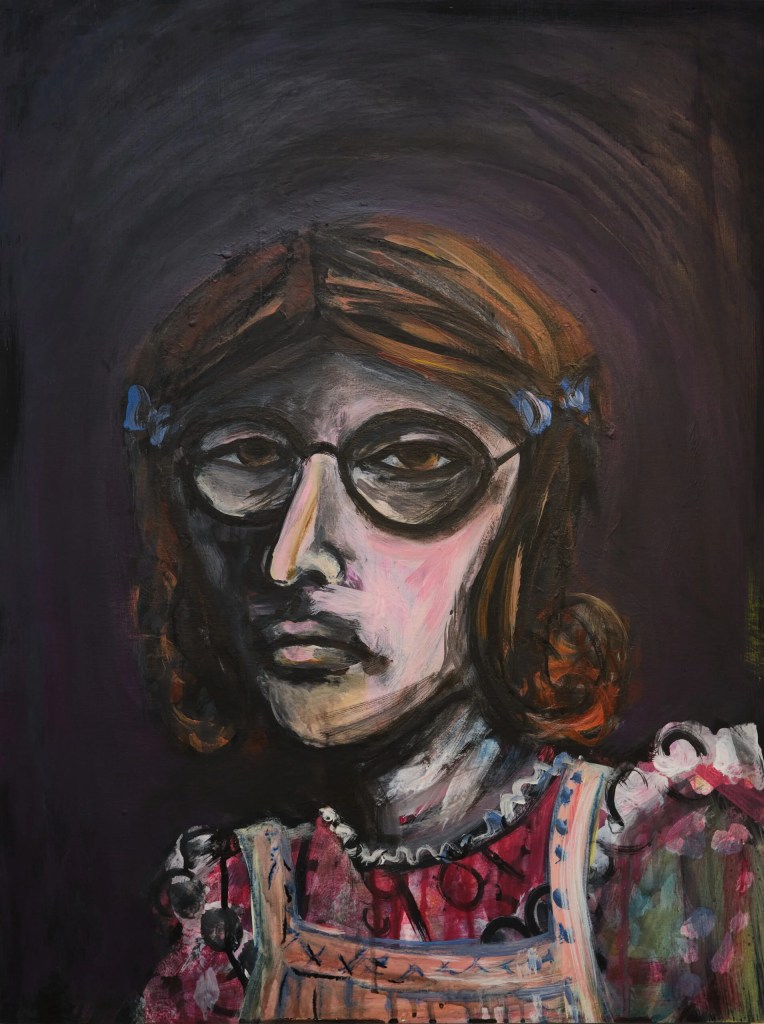
KB: Let’s talk about this wonderful portrait here, which has the honor of being on the cover of this month’s Brooklyn Rail. It’s called Farmer’s Daughter. It’s someone that Deborah knew from her farm days. As she told me, she felt that they were kind of frilly and girly. So, she put on this apron, this very feminine apron, but she felt that the farmers’ daughters, the women in the farm world, were fierce. When it appeared that this portrait was sort of getting a five-o’clock shadow, Deborah told me, “Well, she started to look like a man, and I felt that these women were like a man.” So, the farmer’s daughter has this side to her?
DB: It’s true. Living on the farm, you met all the people who lived around you. The women were sort of different from the women in my family who were more sophisticated than most of the people who lived around us on these farms. But these women, you know, they really worked hard. I mean, milking cows. They were strong with big hands and were just big. But they all made themselves these aprons and embroidered them with things like flowers and little birds. There was something very like, little girl about these aprons that these big, strong, heavy women chose to make for themselves and put ruffles on. So, I painted that one with one of those aprons.
It’s part of that process that occurs when you’re creating a painting. Like when I do these portraits, I look at them and I ask them, Who are you? Who are you? Who are you? Come on, come on. Like, who are you? I’ve got to pull you out of the paint. While I was doing that painting, I’m looking at her and I’m thinking, Who are you? Who are you? And I put the little barrettes in her hair. And then I noticed that she kind of looks like she has a five-o’clock shadow, and that’s fine.
Okay, so she’s got a five-o’clock shadow. Who cares? I mean, that’s who she is. And now I’m going to really tweak the ruffles on that apron. I’m really going to give her one of those farm world aprons. So is she the farmer’s daughter? Is she the farmer’s son? Is she both? I don’t know, but, you know, that’s how all these portraits come about. They materialize while I’m painting them. At a certain point, she sort of said, okay, I’m done. I’m here. I’ve got a question. Am I a boy? Am I a girl? Am I? I don’t know. This is where I’m going to stay. And so all of them kind of get to that place where it’s like they’ve told me all they have to tell me, and then the rest is up to the people looking at them to figure out who is this, who is this?
KB: And these are much older.
DB: These are from the early 90s. I was moving back toward abstraction but still wanted them to be a little perverse and make you uncomfortable. I’m still thinking about how women are confined. She’s in a tutu, but she’s no dancer. That one is chopped off at her knees.
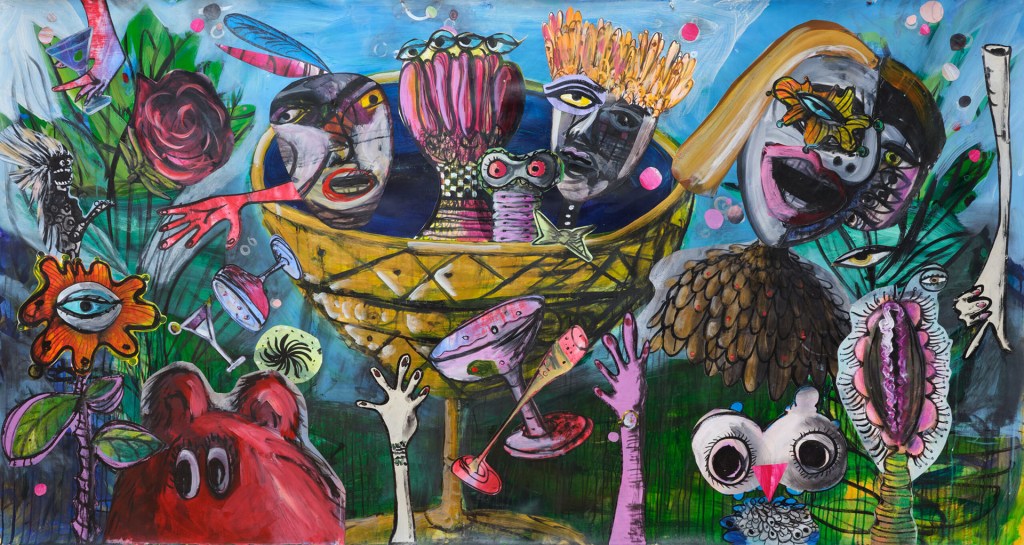
KB: And this newer one is Call to Reason?
DB: That one’s 2024, election. Like, how can this be happening? Why isn’t someone speaking out? Why isn’t a whole group speaking out about what is happening to our country and to the ideals and values that we’re hearing that, for me, are anathema. And so that was called A Call to Reason. I paint where I am, I paint what I know when I’m in a certain place. I think that’s how I make the world make some sense to me. And so that one was my protest.
KB It’s very original, I think.
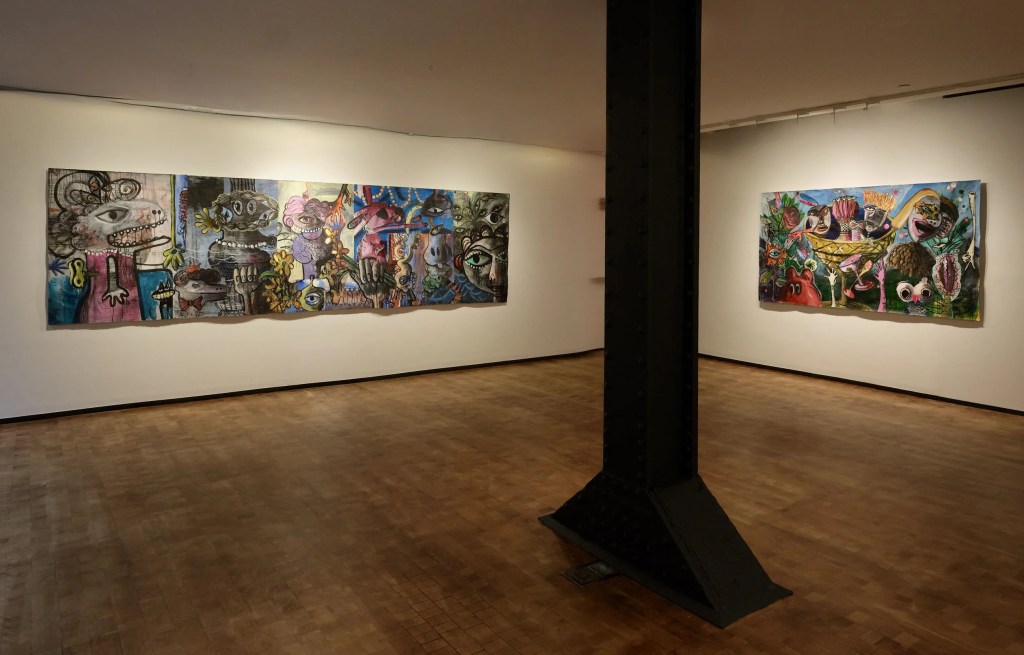
“Deborah Buck: New Jewels,” Pen and Brush, 29 East 22nd Street, New York, NY.Through February 1, 2027.
About the artist: Deborah Buck is an artist based in New York City. She was selected for the Artist in the Marketplace program at The Bronx Museum of the Arts, and has exhibited consistently since the 1980s. In 2019, Buck founded the Deborah Buck Foundation, supporting institutions that elevate the voices of women in the arts.
About the artist: Painter Katherine Bradford is represented by Canada and Kaufmann Repetto Gallery in New York. Her work is held in the collections of The Metropolitan Museum of Art, New York; The Brooklyn Museum, New York; Dallas Museum of Art, Dallas; The Menil Collection, Houston; institute of Contemporary Art, Boston; and the Portland Museum of Art, Portland, among others.