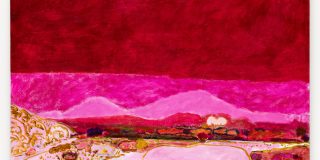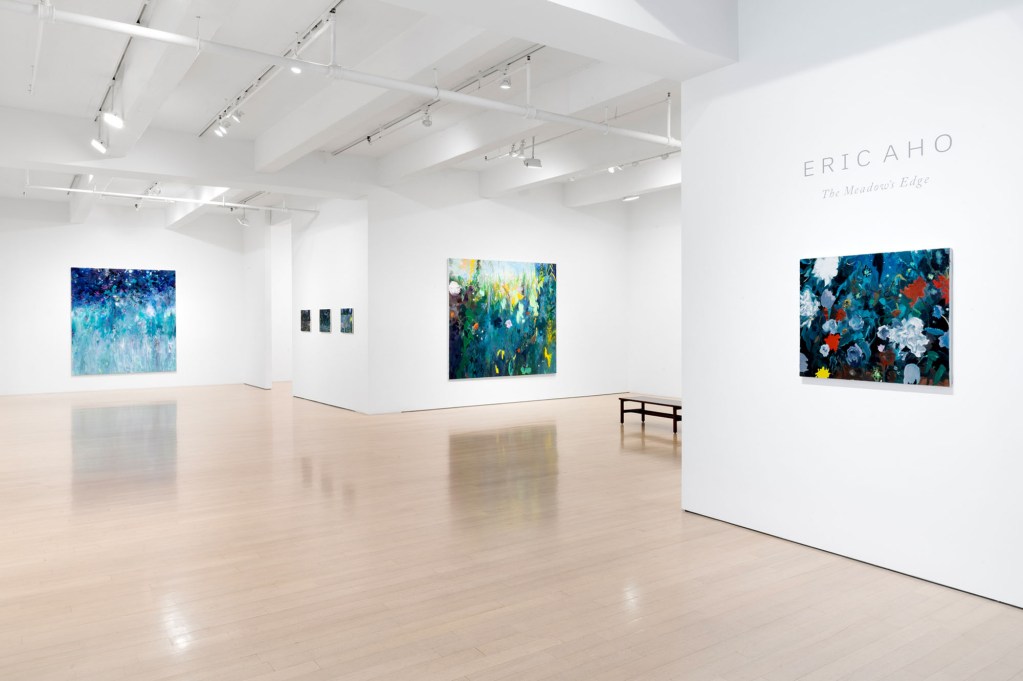
Contributed by Alex Grimley / Unique among the twenty-odd paintings in Eric Aho’s exhibition “The Meadow’s Edge,” on view at DC Moore, is a grass-green landscape. While many of the exhibited works feature a shallow foreground, this scene is bright and open, incorporating a meadow dotted with dandelions and stretching back to a remote tree line. The picture’s title, Meadow Near Lincolnville, Maine (1954), refers to the year that artists Alex Katz and Lois Dodd purchased a home in that town, and, as Aho remarks, “embarked on a new chapter of American painting.” Katz and Aho share a compelling interest in what seeing feels like. I first saw Katz’s manifested in Twilight at the High Museum in Atlanta. There he evokes the condition of seeing in near total darkness with a ten-foot-tall black expanse that gives way only near the very top of the canvas, to a faint patch of sky through tree cover. Without representing any recognizable landscape elements, the painting records the experience of looking up at the night sky.
To paint the experience of seeing, Aho does more than represent the landscape; he charts the fragmentary nature of human sight, isolating the way our attention focuses on some things in our field of vision while overlooking others. His paintings balance selective focus against “averted vision” – the phenomenon whereby faintly lit objects become clearer when you look slightly away from them. In Stars and Asters, he leaves the foreground at eye level and relatively indistinct, while the top of the canvas is teeming with detail. A similar quality is found in Meadow at Sunrise, where the landscape seems to cascade forward, with greater specificity concentrated near the top and left. Aho continuously explores this boundary, testing how little definition he can offer without dissolving the picture’s grounding in the natural world.
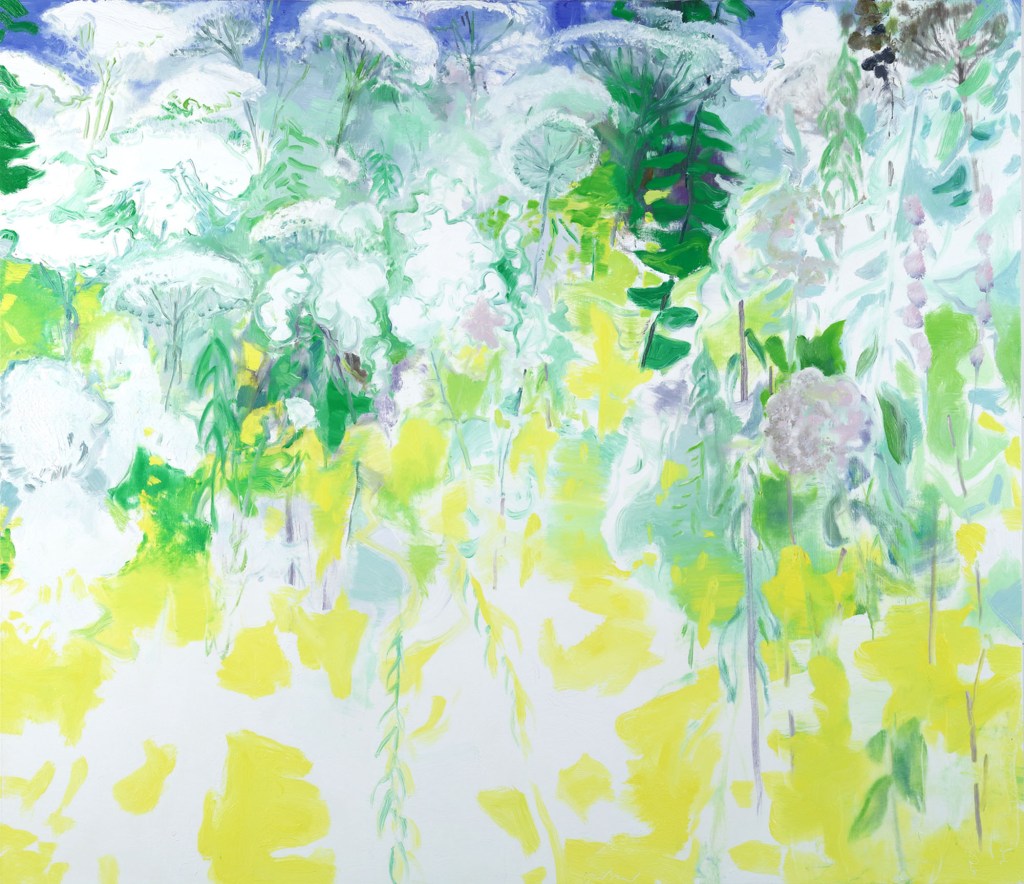
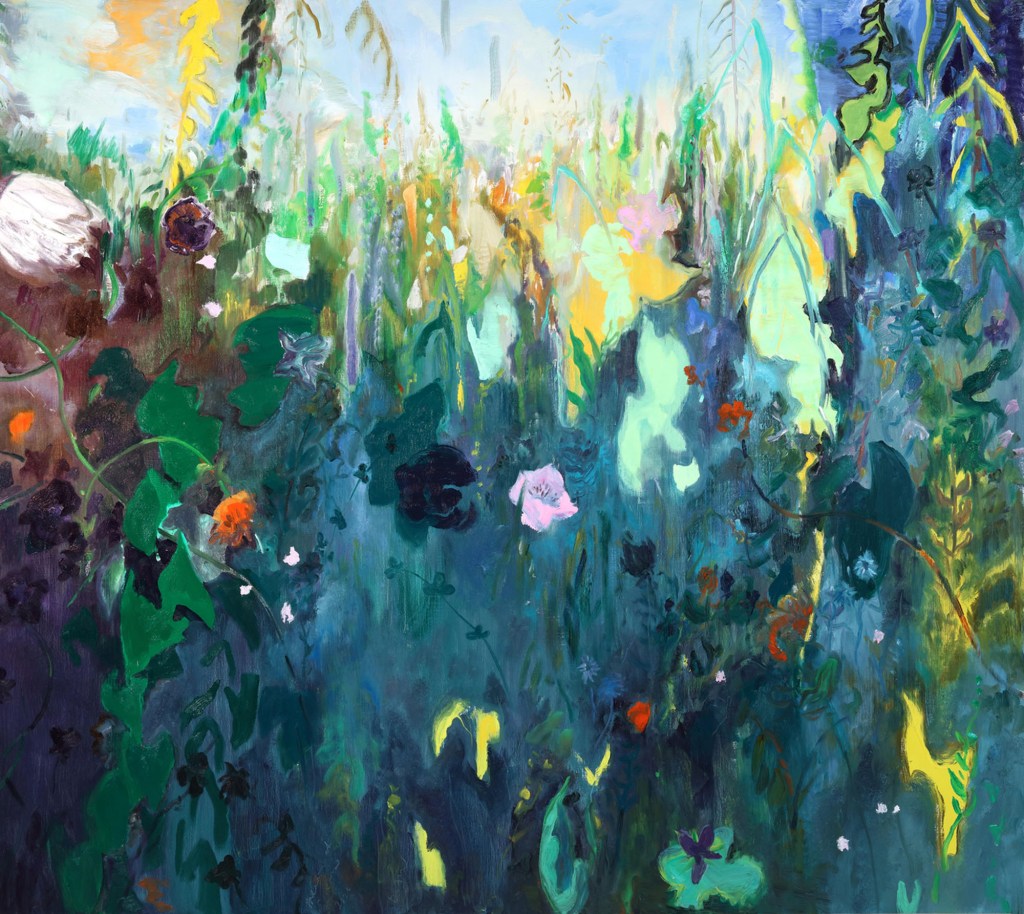
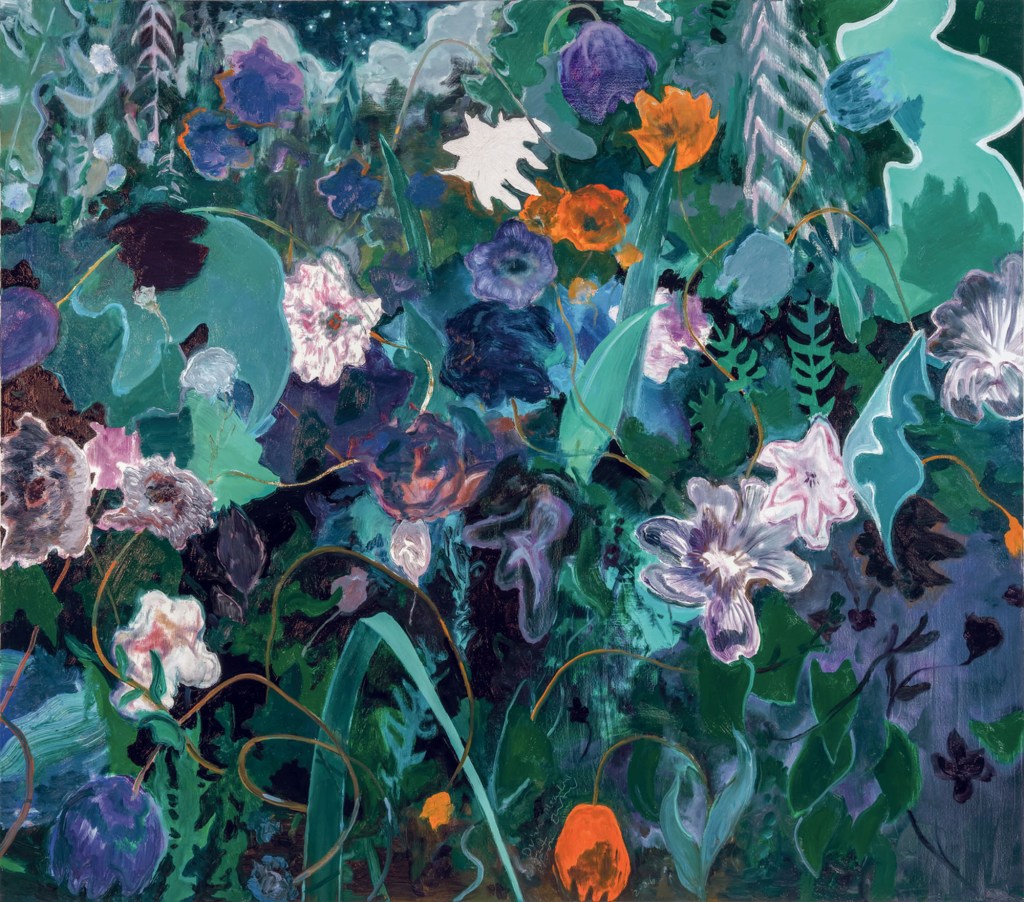
Aho also illustrates the fluctuating character of visual perception, particularly in paintings that capture extremes of light, such as Ink-Dark Forest (Full Moon, January) and Bright Roadside. Here he establishes areas of clarity and opacity by contrasting botanical detail against broad, minimally inflected forms. In the former, the dim glow of moonlight gently illuminates a dense forest interior; in the latter, floral forms yield to a patchwork of blinding white and yellow sunlight. Though many scenes remain recognizable as landscapes, Aho frequently drifts into abstraction. In the two Dutch Meadow pictures and the related Meadow Edge at Daybreak, he renders flower blossoms like flat bursts of color, aligned so emphatically to the surface as to give the impression of collage. Similarly, he positions organic white forms rhythmically across pictures like Meadow Edge in Fresh Snow and Blue Thistle in an Eastern Field, reducing snow-covered branches and grass to flat shapes floating free of gravity. They evoke the natural world without illustrating it, inviting us to connect abstract arrangements with natural forms. We might, a bit awkwardly, call this “topomorphism.”
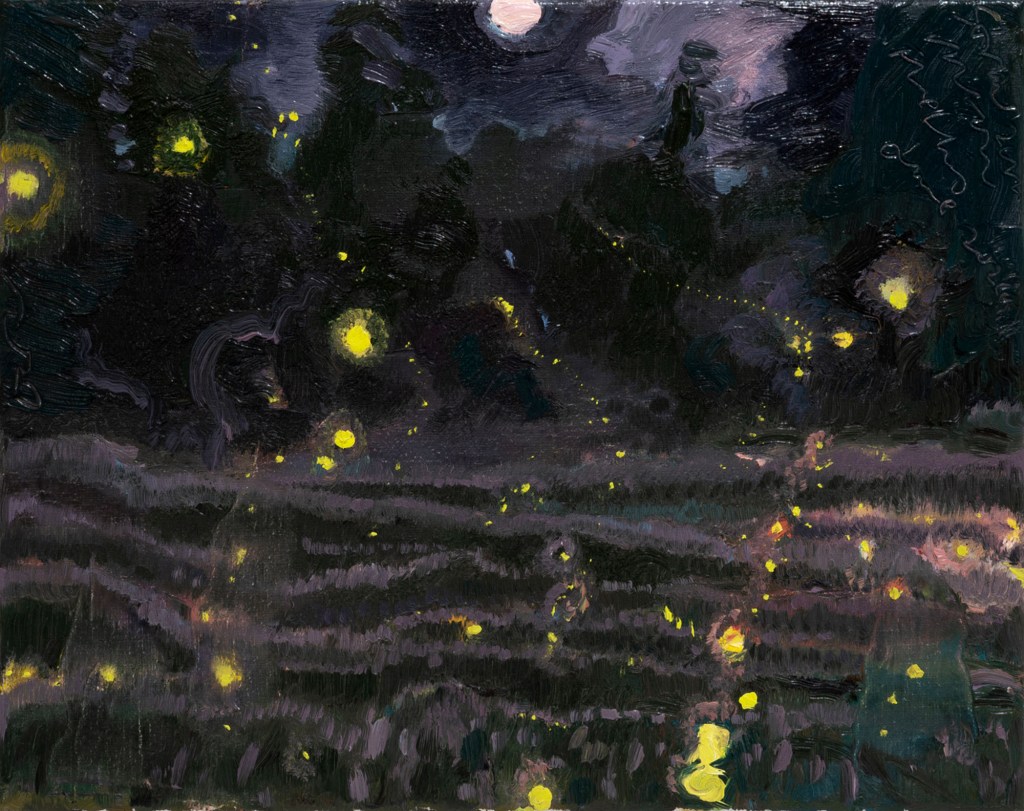
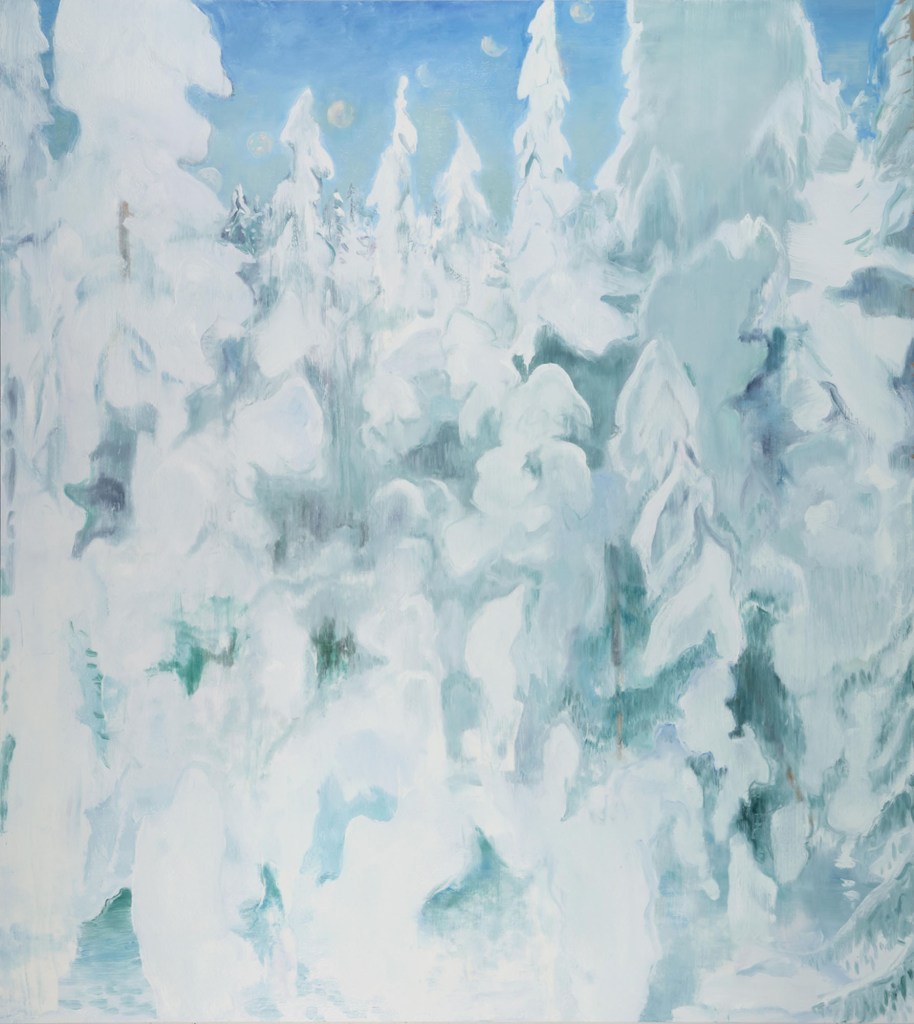
In all his paintings, Aho balances the demands of verisimilitude with those of painting. For each identifiable variety of wildflower or grass, there are many poetic transformations. He frequently inverts substance and immateriality. For example, the atmospheric nighttime haze of Fireflies in Mist and Moonlight appears palpably dense, while the snow covered trees in Daytime Moon are ethereal, unfurling toward the sky like billowing smoke. In that painting, Aho gives pictorial form to the passage of time, showing the moon at different points in its arc across the sky, an effect approximated in Strawberry Moon Firefly, where a lightning bug’s flight through the night sky is charted as a flickering trail of dots. For Aho, abstraction is not a departure from nature but rather a means of simulating the experience of it.
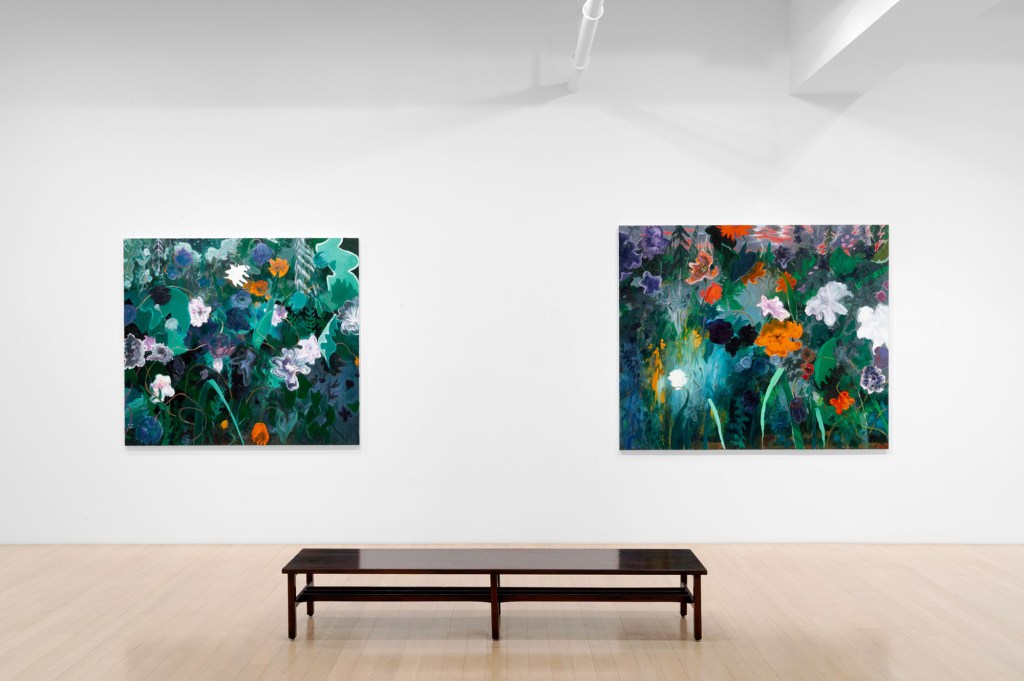
“Eric Aho: The Meadow’s Edge,” DC Moore Gallery, 535 West 22nd Street, New York, NY. Through November 14, 2026.
About the author: Alex Grimley is an art historian specializing in postwar and contemporary art, particularly Color Field painting. His writing addresses intersections of visual art, criticism, and experimental music.