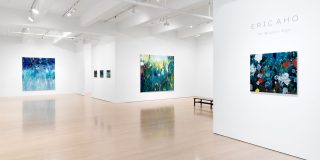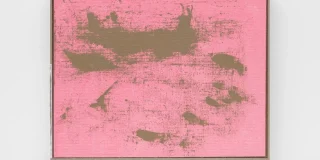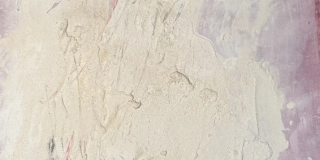
Two Coats of Paint invited artist-psychoanalyst Laurence Hegarty to meet with painter Steve Greene on the occasion of Greene’s solo show at Frosch & Co. They talked about the drones and ambient sound collages he plays in the studio, edges and scale, the wrinkled, net-like structures that function as grids, and how the colors migrate from one canvas to another. Greene also reflected on giving up collage for oil paint and generating new ideas from past failures.
Laurence Hegarty: It is always a puzzle where to start with conversations like this. Here we are in the gallery, and I’m supposed to pick a painting to start with? Randomly? Privileging one over the others? So, I was thinking I was struck by you saying the other day that the titles come last. I think you even said they come after the painting is finished? So, I perversely thought, let’s start backwards, start from the titles. How do you get to these titles and then how do we get back to the paintings by talking about the titles (if we do)? And even before you answer I want to acknowledge that the titles are evocative breadcrumb trails away, it seems to me, from the actual painting.
Steve Greene: It’s not that perverse to start with the titles, but you’re right they usually come last. Sometimes when I’m working, I’ll get an idea for a possible title. I’m working on something and it’s just like the title comes out. Maybe I’m listening to music, and I hear a lyric or some phrase will pop out. And I’ll put it on a post-it and put it next to the painting. Then I’ll forget about it!
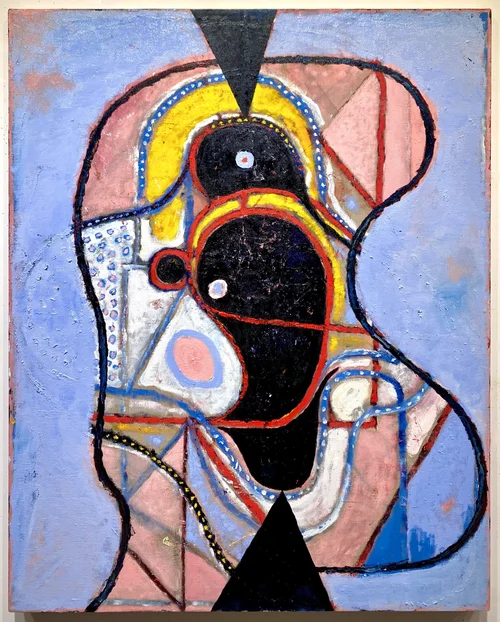
LH: It doesn’t necessarily come from the painting. It comes from the radio from out there, not outer space, but from over there some other place than the work?
SG: Right. It just has some connection that I can’t quite describe. Some kind of connection with what’s going on while I’m thinking about the painting. It could be a non-sequitur – it just sounds right at that moment, so I scribble it down and save it.
LH: Music is a constant in the studio?
SG: Sure, always. It’s interesting. My musical taste in the studio is not always the same thing that I would listen to when I’m driving in a car. In the studio its more drones, ambient, sound collage.
LH: Anti-anxiety music? Soothe the studio anxiety?
SG: Right, but it’s also abstract sound that seeps into my unconscious. It’s not foreground information that I’m receiving, but at the same time not background music, and not necessarily soothing.
But getting back to titles; what I do is I come up with them when there’s a show. I start thinking about the work that I have, and, OK! I need titles! I’m in my studio surrounded by work, and I make lists: words and phrases. I’m a list maker! The lists are not always title ideas, but I scan them for things that jump out. Maybe they’re phrases about matter, the body, maps, diagrams – they come from music, from poetry, things that I hear in the news. I end up with a catalogue of words, and I start forming them into poems. Connecting them in ways that are not necessarily a narrative. They all make some sort of sense to me. And when I join them with a painting, I end up with something else: like a third thing.
LH: Scattershot listening? And then something leaps out as different? You’re like a shrink, you listen to prose and hear poetry. I do like this notion of a “third thing”. This is the “thing” we end up calling the title? Or maybe not, maybe it’s some other “thing”. It feels disruptive, intrusive, in a good way. Something scratchy and distracting. It all leaves you grabbing around for a place for this third thing. I suppose we could call the titles poems, no? Something much vaguer than a capital P poem. Something just sort of poetic. And this poetic organization of meanings where you’ve just montaged words next to each other, it beckons; we end up with this thing we call a title. It sits there close to the painting and won’t let it be.
SG: Word collage!
LH: Right, collage. Which is, I think, how I see them relating to the paintings. And as with the best of collage or montage there is a weird but seductive gap. Something flickers up in that gap, there and gone, but in fact never quite gone.
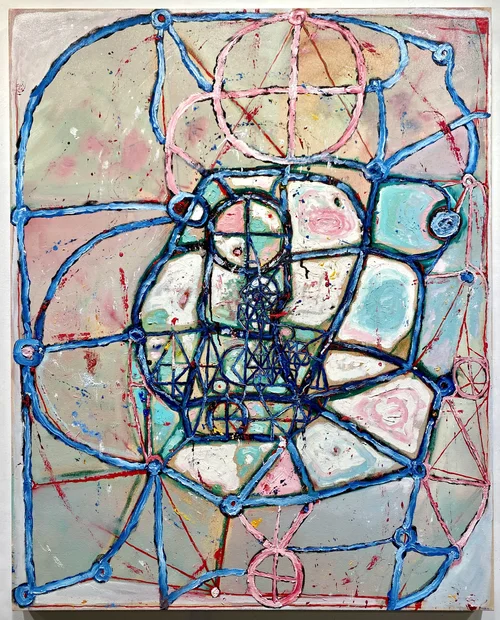
SG: Right, it’s like a sound collage, in conversation with the painting. I don’t like titles that are prescriptive, If you’re trying to make some kind of connection between a title and abstract painting why surrender to the literal? The titles are not telling the viewer what the painting is about; they add another element to the work. I know it when I see it, and if the viewer can’t find that thread that’s fine. Then it will create another question. I just don’t want the connection to be obvious.
LH: Oh, trust me, they’re not too obvious. But even if it is so, that you are the only one who would see the connection, by having a title, virtually any title, you raise the issue of the abstract visual field having meaning of some sort. With abstraction, one can hypothetically dodge the issue altogether. (well, not really) But if the artist throws a few words at the painting it changes the viewers relation to the object. Inevitably, you are inviting the viewer to follow your breadcrumbs.
SG: Basically, my goal is to have the title and the painting combined to create this third…
LH: Right. I like listening for that other weird, third thing. There’s a rift between the title and the painting, and something happens in there, something else a “third” term arises there, whatever it is. For me this third thing, the rift, the gap is important. It’s a place where stable meaning drops out, or there’s a lateral shift: something unconscious peeks through. Maybe it’s a place where something is co-created, viewer, painter and painted cobble it together.
SG: In a related way, I think inserting in the show a painting like this small black piece, gives you a little bit of a break and a pause.
LH: For the cobbling?
SG: It’s like a comma! Like a comma as you’re looking. Because so much of the work in this show is very clotted. and active.
LH: “Clotted” is a great word, you should use it as a title. I also I like the notion of punctuation.
SG: It’s a pause, a relief from interpretation.
LH: Seeing or saying this as a comma; the language analogy keeps creeping in somehow. Curiously, do you know what the actual title of this one is off the top of your head?
SG: Oh, this one is…It has one of the stranger titles. Out-of-body in the parking lot.
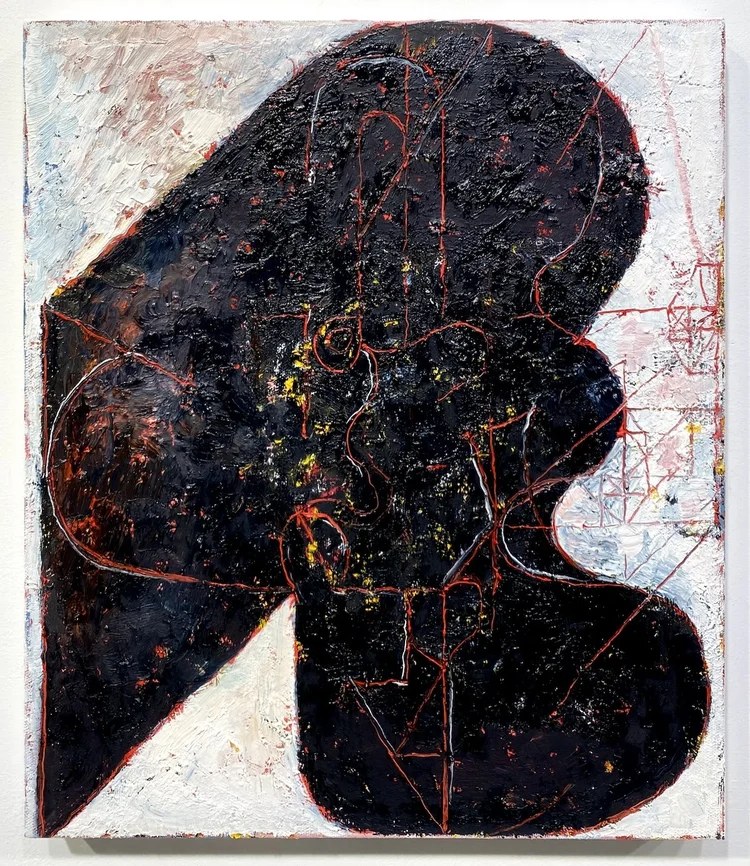
LH: That’s the title? How’d you get there? A parking lot? Out of body experience in a parking lot, dissociation in a parking lot? I’m being way too literal.
SG: I know what the image calls up from me and I’m trying to remember how I came up with it. I had an experience sitting in my car at a strip mall. They have all these speakers blasting music out in the parking lot. And it was playing some kind of pop music, Britney Spears or something like that. And it was malfunctioning, so it was just a pulsing static beat. I was sitting in the car, listening to this, and it sounded much better than it should have. It sounded like Alan Ravenstein playing synthesizer in Pere Ubu. And I’m listening to this, like a synthesizer solo…
LH: And from that, you get “out of body experience”? The perplexity –well maybe it’s me. Wonderfully enigmatic relationship between this abstract painting and its title; not to mention viewer, even the first viewer. I’m not sure that language really clarifies anything; probably we don’t need it to. Maybe it gives some pointers. It’s a bit like naming your emotions when your therapist asks how do you feel about that. There’s a lot of approximating going on. I’m more sold on the third thing we talked about. We’re not sure what it is but it has something to do with both the painting and the words. It provokes a very active sort of viewing, a very active relationship, toggling back and forth between the image the title, getting lost in the space between them. interestingly for a comma, it’s actually very activated; the surface, all these smaller lines.
SG: Well enigmatic, sure. But overall, you get this graphic sense of it as a big black shape. And when you get into it, you see that there’s just as much visually going on. There’s another painting underneath here. I can’t recall what it was. It’s partly that. But part of the surface color and marks are from taking another painting and smashing their faces together.
LH: That’s a way of things migrate across the studio, painting to painting; bam? The yellow came from some other place; from studio history. But it makes it your studio history a usable device. Within many other paintings you keep pointing to the edges, lines, image-devices that make sure we know where the edges are. Like you want us to know where the painting ends and the other stuff, the world, begins.
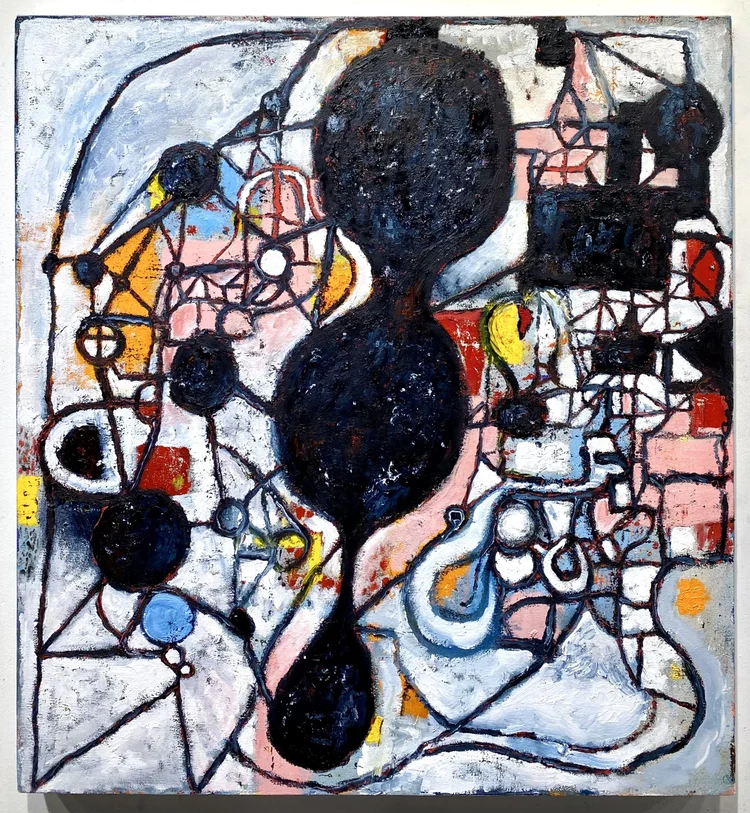
SG: Yeah, it’s interesting that you bring up these where they have points that go to the edges. All of them do that in different ways. Many of them have this line that circles the whole thing. My work is changing. Before, the outlined shapes pushed against the edges- the outline itself, of course, connects my work to comics and my reliance on drawing within painting. Now, the networks of structural lines that were localized before, are pushing out across the surface, but I am still running an outline close to the perimeter, it’s like a frame. Really, for me this goes to any question about scale. For me, it changes the way you look at the scale of the painting. And I just have this idea that when something goes off, completely off the plane, off the surface into infinity, you get a different feeling of scale than something that’s really contained. So, it keeps it really compacted for me and energized. And so, I think it makes it seem bigger than it really is.
LH: It occurs to me that what you are describing does organize the painting for a very particular viewing experience. Odd association here, but if it were cinema there would be no tracking shot. Just a singular almost fixed static POV shot. Weirdly like early cinema, from the same time frame as when western abstract painting was being invented.
SG: But on scale, you know it’s a strange thing. A very large painting that does not resonate can seem smaller. I sometimes find that huge paintings get in their own way. And this is a very personal observation. Being a painter of smallish paintings, before I can engage a huge work I have to get past several hurdles – how is it physically possible? Does it take more than one person? And then I get into my own thought traps about ego, ambition, money and the mechanics of the art world, any one of which might be unfair to the artist I am looking at. Nevertheless, I have to push these thoughts aside to fully engage with the work. Then there is the question – is very large painting more serious than small painting? The same way that painting is often seen as more serious than drawing?
LH: Well, the dynamism prevails. Like you said, it presents as larger than it is. Like this diamond shape you use is forcing towards the edges, trying to get out. And then there’s this thing going on.
SG: I don’t really think about them as grids, but I’m very aware that they function as grids. I liken it to a net that’s wrinkled up.
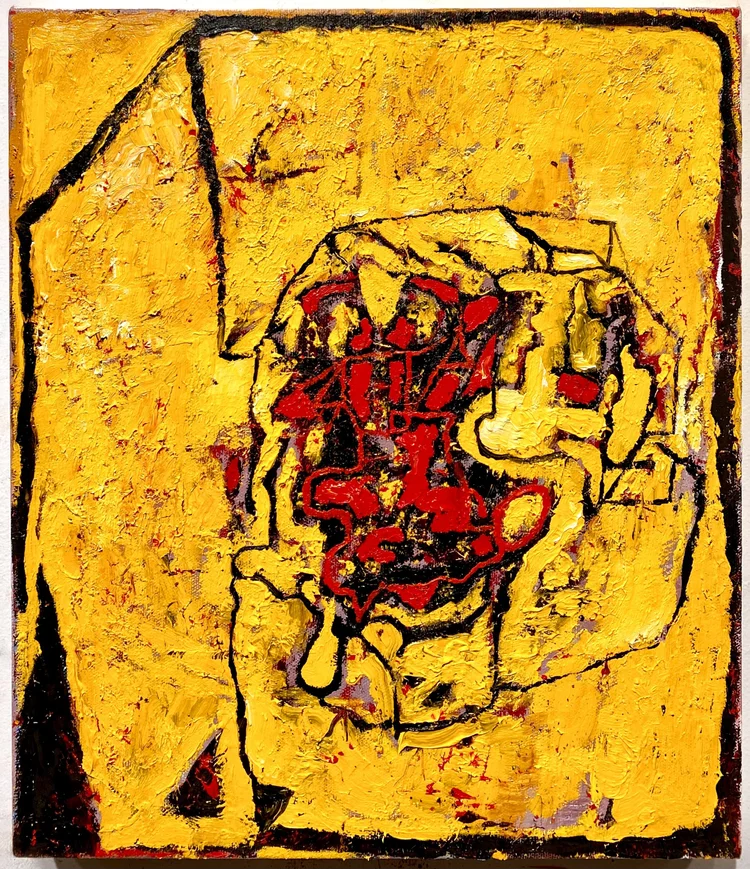
LH: What I do I see is that sometimes the wrinkly net is obliterating something behind; cancelling out something else. I’m not even sure I can say what it was that was cancelled out, but there’s an act of cancelling out some previous element? We get a sense of your past studio life here. An archaeology. Maybe anti-necrology, you don’t want corpses lying around? Something repressed? A gap where some past something flits through momentarily?
SG: Well, getting rid of collage was big.
LH: Collage is the one of the corpses, no? It’s not in this body of work, but there are others I’ve seen images of, past work. where the collage is very apparent.
SG: A lot has to do with the physical properties of oil paint, with collage I would use acrylic glue to adhere the collage down on the canvas, then coat with an acrylic clear coat, and then start using oil paint on top of that. With these paintings, I dropped the collage because for one thing I was returning to painting. The collage was a way of building an underpainting. And then working on top of that because it became sort of a structure. In these paintings, I got rid of the collage and I’m using my drawing as a structure to hang the painting.
Also, the drawing happens to be somewhat grid-like. Right? For me, this structure is one way of keeping the painting from sliding off the wall. It’s this thing that holds the painting. It’s a structure that I can nestle these organic shapes inside.
I think the imagery that I use is kind of not circular, but kind of spiral in that I’m always looking at… coming up with new ideas for imagery, but I’m always looking at my older work. Not looking to repeat things that were successful, but a lot of times looking at things that were failures, but I thought there was an idea there. Something I was never able to really pull off five years ago. And what if I tried that again, but combine it with something else that I’ve learned?
LH: Your own archaeology, your own history as a point of departure?
SG: Older ideas, I think? I, mean, next year I might be doing, I might be doing paintings of stacked tires and trucks again.
LH: That’s hard to imagine. I need to see the older work. For now, instead of tires there is also a biomorphic quality to a lot of the work.
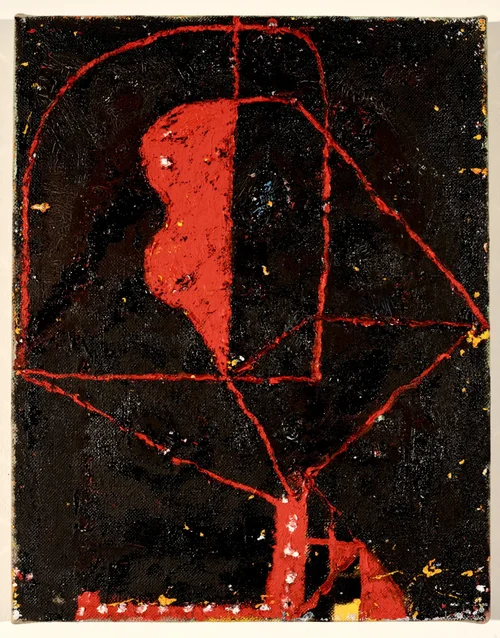
SG: Yes, I think of a lot of them as heads, honestly. I mean, almost all of them. And I keep threatening to make them into more obvious figure paintings and figure drawings, but it doesn’t happen. It hasn’t happened yet. But now that I’m saying it out loud, maybe that may just get it to happen.
“Steve Greene: New Paintings,” Frosch & Co. 34 East Broadway, New York, NY. through November 29, 2026.
About the author: Laurence Hegarty is a New York-based artist and psychoanalyst.