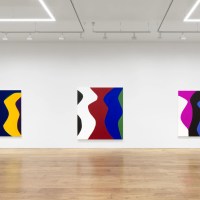
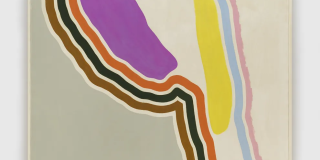
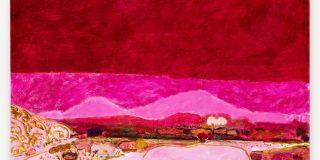
Contributed by Amanda Church / Marina Adams has long been exploring the range of allusions that can be conjured by various color combinations and the scale and placement of simple shapes, which press up and vibrate against each other in subtle, sexy ways. Curvy configurations, interspersed with diamonds and triangles, hint at myriad aspects of nature and the female form. In Adams’ current show “Cosmic Repair” at Timothy Taylor, variations on this trajectory continue in nine paintings, all new and acrylic on linen except Singing to the Highest Deity from 2020 hanging by itself in the back room. Influences range from Matisse to, according to the press release, “Uzbek textiles, Indigenous American Southwest pottery, and the Great Pyramids.”
Tag: Minimalism
Susan Rothenberg: The way things can’t be
Contributed by Jason Andrew / Susan Rothenberg’s exhibition “The Weather,” now up at Hauser & Wirth, is a rare chance to experience the breadth and intensity of one of most vital influences in American painting. The exhibition gathers fourteen works from across her career – horses, fragmented bodies, and spectral forms – some rarely or never before exhibited. Rothenberg told the LA Times in 1983 that she liked to think of the subjects in her paintings as being “swept along in unconfined space by forces of weather” – rendered in thermal swirls and blizzardy brush marks – and the exhibition is structured around this idea.
Claudia Parducci: Catching the falling dust
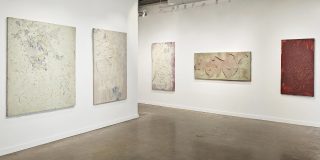
Contributed by Doug Milford / Good art can have multiple sources of meaning – material, color, scale, intention, chance, change, process, metaphor, ontology, epistemology, philosophy, biography, zeitgeist, history, and more. These may or may not be apparent or even deliberate, but they make up the work’s internal structure and shape its style. Ideally though certainly not always, these influences operate in concert while remaining distinct. The nine works in Claudia Parducci’s exhibition “Blue”, at Ochi Gallery in Los Angeles in February and March, achieve this balance, both as individual pieces and as an ensemble. The six years that had passed since her previous show included a three-year hiatus from painting after the death of her husband, the artist Peter Alexander, in 2020. This body of work was a response to his passing.
Ted Stamm’s conceptual adventurism
Contributed by Saul Ostrow / When Ted Stamm’s career was cut short by his death at age 39 in 1984, he had already begun to attract attention in the United States and internationally. Critics including Edit deAk, Peter Frank, Robert Morgan, and Kay Larson recognized Stamm’s ability to bridge formal rigor with playful urban references. In 1975, deAk wrote in Artforum that “Stamm’s work confounds its own apparent simplicity; the shape’s tense complexity and stubborn definition of itself make it totally the artist’s like an insignia. The color is equally personal, and the painting’s presence is quietly assertive. This is certainly not the elegant nihilism of reductive solutions.” Conceptual endeavors were central to his ambition of making the border between art and everyday life porous.
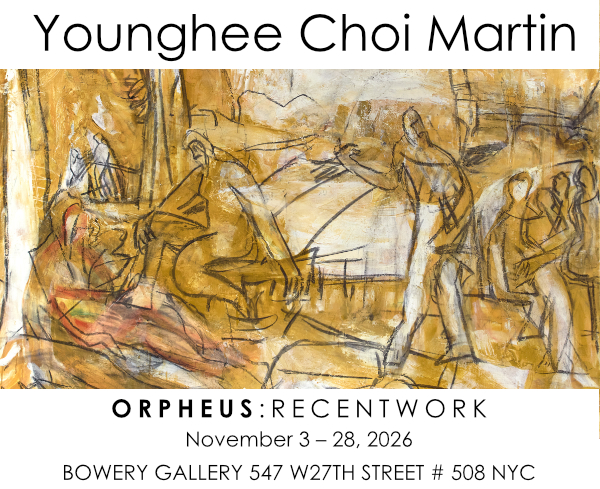
Call it Orphism
Contributed by Adam Simon / At a Four Walls event in Brooklyn in the early 1990s, Erik Oppenheim, at that time a young artist, stood up and said, “I’m starting an art movement. Anyone who wants to join, meet me in the back after the show.” It was a hilarious and audacious gesture, in part because no one joins an art movement on a whim, like a list-serve or an exercise class, but also because there hadn’t been any artist-initiated movements for a very long time. They proliferated in the late nineteenth and early twentieth century with the advent of Impressionism, Surrealism, Futurism, and Dada, and enjoyed something of a resurgence in the 1960s with Fluxus in the United States, Supports/Surfaces and Zero in Europe, and the Gutai Group in Japan. Most of what we consider movements were proclaimed by an outside observer, usually a critic or curator, looking to group artists who had similar concerns and made work that fit the designation. For the artists themselves to rally around a specific cause, even an aesthetic one, was not required.
Morandi’s pointed timelessness
Contributed by David Carrier / Giorgio Morandi was born in 1890 and died in 1964. After the 1910s, when his art had some affinities with that of Giorgio de Chirico, he painted only still lives – bottles or flowers – and landscapes. “Time Suspended, part II” at Mattia de Luca Gallery, part I having been staged earlier in Italy, is a blessedly large presentation of 45 paintings and fifteen works on paper that reveals how little other artists or current events – indeed, anything outside of his studio life – affected his work.
Mark Dagley’s little god
Contributed by Michael Brennan / As a boy, the sculptor Tony Smith – a canonically important and under-appreciated American sculptor who connects AbEx and Minimalism, equally at home with Pollock and Serra – suffered from tuberculosis so severe that his father built him a small shed in the backyard of their South Orange, New Jersey, home, with fiberglass curtains to minimize dust and a small black stove. Smith lived in the spartan outbuilding for several years. Imaging him there might elicit the melancholy that Van Morrison conveys in his aching ballad “T.B. Sheets.” As an adult, however, Smith noted an upside, at least for an artist: “If one spends a long time in a room with only one object, that object becomes a little god.” I grasped the significance of this observation acutely when I encountered Mark Dagley’s sloop-like sculpture Vāyu-Vāta, which, pointed away from a black radiator and darkly mullioned window, dominates the Abaton Project Room in the Financial District.
Jill Nathanson: Beyond Color Field painting
Contributed by A.V. Ryan / Jill Nathanson’s solo show “Chord Field” opened in late June at Berry Campbell Gallery. It is her fourth at the gallery but her first in its spacious, skylit new space. It seemed a fine opportunity to talk to her about her work, new and old.
Hung Liu’s timeless twentieth century
Contributed by Rosetta Marantz Cohen / Rare among contemporary artists, Hung Liu, who died in 2021, chronicled the trauma experienced by the Chinese diaspora in the aftermath of the Cultural Revolution. Her paintings, currently on view at Ryan Lee, vividly depict a female artist’s efforts to reconcile the terror of China’s recent past and the “otherness” she experienced after her emigration to the United States. The exhibit seems especially poignant now as questions about homeland, memory, and trauma resonate with such immediacy.
Alessandro Twombly: Strikingly original, richly allusive
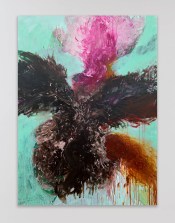
Contributed by David Carrier / Alessandro Twombly’s twelve large new paintings, now on view at Amanita Gallery, all employ one basic, immensely fruitful motif: knots of color resembling enlarged floral forms, depicted in high-pitched, gesturally painted oranges, pinks, reds, and blacks on bright turquoise backgrounds. An artist friend nicknamed these pictures ‘Tiepolo in the Sky,” which accurately describes them. Twombly’s abstract images look like drastically enlarged figures you might find in a work by the eighteenth-century Italian painter Giovanni Battista Tiepolo. They are strikingly original yet richly allusive.
Zilia S�nchez, surrounded by the sea
Contributed by Katarina Wong / In Zilia S�nchez�s retrospective currently on view at The Phillips Collection, a video shows her on the beach, casting one […]