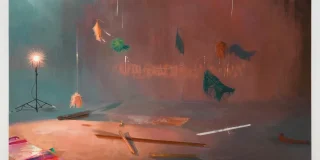
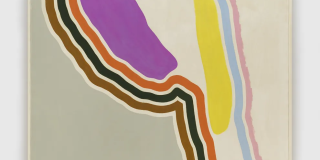
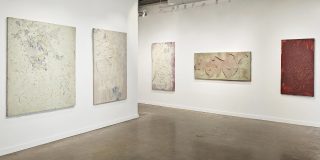
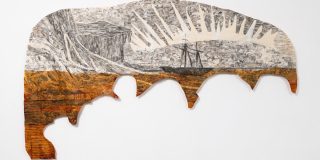
This conversation took place on April 27, 2026, between Kerry Downey and Julián Kreimer at Sarah Lawrence College Heimbolt Center for Visual Art during Kreimer’s exhibition, “Yuyo.” The exhibition was on view April 2-May 8, 2026.
Kerry Downey: When I go into a gallery, I want to give myself permission to wander around and have an experience and without reading the press release of needing to know anything first. My first experience of this work is pattern and color, tone and texture. There are a lot of overlapping lines, crisscrossing latticework and an almost lace-like or mosaic effect. I notice how representation and abstraction are deeply woven together, maybe even co- determining each other.
There’s an intense sense of touch in this work. There’s a lot of labor; there’s a lot of care. There’s a practice of working across surfaces and diffusing surfaces, a sense of something proliferating. Dare I say, a wildness and an aliveness in this work. There are moments of psychedelia mixed with close observational studies. Who makes plein air paintings of construction sites?!
This work resonates with me on so many levels. There’s a sense in which you making the image is making a world, and the world is making you; that the construction is deconstruction and co-construction, so that figure makes ground, ground makes figure, positive space makes negative space. They’re holding hands together in a push-pull dynamic.
When I think about this wildness, there is a sense of growth or expansion, it leads me to the title of the show, which is called “Yuyo.” I understand this was a lifelong family nickname and that it is also a Spanish word for “weed.” Could you talk about your associations with this nickname and the idea of “proliferation” in your work?
Julián Kreimer: I like to go to what’s embarrassing, what you’re not supposed to be making work about. Making work about your parents and your relationship to your parents as a middle-aged person is a deeply embarrassing thing. I didn’t choose my nickname, my parents gave it to me, partly because I was tall, but also running outside and spending all my time in the backyard or whatever, playing with rocks and discovering how big a hole can I make with a hose? Just like shooting water at the ground and my parents coming home terrified, “How did you make this pit?”
I never really interrogated the nickname until 2006 when I taught study abroad in Argentina, where my parents are from, and where I spent time through my life. We had the luck to get Luís Felipe Noé, one of Argentina’s most respected painters, to join us, his nickname was also Yuyo and I thought: oh my God, it’s like the stars have led me on this path!
Noé, like my parents and a lot of intellectuals and artists of their generation, left Argentina in the 70s and had kids abroad, the parents had to leave for a combination of political and economic reasons, and then they just couldn’t go back. The worst dictatorship in Argentina started in March of ‘76, and I was born in November, my parents couldn’t really go back in the thick of that.
In some other universe there’s a version of me that grew up there, and I always wondered what that me is like.
In this universe, I lived like a 100% dual life where nobody ever spoke English at home, ever. It was extremely awkward when a friend would come over and I’d have to decide whether to speak English to my parents. It was almost physically painful. But when I’d go back to Argentina, my cousins would joke that I sounded like I was from the 70s, from growing up in this linguistic bubble.
But I love that the word “yuyo” is not Spanish you learn in school, it’s regional. When Vera Iliatova, who did an amazing job curating, asked me for the title, I knew I wanted to use “Yuyo,” but I figured I should look it up, in case it’s a bad word. I noticed that it is only used in Argentina, Peru and Uruguay, so essentially the Incan empire, and sure enough it’s a borrowed Quechua word, the language of the Incas.
There’s a split in Spanish, where a lot of South American words derive from Quechua, so for avocado, instead of “aguacate” which is Nahuatl, from the Aztecs, in the Southern Cone of the Americas they say “palta,” which is Quechua. I started realizing that the language I spoke my whole life is imbued with this history. My family’s been in Argentina since the 1890s, but the history is so entwined.
Since I love the embarrassing, … This is going to be hard to talk about.
[Deep exhale, pause…]
For my parent’s generation, middle class families in Latin America in the late ‘60s or ‘70s, they often had a servant, often of indigenous descent. There’s been amazing Argentine films about this dynamic, like Lucrecia Martel’s films or Roma, or Jorge Gaggero’s Cama Adentro [Live-in Maid]. The Argentine-Brazilian sociologist Rita Segato talks about how in Latin America people would have their biological mother, and then they would have a woman who bathes and cooks for them and raises them, the one who touched them: the servant, basically. Segato calls them the saltwater and freshwater mother.
So my biological, saltwater, mother, is here in the video, in her office at the National Science Foundation. She and my dad had to be super badass professionals to get jobs that would allow them to stay in the US and not go back to the dictatorship in Argentina. So my mom taught at MIT and then worked at the world Bank and was a force of nature. While my, freshwater mother who cooked for me and raised me because my mom was busy, was Peruvian: Blanca, who learned Spanish at 18 after moving to Lima, her native language was Quechua. She taught me a few words when I would do homework in the kitchen, because she was who I would hang out with after school. Blanca moved back to Peru in 2010 when my parents separated and my dad moved back to Argentina. She’d visit DC and we stayed in touch. We spoke again during the pandemic after a few years, and it was super-powerful to talk to this person whom I have this profound bond with, our lives were, entirely connected and entirely separate. And that’s something that we don’t talk about in the States, where most people don’t have the experience of growing up with that bond with a servant. But I think in much of the rest of the world, it’s a profound, but mostly buried thing.


Kerry Downey: I want to zoom out a little bit and talk about multilingual layers. You’re speaking of pulling us into a world and then there’s another world inside that. In going back to my initial phenomenological experience, there’s a lot of narrative and context that’s not obvious with a first look.
Knowing your mother worked for the World Bank in disaster relief and urban planning adds a significant layer to your plein air paintings of construction sites. We think about post-earthquake, post-flood, post-fire, this world that we’re living in that’s incredibly precarious. I’m thinking about the forms of labor that go into relief work, which is emotional, it’s physical, it’s architectural, it’s creative, it’s social. Considering this helped me unpack the connections between all of this and narratives you’re exploring, but also the formal connections because you’re painting observationally, outside, like the Impressionists, which is a very romanticized form of painting. You go outside, you’re in nature and it’s beautiful. The light is changing, you feel the wind in your hair or kissing your face. Maybe there’s a mist of rain. The seasons are changing and you’re doing the work of observation.
With the additional context of your mom doing disaster relief work, you are making contemporary the idea of plein air to be about our nature today, how so many of us are living inside different kinds of construction sites: our campuses, our neighborhoods, our buildings. We are living inside spaces that are in various forms of disruption and endless transformation.
While you’re not eliminating the romantic ideals of the Impressionists, there is sociopolitical way that you’re working. Can you talk about how your plein air engages the social space of your neighborhood, how you’re painting in front of other people, and how your work is influenced by your mom’s work and the impacts of climate catastrophe and themes of construction and deconstruction?
Julián Kreimer: My mother was an architect who later specialized in urban planning and disaster relief. She got hired by the World Bank partly because they were looking for a planner with a PhD who was willing to fly on a dime to Mexico after the earthquake in 1979, while people were still being exhumed alive from the ruins.
That’s what she talks about in the video, how the buildings in Mexico City just flattened like “panqueques,” with tons of textile workers inside. Apart from immediate mitigation and rebuilding, she helped change the seismic rules for buildings, so you don’t hear about that level of death after earthquakes in Mexico since then.
When I interviewed her, she explained that they can’t use heavy equipment to pull the rubble off people inside because it will crush them. They do it by hand. And you’re hearing these people stuck underneath. It hit me that she was in her 30s with a little three-year old kid, me, running around at home back in DC while she’s dealing with this. Even when the newspaper celebrated the rescues, those people never survive a week after they’re rescued because their thorax is crushed. That detail, that she was so matter of fact about, was just part of her professional life. The closeness to death that both my parents had in their work, in their official roles, was intense.
In terms of your question, I’ve always been obsessed with construction, I think partly through my mom’s practice as an architect and urban planner and thinking about things like seismic resilience. In our house, “Le Corbusier” was a bad word, because his piloti system, that was copied all over Latin America, was seismically insufficient. So my mom, despite being a big Modernist, felt that his influence was responsible for thousands of unnecessary deaths. Construction was just part of our lives, they renovated a couple houses when I was little, and my dad felt that empty construction sites were perfect weekend play spots for me and my friends, climbing over 2x4s and clambering up ladders. Every weekend we would go see building sites or open houses and think about the architecture, how things are built.
These construction paintings were all done between my apartment and my studio a mile and a half away in Brooklyn. There was so much construction constantly. I thought about the paintings Manet did when Paris was under renovation by Baron Haussmann in the 1800s. We think of Paris as this fixed thing, but Manet was like, no, for like 50 years it was just one huge construction site. Brooklyn still is a giant construction site, particularly near Gowanus. I decided to only paint worksites in this one and a half mile stretch. We think of things as fixed, “things used to be so good or “look at how beautiful it is now.” But we live in this constant state of uncertainty and, unfinishedness, what does the reality of our flux state look like?
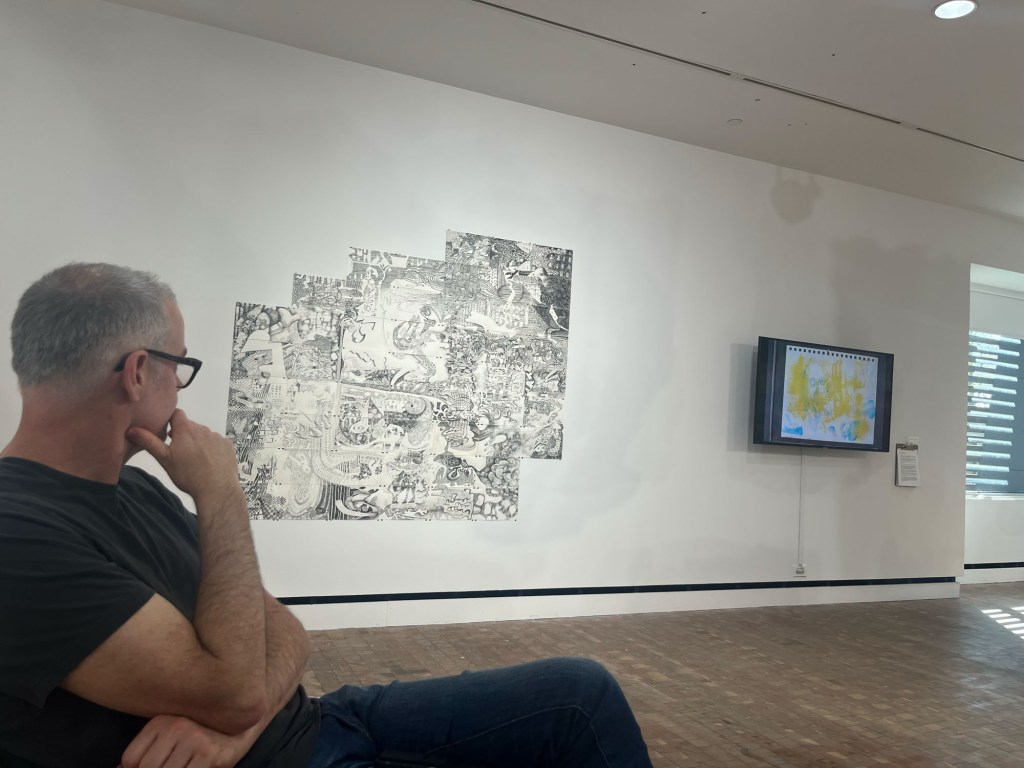
Kerry Downey: It’s impossible to look at your work and not read the intensity of your creative experience as a maker in the work, which then becomes available to the viewer. There so much care and labor in the ways you make contact with your materials and embed your familial histories. One could have a deeply satisfying formal experience of this work but miss important details, for example, these drawings were made on 54 sheets of your father Osvaldo’s letterhead. Your Escher-like psychedelic patterns look like doodles that we do on the phone. But then you fully commit to the doodle and take it to the next level by repeating them on 54 interconnected sheets of paper.
There’s another story here which is that your father is a master calligrapher. There is a connection to penmanship, where mark making or drawing and a doodle has this other layer behind it, too, which is about the haptics, the touch, the movement of the hand, and writing as drawing. Your father taught you calligraphy as a kid?

Julián Kreimer: He taught, but I failed to learn it.
Kerry Downey: Right! This is the thing about our parents– they attempt to teach us all kinds of things, and then we do our own kind of integration or translation of that knowledge. We have to make our own sense of what we can and can’t learn from them. Since my Spanish is terrible, can you tell us the name of that piece?
Julián Kreimer: It’s la (in)herencia de la última caligrafía del Buenos Aires. Forgive my thick porteño accent. There’s a lot of wordplay in that.
Kerry Downey: There’s this doubling or tripling of meanings here.
Julián Kreimer: In Spanish, an inheritance is “una herencia,” like in English but without the “in”. I added the “in” back in with its Latin meaning of “non,” so it becomes the “non-inheritance”. Then “la última caligrafía del Buenos Aires,” it’s a thing only people in that city will understand, because when you add the masculine article and say “el Buenos Aires” it connotes the selective public high school my dad went to, “El Colegio Nacional de Buenos Aires.”.
My dad was born in 1936, so he went there when Juan Perón was president. His was the last cohort where they were required to learn calligraphy, a holdover from the colonial period when, if you’re going to be in public service or govern, you needed to know beautiful lettering for official documents.
My dad would tell me about this sadistic calligraphy teacher who assigned them to repeat the same mark for two hours, if you took a break to get a glass of water or pee or even rest your hand, he would know. He would make you redo it all because you could see the change in the hand of just a diagonal line. His whole, life my dad, without looking at any source, could create incredible calligraphy.
He would always bring me gifts of little or wide pen nibs and beginner manuals. I could never learn because I didn’t have his training, even though I would try to copy the books. But I did learn how to use a nib pen.
So the “non-inheritance of the last calligraphy of the Buenos Aires” is the direct translation, but there’s lots of layers in there.
I did not inherit his calligraphy, and I was not able to inherit his version of Argentina, and I was not able to inherit… there’s all these things we do not get from our parents that they want us to get. But I’m a doodler, I doodle at faculty meetings. I doodle all the time.
I totally took on the doodle as my “non-calligraphy”. I had these 54 sheets of his letterhead that were left over when I moved my parents’ stuff that I couldn’t throw this away, that felt like sacrilege. But I can’t write letters on his paper, either. So I started doodling on it and kept drawing until I ran out of paper. The only rules were that I just start, no pencil sketch, no planning, no erasing. I could only use the one nib pen that I would dip into black. I could water it down, but I could only use black ink. And keep adding sheets to the drawing until they run out.
The weird overall shape was because each thing would head one way or the other and then I finally just ran out of sheets.
Kerry Downey: I like the way that the drawings are organized like steps, so they are ascending and descending, which makes me think about inheritance. There’s something here about the patrilineal inheritance with ‘the father,’ but it’s also about the country, and it’s also about the culture, which is also about craft and skill of calligraphy.
We’ve both worked with Mina Takahashi, a “master” paper maker. We still call master printers “master printers”. Inside that there’s a kind of colonial legacy of “mastery.” We want to learn those skills and keep them alive but we are hopefully decolonizing or re-situating them through new lenses. There’s a tension in the patrilineal relationship between one’s father and inheritance. There’s an honoring here, even a pleasure because of the way you’re working with the doodle through an almost automatic surrealist technique and the exquisite corpse way you make your drawings connect, which also imbues the work with a psychology, getting up int a mental world that you’re inhabiting.
You have a very temporal and embodied way of working with your family’s history and archive, especially with this piece made from projecting slides, tracing them and making the still images into a video. You draw several versions of the same slide and then splice them together, which creates both connection and gaps. There are gaps between the images, a gap between the original image and your translation, there are generational gaps between you and your parents, relationship gaps.
How do you manage the anxiety of translation, potential gaps in understanding? In working with archival materials, what permissions are we allowed to give ourselves, how much are we allowed to move away from the original content?

Julián Kreimer: For many years I painted the world around me because I felt like I wanted to embed all these layers of meaning into what’s around us— a very 19th century French idea. I was really committed to that possibility. I was scared to deal with this kind of narrative archive.
Kerry Downey: Why were you afraid?
Julián Kreimer: It’s a combination. My mom had a teacher in the ‘50s, who was probably trained in the 1910s, who said using photographs was bad, so my mom transmitted this idea in the 1980s from the 1910s, so it was deep inside me. When I finished undergrad and I could finally paint in solitude, away from other people, I gorged myself on painting from deadpan photos I’d take, a la Tuymans. So I got over that photo thing in my 20s. But I made this piece over the last ten years, in my 40s.
When my dad moved back to Argentina, I inherited 50 years of slides. Both my parents worked for international organizations, where they had to document the work that they would do on ‘missions’ and bring it back to D.C. to report on the progress, what had been done. In the international organization world, when you go to a country, you’re on a mission, even though there’s not there’s no religious component. It was mixed with family photos, like me and my mom on the beach.
The video has this mix of personal photos from DC, the house I grew up in, that my mom renovated. I didn’t know if I could bring myself to really look at them for more than ten minutes, because it was so heavy to be re-viewing my childhood. I wasn’t seeing a psychologist at the time. I couldn’t handle that much family intensity going back into the past, but I slowly started looking at them.
My dad came to visit and I asked him to help me make sense of this archive on a huge studio table just covered with these boxes of slides. They’re tedious to look at–you take them out one by one, lay them out, peer through a tiny loupe. I turned my whole studio to a giant set of light tables–shop lights under glass tables. I had to go through the slides twice, in 2016-17 and then a second pass a few years later, in 2023 on sabbatical, it took me three months to go through every single slide and choose an arc and figure out which ones to use. To go through everything was insane. At that point I started psycho-analysis, which was helpful, because all the slides are from my parent’s point of view. I’m viewing the world that they saw over their entire working lives, from like 1950-something until about 2003.
I would put them in the carousel and then place the projector a few feet from the sketchbook to make quick, fragmentary drawings. When I show the fragments fast enough, the mind composes the image–persistence of vision. Which is how we see the world, that’s what I learned from my years of landscape painting. We don’t really see the world; we see little fragments, and we make up a story about what’s in between those fragments. I wanted to make that very literal.
It took ten years because I would do it for a few months, then take a break, then choose another bunch of slides to draw from. I’d go into some kind of catatonic state where I wouldn’t want to go to the studio for two weeks because it was too much. And I would then switch back to painting on-site or do abstract drawings, and every six months or year I would be like, okay, let me take another stab at the slides.
Meanwhile I was interviewing my parents in spurts about the images. What’s this? What’s that? They would tell their stories. I collected five hours of interviews about their work, which I edited down to about ten minutes for the video. One of the spurs was that I started watching Narcos on Netflix. It was set in the 70s and 80s, 100% in my childhood, but the side that I heard about from my parents when they’d come back from their missions. I was friends in college with one of the writers from Narcos Mexico. She’s Mexican, and I thought, “Oh my God, Eva is doing the same thing, having the same experience.” I could just tell. She was from a culturally prominent Mexican family and she knew that history firsthand.
My dad was a human rights lawyer and did indigenous rights and, he would tell me stories of visiting Colombia in the 80s, “we had guards on motorcycle around our van, each bike had one machine gun guy and one driver.” They went to eat and they in the farthest back table of the restaurant, and the armed guards stood behind the columns by the windows. A lot of my parents’ stories about that time would end with something like, “there was this incredible young guy who was part of this movement to get housing. They killed him.” They had to have thick shells. Part of my dad’s work as a human-rights lawyer was to go to the jungle to evaluate whether a massacre had happened within these civil wars in Latin America, meet with death squad hitmen, with hundreds of notches, in Guatemalan prisons to evaluate whether to cut a deal for information about their commanders.
I realized, with my slides (as with Narcos) that that we’re embedding this tiny biographical story within the story of this country, but also in the late cold War geopolitical context. I was understanding, on a gut level, how my parents happened to be Latin American intellectuals and professionals within this. The video starts with my dad talking about how the OAS was critiqued for being a front, the Latin American-control wing of the U.S government. “Those of us who worked for the OAS and some smart people in Latin America were well aware of this reputation, But we realized we could do a ton of good even within that structure.”
The video mixes personal scenes of my childhood, our house, with the scenes that they took on their missions: the Mexico City earthquake, that’s Colombia, engineers going to evaluate housing that had been built under the World Bank’s funding, that one was in Nicaragua.
Kerry Downey: This piece generates a lot of ideas for ways we can contextualize our own work. It anchors and grounds the show even more so than the press release. It opens up the political gesture of the work and the social and cultural context. Your work shows us different strategies for revealing, unpacking, narrativizing content. You also have different ways of working durationally. There’s part of your practice that takes ten years or longer and requires revision and other images, like plein air painting, that take 4-6 hours.
Julián Kreimer: The first version of this animation was in 2018 or 17 before the pandemic and this iteration, we edited down to about ten minutes. We finished it the Monday before the show opened. I was still tweaking it with the editor. I was in Buenos Aires and she was here, we were watching on a shared screen, it was like “can you lengthen this by two seconds?” It’s ten years, but we still came up against the deadline.
Kerry Downey: You can make really good moves at the last minute in an unexpected context. You can work with unexpected opportunities. That’s another modality or speed of working that is improvisational.
Julián Kreimer: I’ve made a lot of colored pencil drawings on individual 22” by 30” sheets, that often took months or years, but kept a lot of improvisation as erasing played a big part in the making. This big tiled one, Woodley Woods, I finished a few weeks before the show opened. Technically, it started like eight years ago, but really the bulk of it was done in the last six months before the show. I had a couple of colored pencil drawings from 8 years ago in the in-progress drawer. So I started with those three, I started sticking white sheets between and around them.
There’s this image of Bonnard where he would keep his paint on a chipped plate on one side of the studio, and the painting would be on the far wall, and he’d walk across the studio to make a mark and then walk all the way back to get more paint. There’s a little bit of that with the color pencils, because it’s like, I could only make so many marks before I have to sharpen it. I would alternate between working them on the wall together and sometimes working on the desk, back and forth. So technically the piece started eight years ago, but really it was made in the last few months before the show, finishing it a week before install.
I kept looking at these small drawings I made at MacDowell that we decided not to include in the show. My friend’s father had died right when I got to the residency in spring of 2017. But it was Pesach, so the rabbi can’t bury him, they’re trying to figure out when to have the burial. He was close with my dad, Argentine marooned in DC together, so my dad sent me a eulogy from Argentina that I had to translate and read at the burial. I’m in NH waiting for the call to drive down 8 hours to DC, stop in Brooklyn to get my suit, mourn, and drive back. While I waited, I just drew in the woods behind my studio because I can’t get into painting, it’s too involved, I can’t do it while listening for the ring. I kept the suite of drawings tucked away in a studio drawer, and I didn’t look at them for years. Halfway through this big piece, I realized that I needed the landscape drawings to bring space into this drawing, a sense of the woods. I pinned them on the side wall as reference. The title, Woodley Woods, refers to my plunging into the few yards of woods behind my childhood home, on Woodley Road, the address in the letterhead drawing.

Audience Q+A:
Audience member Sharon Horvath: Would you ever have a huge piece of paper and sort of work this way, or is it important to be able to have all the pieces?
Julián Kreimer: I like the modularity, the stubbornness of acknowledging that we live in a world where real estate is a thing. It’s hard to store large paper. With the landscape paintings I had a dealer tell me, “I can’t sell these unless they’re couch-sized,” but I can’t make couch-sized observational paintings at construction sites. I like revealing the process through the scale.
Audience member Susan Ziegler: I’m just thinking about this enormous sort of swirl of your parents’ career, their lives, the cold war, Argentina, the U.S. you have all of this kind of funneling into you. This work just feels like it’s now this vortex kind of coming out the other way. But, I mean, I think of that it’s like an extraordinary pressure on a single person, on an only child.
Julián Kreimer: I would say for all eight oil paintings (I made observational oil paintings for 15 or 20 years) in that whole series of work I had to put everything I’d ever read and thought and every movie I’d seen and everything I experienced into each six-hour painting.I love that work, but there’s a tightness to it, it’s coiled in a way that’s very different from the sprawling new stuff. I love how Vera brought those two together.
Your comment resonates with the idea in the last few years of taking up this much scale. A lot of this newer work is in response to the physical act of eldercare, driving and flying, the hospital and the fluids when you’re dealing with elderly parents. I accidentally spilled the brown paper-pulp in these pieces in the studio with Mina and it felt like the universe telling me this was a necessary step, dog hair and all: squeegee this back into the bucket and use it because that’s the reality of those liquids, the bile and poop and blood.
That opening up was me being honest to myself about the scale of the physical act of dealing with somebody who’s old and sick. The vortex of opening up you asked about, it’s like elder care–you have to go from being the smallest person in the hospital room where the doctors are, just listening, scribbling notes and doses, learning all these biological terms. Then fly 11 hours, or drive five hours and you have to take on this giant scale; you alternate between really little and really big.

“Julián Kreimer: Yuvo,” Sarah Lawrence College Heimbolt Center for Visual Art, 915 Kimball Avenue
Bronxville, NY. April 2 through May 8, 2026.
About the artist: Julian Kreimer is the chair of the MFA Program at Purchase College SUNY. Solo shows have been at the Atkinson Gallery at SBCC (CA), TSA LA (CA), Lux Art Institute (CA), and Weeknights Gallery (Brooklyn). His work has also been exhibited at 1969 Gallery, the 2021 Armory show, Super Dutchess Gallery, Kunst in Fluc (Vienna) and Morgan Lehman Gallery. His work has been reviewed in Art in America, Hyperallergic, Artcritical, and Two Coats of Paint. He is a repeat fellow at Yaddo and MacDowell and received a 2018 NYSCA/NYFA Painting Fellowship. He has been a frequent contributor to Art in America, and has written for Paper Monument, Hyperallergic, and Modern Painters, as well as numerous museum catalogs.
About the interviewer: Kerry Downey holds a BA from Bard College and an MFA from Hunter College. Downey spent over a decade running community and access-based arts programs at The Museum of Modern Art. They have taught at Rhode Island School of Design, Williams College, and at Hunter College. Downey is currently Guest faculty in Visual and Studio Arts at Sarah Lawrence College.