Contributed by Jonathan Stevenson / It’s the contrast between the stately simplicity of On Kawara’s plangently arrayed dates and the complexity of the days on earth they mark that makes them so moving. Time passes with spartan uniformity, but what happens within the neat artificial boundaries – hours, days, years, decades, centuries – is extravagantly messy. In her osmotically provocative conceptual exhibition “Father Country I Do Love You” at the Guggenheim, Taryn Simon takes the z axis through the observed world into events many of us don’t want to know too much about lest we walk in fear. While that cryptic title may slant towards the my-country- right-or-wrong, love-it-or-leave-it jingoism turbocharged by MAGA’s willful purge of American history, the show itself waxes consistently ironic and inflects the title with more wistfulness than defiance. The “do” seems grudging.
Propelling the discursive 42-chapter exposition are an improbably Zelig-like and unnamed FBI agent’s war stories, which he purportedly shared with Simon in conversations spanning years that began in 2017 at a Mexican restaurant near a Maryland airport. She comes by her existential prurience honestly. Her father worked ostensibly for the State Department in Bangkok, presumably in an intelligence or intelligence-adjacent capacity. Though she will probably never know his full story because he kept mum and developed Alzheimer’s, she does know that his friend Jim Thompson – an OSS man during World War II, then a Bangkok-based businessman but inferentially a CIA officer under non-official cover and thus unprotected – disappeared in 1967, at the height of the Vietnam War, some say at the hands of Chinese agents.

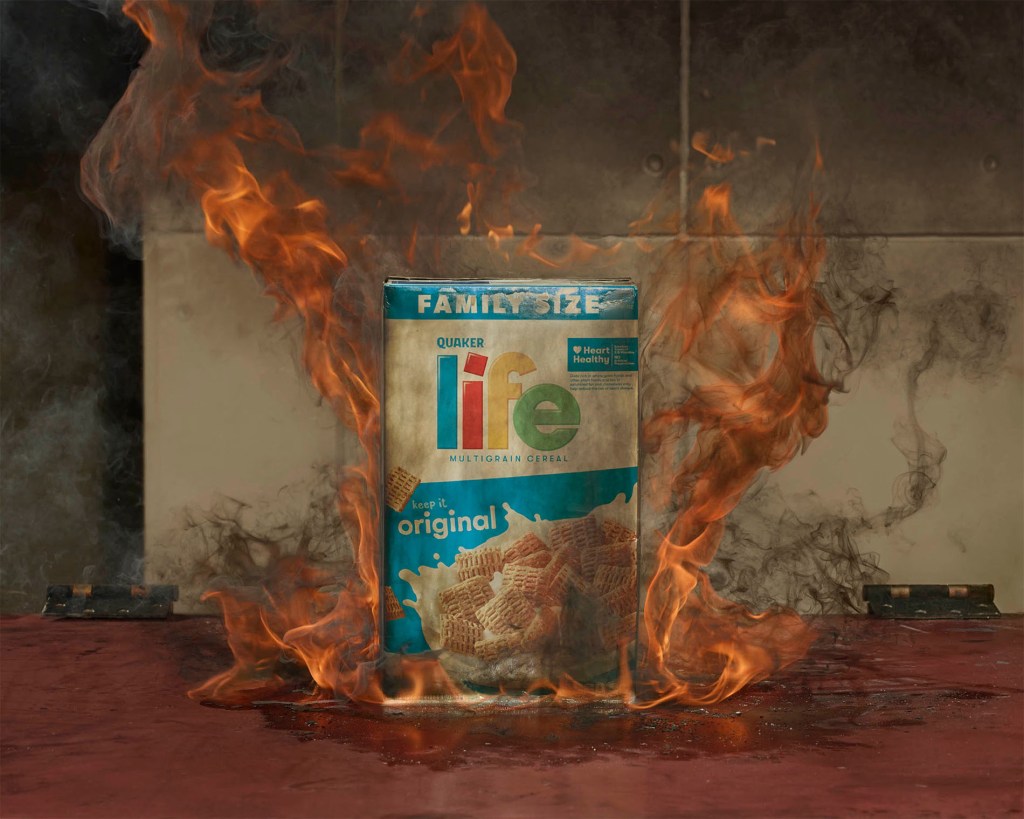
Simon’s process is a kind of cumulative meander, to which the museum’s spiral lends itself. For most chapters, she provides background notes about a given FBI case and selected reminiscences from the ex-agent about his role in wall texts. She idiosyncratically follows the tendrils of each case, embodying her results in photographs, video, and sculpture – hyperreal yet sometimes quirky or outright bizarre – that contextualize the skeletal narrative about a largely hidden event with ambient aboveground realities. This nexus functions not so much as stark exposure from within – she doesn’t reveal much if anything she’d require a clearance to legally know – as patchy illumination from without, in the juxtapositional manner of John McPhee or Frederick Wiseman but far more whimsical. Several chapters are too eccentric to register easily, but most have enough grip to land their messages and sustain momentum.
Some connections might be conventionally forensic. From the TWA Flight 800 crash in 1996, Simon diverts to the National Transportation Safety Board’s meticulous reconstruction for diagnosing the tragedy. 9/11 prompts a detour to lethally mistaken assumptions about the Twin Towers’ design. Just as often, the segues are archly flamboyant. The 1995 case of a female policewoman imprisoned for siccing her dog on an undocumented immigrant yields several jarring photographs, ranging from the woman post-release in an evening dress to contemporary trainers teaching dogs to do exactly what she commanded hers to do. Her visual take on the 1998 murder of two Capitol Police by a mentally disturbed man is a photograph of Gina Bisignano, who famously stormed the Capitol on January 6, 2021, bellowing incitement through a bullhorn. Civic progress comes hard. More attenuated is Simon’s treatment of the FBI man’s unbriefed babysitting gig for two young children whose mother, it transpired, had been enlisted to entrap Marion Barry, her former boyfriend and then the mayor of Washington, D.C., into smoking crack in a 1990 FBI sting operation. Simon presents a video of the femme fatale’s sister singing “This Little Light of Mine.” My own father, a lifelong Great Society liberal, might have found this wry memorialization of a sordid but minimized slice of a triumphal American epoch gratifying. In a subsequent election for a D.C. city council seat, he lodged a protest vote for the politically doomed Barry because he considered the feds’ conduct targeted racism.
The apparent conceit of Simon’s sprawl is that if untoward clandestine episodes are part of her parent’s narrative, they are also part of hers, and that this proposition is generalizable. Through various degrees of separation, everyone has some connection to benighted and nefarious activity. From this realization, she would naturally fix on a peripatetic ex-Special Agent. His involvement in so many high-profile, low-visibility cases might suggest a composite or even a fictive construct, though some G-men do get around. In any case, the prime consideration is that all the circumstances ascribed to him were real and involved U.S. government personnel charged with protecting Americans and their interests. Simon’s detached, frequently oblique approach puts her broadly in the distinguished company of le Carré and McCarry in locating subtle truths about the situations those designated to protect “national security” are tasked to confront and what they are licensed to do in the name of the people writ large.
During the latter twentieth century and especially the Cold War, novels and movies tended to portray the CIA, FBI, and NSA as noble, world-weary night watchmen, forgiving egregious excesses and missteps. During their post-9/11 mobilization, even in the pall of renditions, black sites, torture, and mass surveillance, they were often lionized. Now, with U.S security organizations co-opted by an autocratic, corrupt, and ignorant leadership, and virtually all U.S. government institutions corroded, they have lost much of their popular luster. It remains difficult for the public to get an informed and sensible bead on the community, and Simon’s efforts to demythologize it are part of the show’s appeal and urgency. A more ambiguous aspect is her roundabout acknowledgement of a “thin blue line” – the fact that the people ask a great deal of the spies, police, and soldiers they dispatch to the shadows on dangerous business that is usually squalid. Simon’s FBI retiree notes that the Bureau mandates retirement at 57, implicitly because the human psyche isn’t equipped to take more than about 30 years of soul-crushing civilizational disappointment without enduring permanent impairment.
Some quit the work because they find it morally or politically intolerable. Philip Agee, a notorious turncoat CIA case officer about whom I wrote a book called A Drop of Treason, quit after twelve years. But in crusading against Agency activities, he invited countermeasures and never stopped behaving like a spook. As the movie cliché has it, you never really retire from the CIA. The subtext here is two coexisting and mutually insulated worlds. Social scientists examining civil-military relations might confirm that the American people, from the vaunted communal mobilization of the citizenry during World War II through the divisive Vietnam-era draft to the exclusionary professionalization of military and civilian security organizations that now prevails, have become unhealthily severed from those who protect them. The reactionary valorization of soldiers, spies, and cops since 9/11, which has reached a crescendo with Trump’s weaponization of ICE and Hegseth’s toxically juvenile “warrior ethos,” has deprived this important conversation of civility and balance. Simon’s apparent determination to withhold overt judgment could be read as passive apologism. But overall, her installations, though not cohesive, do seem to intimate that this state of affairs is pernicious in its perpetuation of social opacity, popular suspicion and paranoia, casual denial, and government unaccountability – that we, all of us, own the darkness as well as the light.
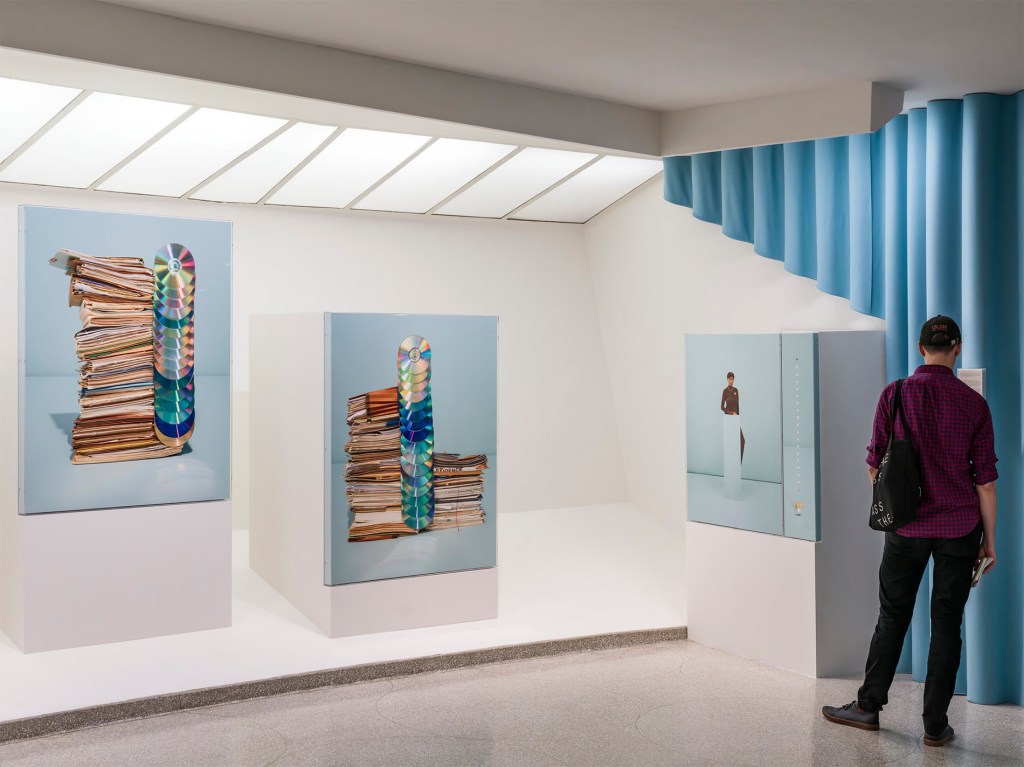
“Taryn Simon: Father Country I Do Love You,” Solomon R. Guggenheim Museum, 1071 Fifth Avenue, New York, NY. Through March 14, 2027.
About the author: Jonathan Stevenson is a New York-based policy analyst, editor, and writer, contributing to the New York Times, the New York Review of Books, and Politico, among other publications, and a regular contributor to Two Coats of Paint.