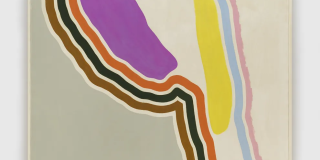
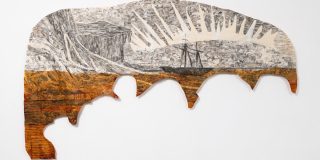
Contributed by Sharon Butler / I was born in New London, Connecticut, still known as “The Whaling City,” having trailed only New Bedford in vessels and voyages in the late nineteenth century and amassed much of its wealth from that maritime oil trade. Sea captains were the sturdiest pillars of the community and their grand homes punctuated the city’s streets. One was Captain Lyman Allyn (1797–1874), who commanded a whaling ship at age 21 and went on to serve as director of a bank, an insurance firm, and a railroad. Harriet Upson Allyn (1840–1926), the youngest of his six children, spent her entire life in New London. In her will, she dedicated funds to establish an art museum, prospectively naming it after her father. I’ve been enjoying the Lyman Allyn for years, and it’s a terrific regional museum – small and stately with a permanent collection of roughly 20,000 works, spanning paintings, drawings, prints, sculpture, furniture, and decorative arts. While its strongest suit is American painting and decorative arts from the eighteenth through the twentieth century, it is now fielding several winningly divergent shows.
Tag: Le Corbusier
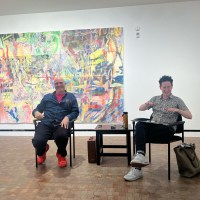
Kerry Downey and Julián Kreimer conversation at the Heimbolt Center
This wide-ranging conversation took place on April 27, 2026, between Kerry Downey and Julián Kreimer at Sarah Lawrence College Heimbolt Center for Visual Art during Kreimer’s exhibition, “Yuyo.” The exhibition was on view April 2-May 8, 2026.
Inside Peter Dudek’s studio
We’re up in the Berkshires of western Massachusetts. The floor of Dudek’s studio is covered wall-to-wall with objects. One can ascertain individual sculptures, or perhaps parts of sculptures that might become sculptures one day. I ask if this is how it always is.
Letter from Venice
Contributed by Michael Brennan / The 60th Venice Biennale runs through the fall. This storied, much imitated global event, like an Olympics or World’s Fair, consists of individual national pavilions and topical exhibitions. They occupy Venice’s Giardini and Arsenale. The Biennale generates numerous collateral exhibitions in palazzos, churches, and former warehouse spaces citywide. In addition to the officially sanctioned shows, there are a myriad unaffiliated exhibitions that try to pass themselves off as part of the Biennale by insinuation. It’s a lot to take in.