Contributed by William Corwin / “Sojourn,” Tim Kent’s latest series of paintings, at Hollis Taggart, falls into the tradition of the interior paintings, of Fragonard, Vermeer, Boucher, and de Hooch, where the key to the drama is ambiguity. The paintings present events as they are purported to have happened, not how they actually transpired. They are unabashed exaggerations of momentary, often banal reality, heightening the drama, enriching the color, enhancing the décor. In Passy, a fully dressed man leans on the wrought-iron rail of a balcony while a woman lies asleep in bed in a hotel room bathed in blue light, her bare knee emerging from the sheets. The somber light, the rococo mirror, and the garden portrait of an eighteenth-century gentlewoman on the wall above the bed (it is actually Kent’s painting Lexapro) suggest that this is a tryst, perhaps in a pitched moment of regret. To kindred effect is Manhattan. A blond woman in a flouncy black and sequin dress pauses, hand on hip, to catch her breath in the hallway of a tony apartment whose open door reveals a party in a dark, crowded room that includes a bare-shouldered red-headed woman. We can see a man’s silhouette in the glass, hinting at the source of the blond woman’s agitation or malaise.
Kent casts the studio itself as a place of mystery and double-entendre. In Sojourn, a painter is working at an oversize canvas while his subject poses on a divan surrounded by sculpture and paintings, a sleeping greyhound at her feet. She’s reaching behind to take off her unbuttoned dress, and her face is slowly dissolving into the shadows behind the canvas, leaving us wondering whether one figure is real and the other an apparition. Objectively, though, Kent is merely depicting a painter painting a portrait. Gypsy inverts the process. A woman in bohemian garb, perhaps a resident of Bushwick, looks askance at the viewer from atop a metal stool seated in the painter’s studio. At the center of this canvas is a void in the shape of this gypsy sitter, implying that she has migrated into the reality of the workspace from a painting of an Italianate courtyard elsewhere on the canvas. Is this an artist’s fancy or simply an interpretation of the act of painting? Perhaps both.


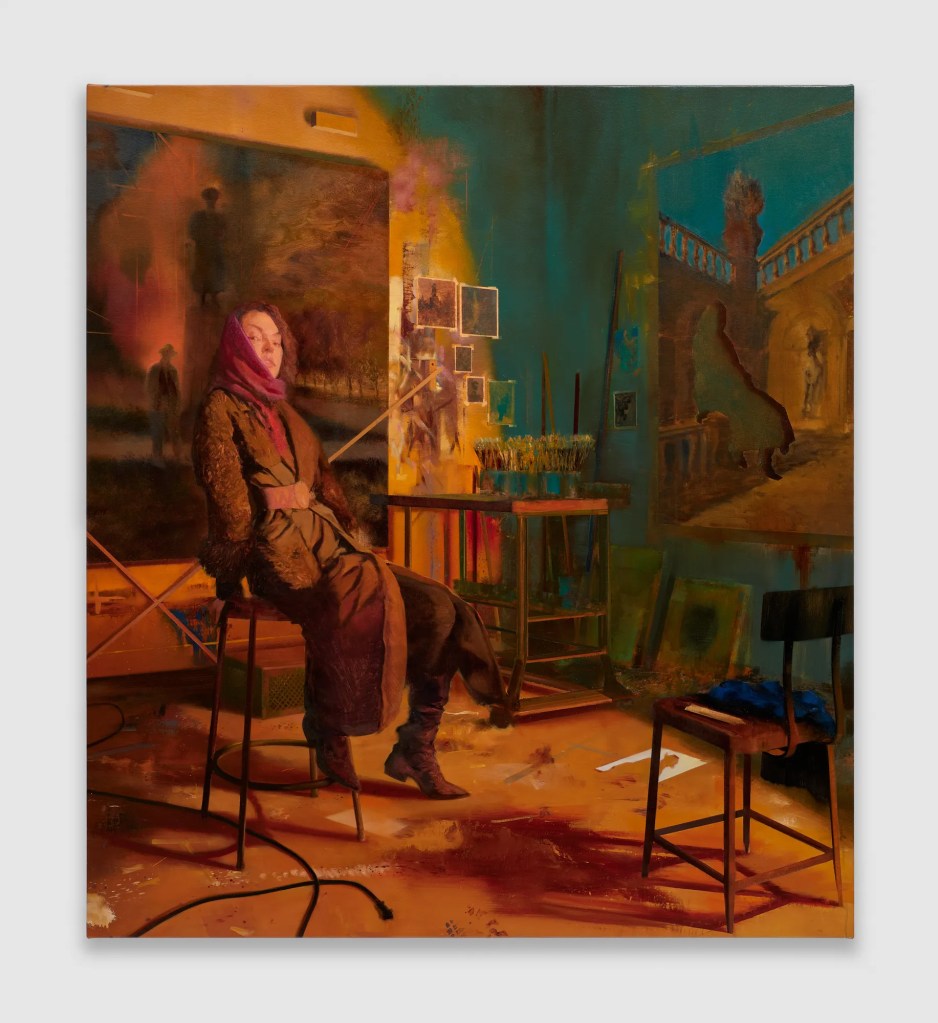
Kent takes a cue from the drawing-room comedy, which as a theatrical genre is extraordinary because it imparts peaks of human emotion – love, betrayal, lust – appear without historic battles or special effects. In the close quarters of the canvas, Kent commands the simmering power to summon the unexpected, deploying paint as a wily and unstable interloper. Faces dissolve, as in Sojourn, or heads completely disappear, as in Lexapro, Dexadrine, and Fluoxetine. Kent also orchestrates smaller slippages. In Gypsy, a workshop table behind the figure bears coffee cans full of paintbrushes that have become a flock of buzzing and flickering fairies, prompting us to second-guess our initial perception. The shadowy back of the painter’s easel and canvas looks to be a red wireframe computer. In previous paintings, Kent bluffly indulged the ruse of perspectivally constructed space. In these new paintings, though, it is not just a tool for generating clever images but also an allegory of social mores and personal interactions. The magic of these paintings consists in the access they provide to a wondrous yet fraught life of luxury and romantic misunderstanding, the plot thickened by an inexorable sense of déjà vu.
“Tim Kent: Sojourn,” Hollis Taggart Gallery, 521 West 26th Street, 1st and 2nd Floors, New York, NY. Through October 17, 2026.
About the author: William Corwin is a sculptor and writer based in New York.