Jason Mandella. © Selena Kimball; courtesy of the artist and Ulterior Gallery, New York.
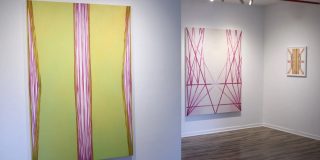
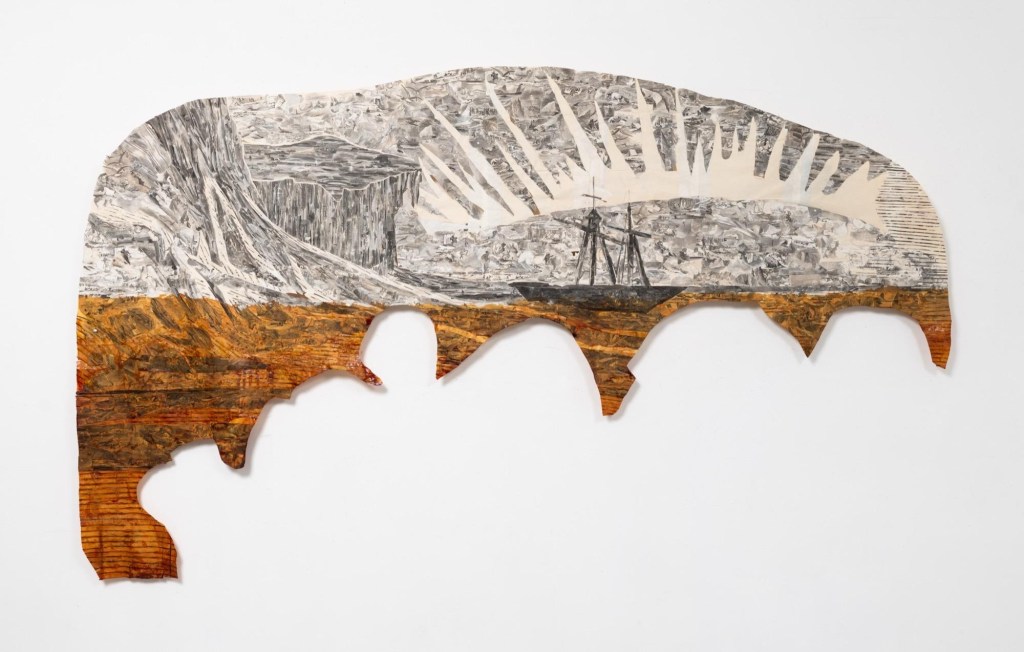
Contributed by Sharon Garbe / Gathering Moss, the title of a work in Selena Kimball’s exhibition “Ice-blink” at Ulterior Gallery, describes both literal activity and metaphorical non-activity. It’s also the title of a book by the bryologist and Native American author Robin Wall Kimmerer. I learned from that book that moss and lichens grow on every continent and in all climates, from scorching deserts to the coldest polar regions. While the Arctic is a central motif of the show, Kimball’s work also plays with scale, location, and authenticity more broadly. The larger works in the show have physical gaps that raise questions. Who is missing? Who is the hero of a referenced colonial expedition? Do works that look fragile reflect the fragility of what they depict? Kimball’s works are representations of representations that resist easy classification. Some might call them collages. Others might think of cargo cult replicas. I would describe them as conceptual process pieces resulting in low-relief wall sculptures.
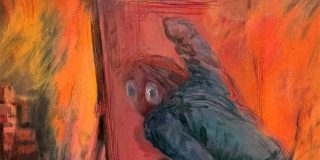
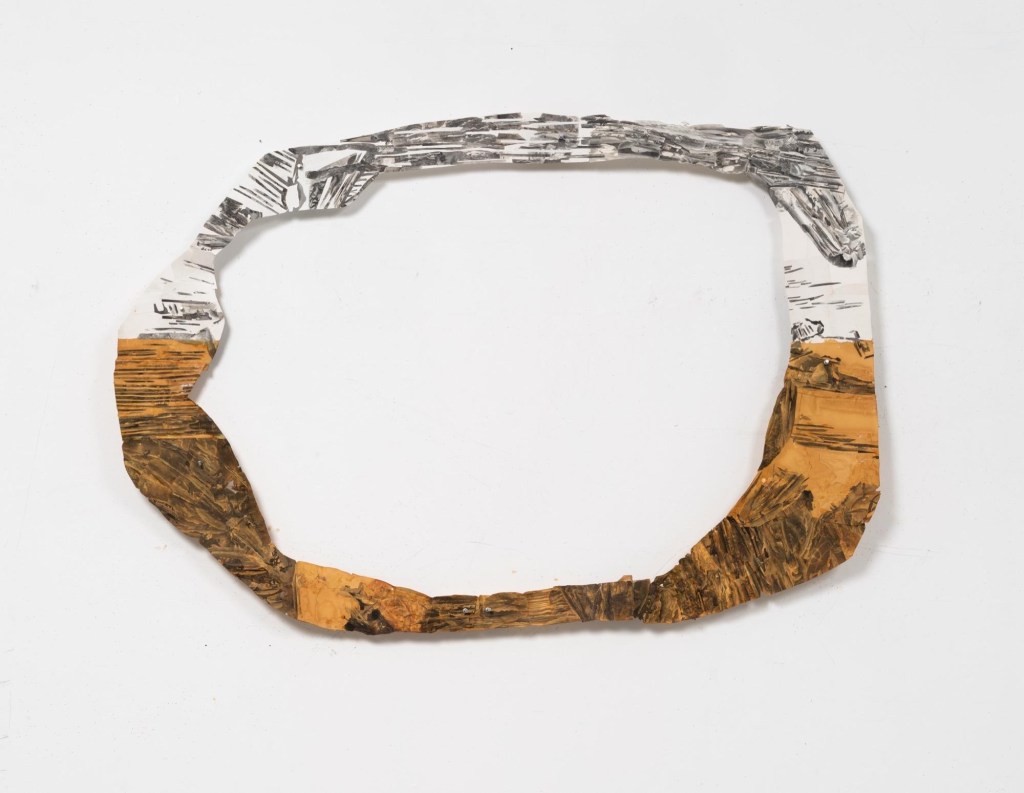
Essentially, Kimball cuts up books and makes art from the fragments. Like icebergs, which feature in this show, there’s a lot beneath the surface. She has replicated and enlarged illustrations from Victorian physician and explorer Elisha Kent Kane’s 1856 series Arctic Explorations, which recounts a harrowing expedition. Kane’s text details the madness fueled by lofty excuses in venturing into the unknown, which his skillful sketches – the basis for the books’ steel plate and woodblock engravings – illustrate. Kimball’s manipulation of the engravings, cut and assembled every which way, creates luscious, painterly, faceted geometries, the highlighted ridges rendered with lighter strips of text cut on the bias. In Gathering Moss, the Aurora Borealis appears on the horizon beyond the silhouette of a double-masted ship. Its radiating white spikes, devoid of words or illustrations, are perhaps cut from an endpaper. There is no single substrate beneath the assembled and glued pieces. What keeps this sleight-of-hand from being a gimmick is Kimball’s creation of a strict, and spare, system. Yet chance, as well as glue and iodine, is allowed.
Jason Mandella. © Selena Kimball; courtesy of the artist and Ulterior Gallery, New York.
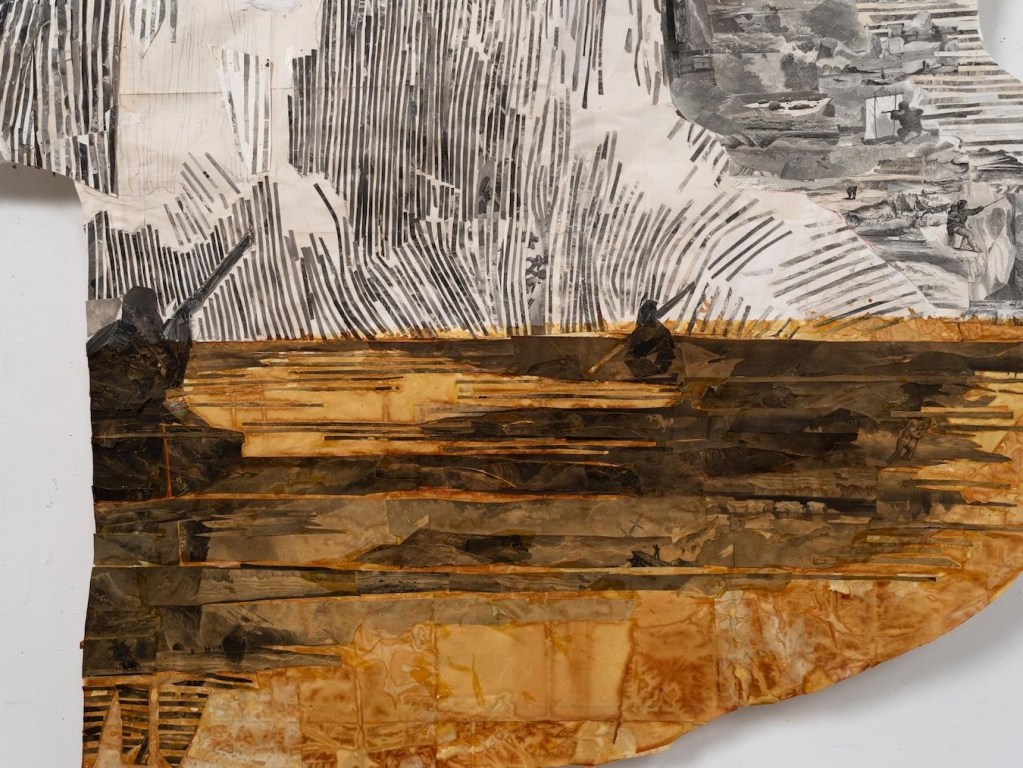
Photo by Jason Mandella. © Selena Kimball; courtesy of the artist and Ulterior Gallery, New York
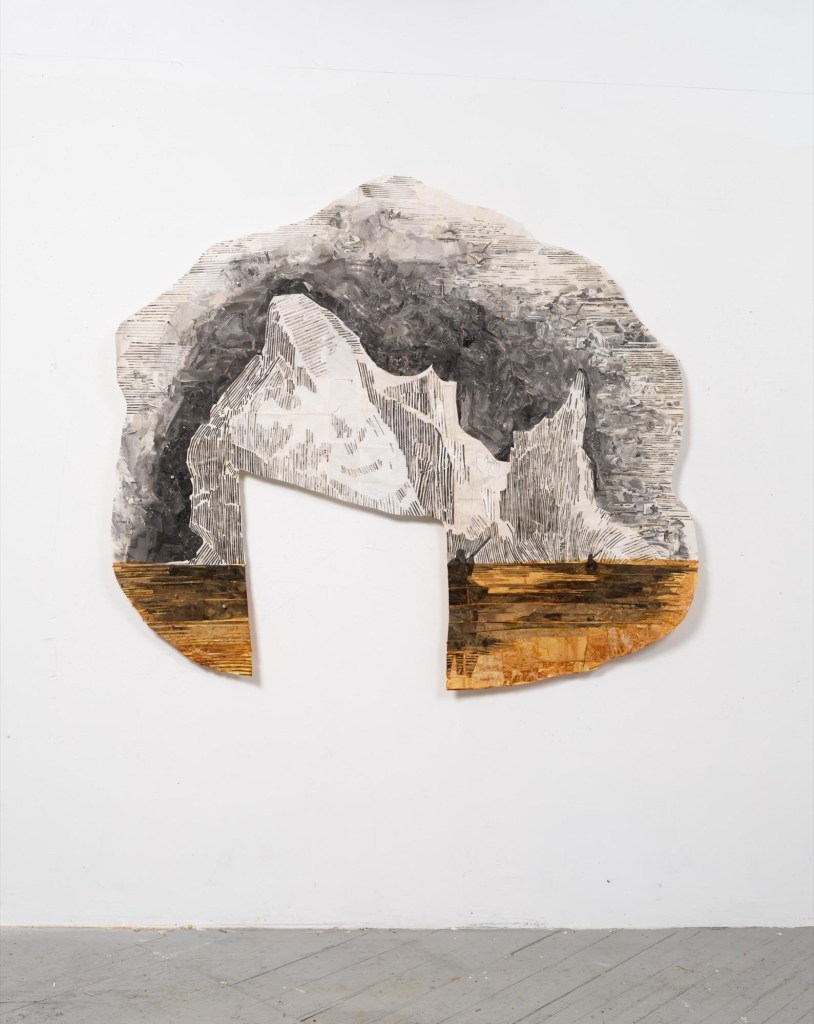
To create the array of graded lines and patterned patches that compose these works, Kimball enlisted the help of friends and family to cut up pages of the books and group the clippings into a system delineated by dark, medium, and light values. From this process, Kimball identified certain visual gems in the deconstructed pages. These meta-artifacts became the sources for the larger works. Forced on an Iceberg has a rectangle cut from its bottom. The pointy, negative shape leans to the left, suggesting an echo of the iceberg above it. Like the other large works, the lower third of this one is stained a deep amber, from being dipped in a solution of iodine and water. It’s an elegant way to weave multiple readings into a single gesture. The image’s similarity with old sepia photographs or colorized black-and-white images brings history to mind. Medical associations arise from her use of iodine, which polar explorers at risk would have needed. The edges of the cut pieces resemble tesserae.
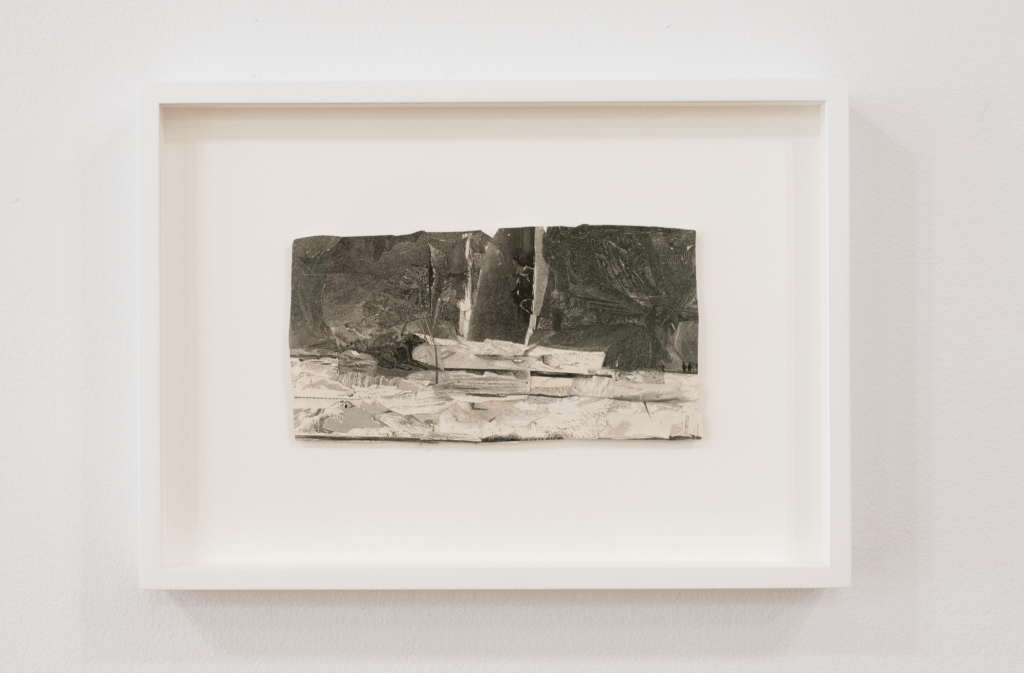
Photo by Takako Tanabe. © Selena Kimball; courtesy of the artist and Ulterior Gallery, New York.
Jason Mandella. © Selena Kimball; courtesy of the artist and Ulterior Gallery, New York.
The critics’ word bricolage – the use of things on hand to make art – applies nicely to Kimball’s process. She finds and uses items that people have stored between the covers of books. In Sonar Reading and two variations, she rendered an image of a boat from a 1985 newspaper clipping with pieces from the Kane books. One of the reasons Kimball used first editions of this once-popular set was that they were printed on high-quality cotton rag paper. It can stand up to the glue, the iodine, and gravity. That stability is ironic in the face of another phenomenon this work surfaces: global warming. Kimball notes that “the paper has outlasted the geography the book depicts.” In such a perishable world, the boldness of explorers – their meticulous planning, single-mindedness, and willingness to go into the unknown with just provisions, tools, and their wits – may sound like folly, or like making art.
“Selena Kimball: Ice-blink,” Ulterior Gallery, 424 Broadway, #601, New York, NY. Through October 17, 2026.
About the author: Sharon Garbe is an artist and writer based in NYC.