
Contributed by David Carrier / The Guggenheim has frequently presented the work of Wassily Kandinsky (1866–1944). Now, finally, the museum has provided the opportunity to celebrate Gabriele Münter (1877–1962), Kandinsky’s domestic partner of ten years and a fellow founder of the Blue Rider Group – the Munish-based network of artists that pioneered German Expressionism just before the First World War. Her German father spent some time in America in the late nineteenth-century, and, after turning 20, she went there and made photographs, some presented in this show. Upon returning to Germany, she trained as a painter and met Kandinsky. The Blue Rider disbanded when the war broke out, Kandinsky returning to Russia, two of its members – Auguste Macke and Franz Marc – dying in combat, and Münter decamping to Scandinavia and working in exile. Returning to Germany after the war, she hid her paintings from the Nazis, visited the Nazi Party’s disparaging and condemnatory show of “degenerate art” in Munich in 1937, and after the war distributed her works to various museums.
Contribute to the Two Coats 2025 Year-end Fundraising Campaign!
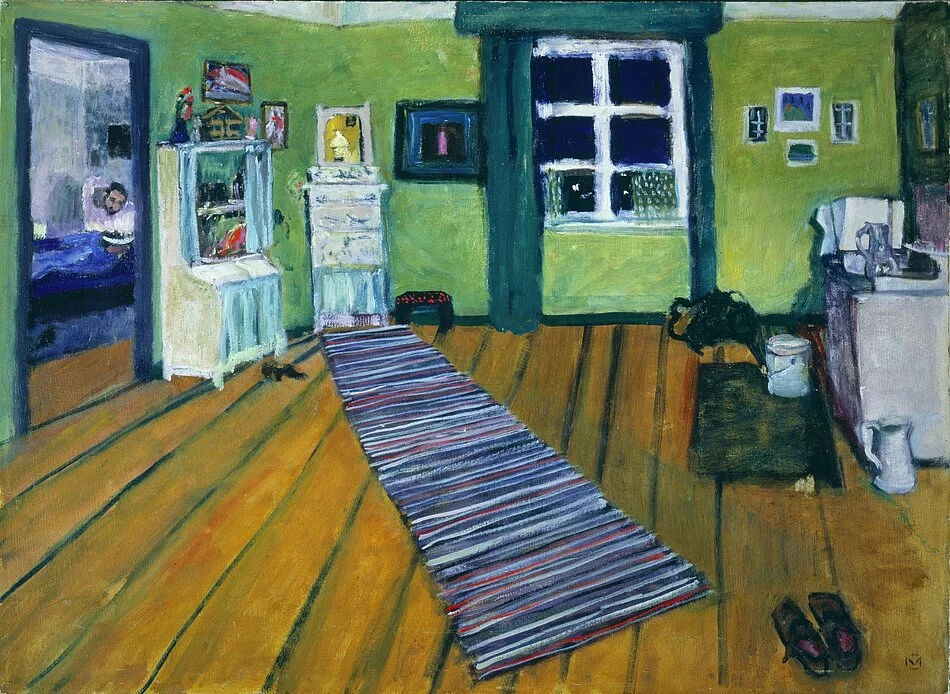
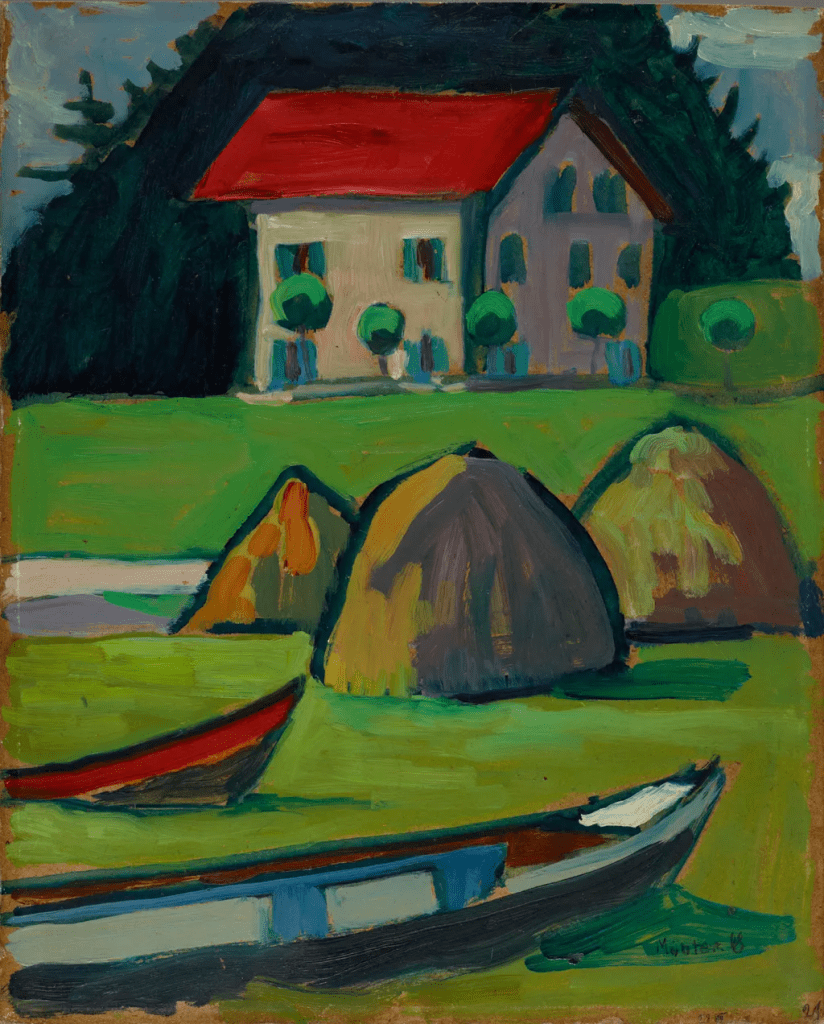
Flowers, children’s toys, portraits, domestic interiors, and landscapes were Münter’s subjects – there were no obvious political ones – and she was a natural, accomplished from the start. I especially admire the flat, intense green fields, red roof, and blue boat in Fisherman’s House (1908) and the green wall in Living Room in Murnau (Interior) (circa 1910), both relatively small pictures. In contrast to Kandinsky, she was a masterful figurative artist and apparently did not delve into abstraction. “Contours of a World,” the show’s title, is derived from statement of hers, quoted in a footnote in the catalogue: “Above all it was folk art that showed me the way, namely the once flourishing, rustic reverse-glass painting of the Staffelsee region, with its carefree simplification of forms and the strong colors with dark contours.” A photo in the catalogue shows some of these reverse-glass paintings. No doubt she also learned from the Post-Impressionists about the emotive power of color, but the Van Gogh reproduced in the catalogue looks very different from her paintings. Her sensibility was, I would say, closer to Matisse’s.
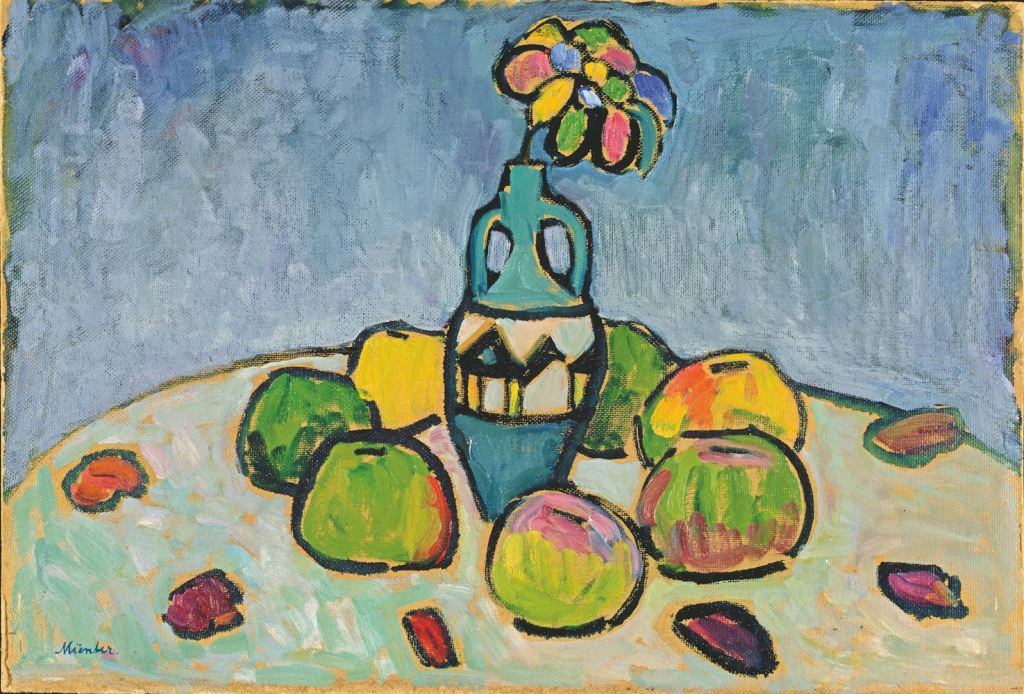

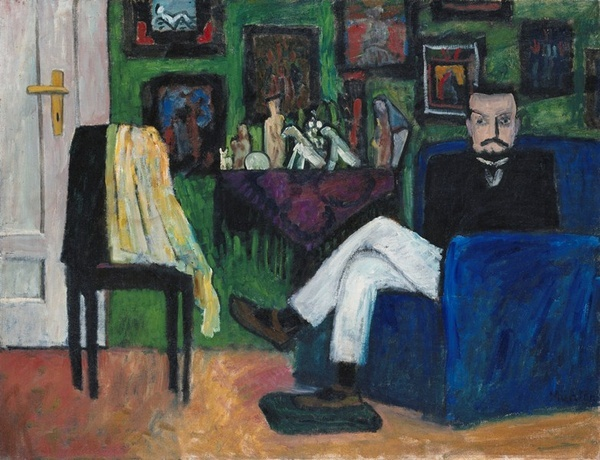
Münter favored rural scenes of southern Germany, interior as well as exterior. Her affection for the region and urge to record it fondly is manifest. In Gray Still Life (1910), her apples, not unlike Cézanne’s, have heavily outlined black edges. She was a consistently brilliant colorist. Christmas Still Life (circa 1908–09) depicts a wonderful branching tree. With deep, fully saturated colors, Snow and Sun (1911) renders snow as light blue under an overcast sky. Man in Armchair (Paul Klee) (1913) sets his white pants against the deep blue of the chair and his black shirt. Boating (1910), a dazzlingly original composition, turns one figure to face and fix on us, insisting on engagement. All these works notably feature preternaturally vivid, indeed positively hallucinatory, color. A couple of later paintings demonstrate that Münter never lost her touch. House with Fir Trees in the Snow (circa 1938) and The Blue Lake (1954) are confidently integrated and entirely successful, if perhaps less daring than her earlier works.
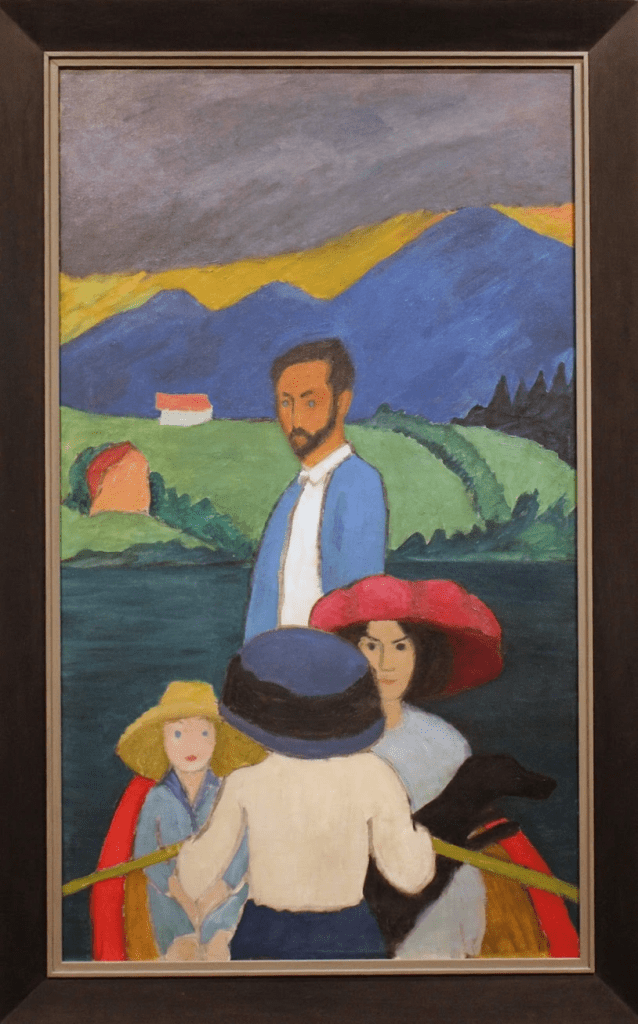
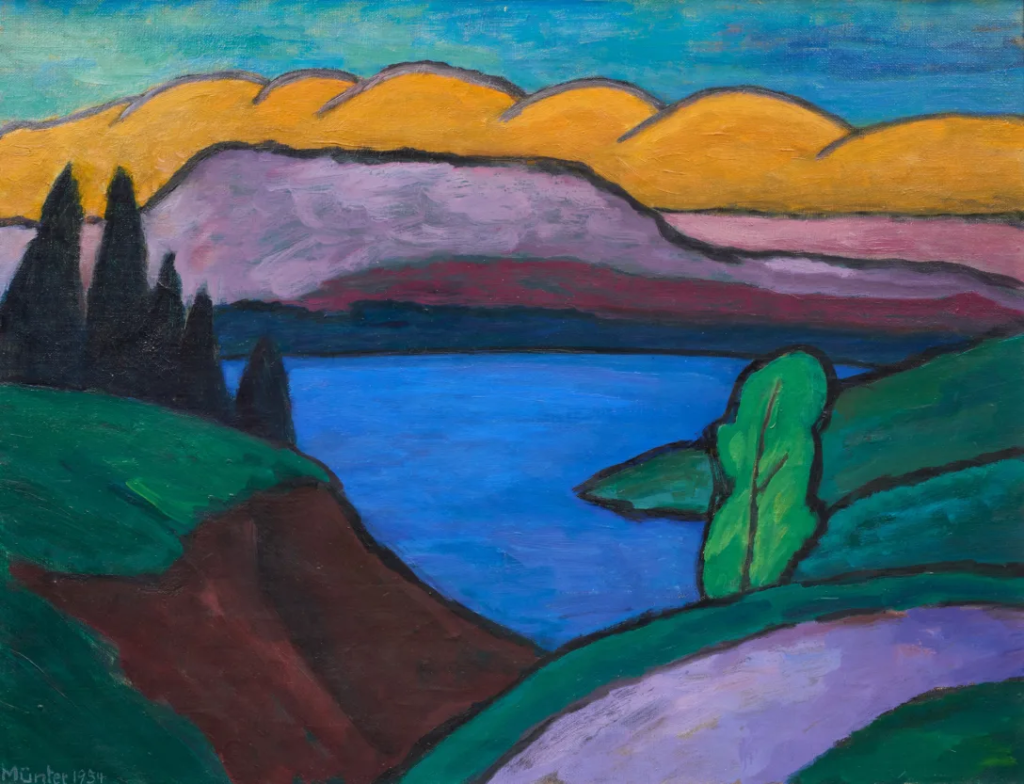
While we are afforded an overdue view of Münter’s independent development beyond the period when she lived with Kandinsky, the catalogue says little about deeper context of her remarkable paintings, or about Münter’s life during that long period, from the end of the First World War to her death in 1962. Her early, touristic black-and-white photographs, made before she studied painting, are fascinating in their own right, but they don’t reveal much about the genesis of her art, which depends essentially upon color. Like many female painters who operated in the predominantly male art world of the early twentieth century, Münter has been unjustly marginalized. She is a major artist and merits a full accounting.
“Gabriele Münter: Contours of a World,” Guggenheim Museum, 1071 Fifth Ave, New York, NY, 10128, Daily; 10:30am – 5:30pm. Through Apr 26, 2026
About the author: David Carrier is a former professor at Carnegie Mellon University; Getty Scholar; and Clark Fellow. He has lectured in China, Europe, India, Japan, New Zealand, and North America. He has published catalogue essays for many museums and art criticism for Apollo, artcritical, Artforum, Artus, and Burlington Magazine. He has also been a guest editor for The Brooklyn Rail and is a regular contributor to Two Coats of Paint.
Contribute to the Two Coats 2025 Year-end Fundraising Campaign!









Great article. She is one of my favorite artists! Will be coming to NYC to see the exhibit in January.