Tag: Henri Matisse

Solo Shows

Jane Haimes: Rehabilitating geometric abstraction

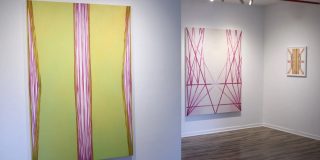
Contributed by Michael Brennan / A painter I once knew – a highly regarded abstractionist, modernist, and lover of Matisse as well as a popular professor – praised the work of a student during a critique. One of his colleagues, a postmodernist painter not so well regarded, said dismissively, “I don’t know, all I see are some colors on canvas.” The first painter replied hotly, “What the hell do you think painting is all about?” Another time, I invited a painter, now sadly sidelined, to join me at a survey of contemporary abstraction. There was a pregnant pause, “To see what exactly, Michael … shapes?” Many remain skeptical about the relevance, meaning, and remaining potential of manipulating shapes and colors. But Jane Haimes is still fruitfully exploring the possibilities. She understands that as long as there is painting, there will be shapes and colors, so we ought to make something of them.

Solo Shows

Lee Tribe: Between paint and steel

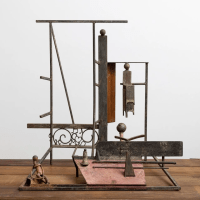
Contributed by Laurie Heller Marcus / Paint on sculpture can disrupt our spatial savvy, challenging habits of looking we bring to the interpretation of form. Lee Tribe plays with them in a variety of ways in his current show “Catching the Sun” at Victoria Munroe Fine Art. As a sculptor, he’s played the long game. Trained at a young age as a welder in the shipyards of his native England, Tribe later studied at St. Martin’s College of Art with Anthony Caro and William Tucker, a long-time friend and mentor. After moving to the United States, he immersed himself in painting, noting how marks move the viewer through the composition of an image.

Solo Shows

Diebenkorn at Gagosian: A remarkable curatorial accomplishment 

Contributed by David Carrier / For a long time, I have always thought of Richard Diebenkorn as a great painter. A couple of his paintings were in my local museum, the Carnegie Museum of Art in Pittsburgh, where I treasured seeing them. But he was, so I believed, someone whose development was straightforward, even a little boring. I arrived at Gagosian’s large upstairs gallery on Madison Avenue with low expectations of a thick array of Diebenkorns in that one room. Maybe it had been a mistake, inspired by misguided nostalgia, to take on this assignment. In the event, the exhibition was revelatory, holding me spellbound. This is one reason why I love being an art critic – the surprise.

Gallery shows Solo Shows

Alex Katz’s seas of orange

Contributed by Tena Saw / Ninety-eight-year-old Alex Katz’s current gem of an exhibition at Gladstone consists of eleven orange and white canvases, each ten and a half feet high, that wrap around the main gallery. All reference a road in Maine where Katz spends summers. Unlike most of his work, they lean heavily towards abstraction, treating the road like an opportunity to explore perspective or the light on the leaves. Particularly if you’re lucky enough be alone in the gallery – a single room of high white walls, industrial scaffold ceiling, and enormous skylights – it becomes a kind of meditation tank, containing a sea of optical orange. Natural light settles on the paintings like a mist. The effect is more akin to that of an installation than that of a traditional painting show. 

Museum Exhibitions

At the Guggenheim: Gabriele Münter’s enduring brilliance 

Contributed by David Carrier / The Guggenheim has frequently presented the work of Wassily Kandinsky (1866–1944). Now, finally, the museum has provided the opportunity to celebrate Gabriele Münter (1877–1962), Kandinsky’s domestic partner of ten years and a fellow founder of the Blue Rider Group – the Munish-based network of artists that pioneered German Expressionism just before the First World War.

Solo Shows

Pablo Benzo smites an art lover

Contributed by David Carrier / To be a happy art critic, perhaps you need to be ready to fall in love – at least with a picture. I have a friend, a very distinguished intellectual, who some years ago fell in love with a famous work of art. He has read all the literature about this picture, written about it, and made repeated pilgrimages to see it. On one occasion, curious about his obsession, I accompanied him to take a look. I certainly admire his picture…

Solo Shows

Marina Adams: Patches of sun in a shadowy world

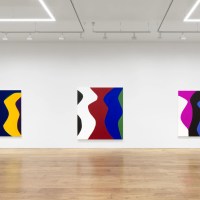
Contributed by Amanda Church / Marina Adams has long been exploring the range of allusions that can be conjured by various color combinations and the scale and placement of simple shapes, which press up and vibrate against each other in subtle, sexy ways. Curvy configurations, interspersed with diamonds and triangles, hint at myriad aspects of nature and the female form. In Adams’ current show “Cosmic Repair” at Timothy Taylor, variations on this trajectory continue in nine paintings, all new and acrylic on linen except Singing to the Highest Deity from 2020 hanging by itself in the back room. Influences range from Matisse to, according to the press release, “Uzbek textiles, Indigenous American Southwest pottery, and the Great Pyramids.” 

Solo Shows

Claudia Parducci: Catching the falling dust 

Contributed by Doug Milford / Good art can have multiple sources of meaning – material, color, scale, intention, chance, change, process, metaphor, ontology, epistemology, philosophy, biography, zeitgeist, history, and more. These may or may not be apparent or even deliberate, but they make up the work’s internal structure and shape its style. Ideally though certainly not always, these influences operate in concert while remaining distinct. The nine works in Claudia Parducci’s exhibition “Blue”, at Ochi Gallery in Los Angeles in February and March, achieve this balance, both as individual pieces and as an ensemble. The six years that had passed since her previous show included a three-year hiatus from painting after the death of her husband, the artist Peter Alexander, in 2020. This body of work was a response to his passing. 

Solo Shows

Jan Dickey: The art of breakdown

Contributed by Lucas Moran / In art, limitations often define, shape, and mold strengths. We can embrace drawbacks and spin them into gold. An impoverished de Kooning, living off ketchup packets and free coffee, turned to house paint to create some of his most compelling work. A bedridden Matisse cut paper. Scarcity, oppression, impairment – these forces have shaped the course of art history. Rather than relying on convention, Jan Dickey – investigator, tinkerer, and forager as well as painter – has immersed himself in studying how things break down, bond, and hold together. “The High Collapse,” now on view at 5-50 Gallery, is the culmination of that endeavor….

Solo Shows

Dan Schein’s muddy sublime

Contributed by Lucas Moran / On Instagram, where most artists list their websites, exhibitions, and accomplishments beneath their handles, Dan Schein keeps it simple: “artist/painter,” followed by “Person Who Stutters.” It’s fitting for a painter whose work, some now on display at JJ Murphy Gallery, feels as though it may sometimes have a tough time coming out of him. But Schein, a painter’s painter, knows how to elicit beauty from struggle….

Solo Shows

Pierre Obando’s potent hybrids

Contributed by Michael Brennan / Pierre Obando presents ten paintings, made between 2021 and 2025, in “Some Kind…,” his first exhibition at the Bushwick salon Starr Suites. While his imagery is for the most part recognizably organic, it is not easily decipherable.

Conversation Gallery shows

Drew Shiflett and Carter Hodgkin on the creative process

Contributed by Riad Miah / In conjunction with their two-person exhibition, The Shape of Things, at the John Molloy Gallery, I had the opportunity to engage in a conversation with artists Drew Shiflett and Carter Hodgkin about their materials and unusual creative processes. At first, their pairing seemed unexpected, as their visual languages appeared quite distinct. However, after seeing the exhibition firsthand, I came to appreciate the deep connections and underlying commonalities in their work.

Solo Shows

Dan Dowd and the folds of memory

Contributed by Mark Wethli / As I viewed Dan Dowd’s intimate and poetic work, now at Magenta Plains, I considered our inclination to cathect feelings and memories onto objects. Clothing in particular echoes the shapes of our bodies; touches them; connotes gender, time, and economic status; and absorbs everything from our scent to our DNA. Dowd creates small, iconic assemblages out of found materials, including fragments of inner tubes, clothing, rags, and home décor.

Solo Shows

Alessandro Twombly: Strikingly original, richly allusive

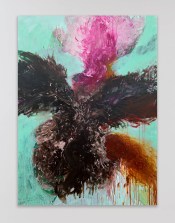
Contributed by David Carrier / Alessandro Twombly’s twelve large new paintings, now on view at Amanita Gallery, all employ one basic, immensely fruitful motif: knots of color resembling enlarged floral forms, depicted in high-pitched, gesturally painted oranges, pinks, reds, and blacks on bright turquoise backgrounds. An artist friend nicknamed these pictures ‘Tiepolo in the Sky,” which accurately describes them. Twombly’s abstract images look like drastically enlarged figures you might find in a work by the eighteenth-century Italian painter Giovanni Battista Tiepolo. They are strikingly original yet richly allusive.