Month: February 2025

Gallery shows

“Hyper-meme” at Living Skin: Immaculately funny

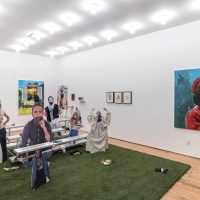
Contributed by Will Maddoxx / On Valentine’s Day, I walked into Living Skin, a “project space and persons hub” in Bushwick that had piqued my interest when I read its manifesto and perused promotional images for the group show “Hyper-meme.” I came to the show with some hesitation, as I have been to countless group shows that seemed unfocused and vague. Smatterings of “work about histories of images” or “art of a contemporary landscape” have gotten old and deflating. “Hyper-meme,” however, is sharp, original, and hyper-specific. It blew me away.

Museum Exhibitions

“Project A Black Planet” – Enshrining a promised land

Contributed by David Carrier / Few human developments have been more consequential, in terms of both art history and broader cultural expansion, than the movement of Africans within and out of their own continent. The mammoth exhibition “Project A Black Planet: The Art and Culture of Panafrica,” now at the Art Institute of Chicago in twelve high-ceilinged contemporary galleries, includes more than 350 drawings, paintings, photographs, sculptures, installations, watercolors and prints, but also books, magazines, posters, and record albums, made from the 1920s onward. It’s a lot, but never too much.

Museum Exhibitions

Berthe Weill: The gallerist who loved art too well

Contributed by John Goodrich / Hindsight, of course, is 20/20. Looking back at the early decades of modernism, we may sense something inevitable about the ascent of Picasso and Matisse. Weren’t both driven, gifted artists poised to take advantage of their cultural moment? And wasn’t the time ripe for Matisse’s upending of expectations of color, and Picasso’s overturning of pictorial structures? Of course, life is not so tidy and linear for the artists operating in the moment. As the luminous exhibition “Make Way for Berthe Weill: Art Dealer of the Parisian Avant-Garde” at NYU’s Grey Art Museum demonstrates, none of the early modernists had a monopoly on talent or a singularly dominant vision of what painting had to be.

Solo Shows

Jilaine Jones’s unfolding curiosity

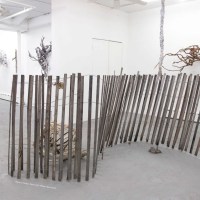
Contributed by David Whelan / If I asked you to make a sculpture about walking through the woods, what would you make? How would you go about expressing an awareness of your body in relation to the dense forest – stepping over downed logs, ducking under branches, feeling your feet against the ground and the sun warm on your skin? In A Walk with D. Ann at 15 Orient, Jilaine Jones suggests that we aren’t just walking through woods but having the experience of being human. There is an emphasis on gravity and things returning to the ground throughout the show. Landscape and motion, forms and space, combine to build emotional weight in the sculptures, asserting a presence while keeping their origins just out of grasp.

Solo Shows

Julie Beaufils: New painting for end times

Contributed by Jason Andrew / It’s easy to associate the new paintings by Julie Beaufils, now on view at Matthew Brown Gallery in Tribeca, with a post-apocalyptic world. The sixteen paintings suggest fractured architectures and abandoned fields, sun baked and rising from a humming radioactive haze. Beaufils lives and works in Paris, and her precise lines and delineated spaces capture its curving promenades, narrowed boulevards, and sinking perspectives. Travels to Los Angeles and the American Southwest have also influenced this new work.

Solo Shows

Force field: Myron Stout’s drawings

Contributed by Natasha Sweeten / In the early 2000s, among the pines and solace of an artist residency, Polly Apfelbaum shared with me a small, well-thumbed through book. Right off the bat I took the isolated black-and-white image on its cover to possess talismanic powers. Such was my introduction to the work of Myron Stout. 

Gallery shows

Fairyland 2: Enchanted tasks and tales of wonder

Contributed by Kari Adelaide Razdow / Lassoing whimsy and venturing into uncanny realms where crimson eyes peer from stones, “Fairyland 2: Deeper, Darker” at Mindy Solomon Gallery in Miami, curated by Valerie Hegarty, presents a captivating visual language of non-human elementals and imaginings. Fairies, as an archetype, are perennially underestimated. Nimble and powerful in their capacity to provoke enchantment, they idiosyncratically neutralize assumptions through glamour, illusion, and surprise, and collapse boundaries of knowing and unknowing, and visibility and invisibility. In this group show, various paintings portray animals – one has bats emerging from petrified stage curtains in the forest – but figuration dominates. Bodies on the ground or bending towards the earth suggest unknown struggles, pixie-led crossings, enchanted tasks, and tales of wonder. Hybrid creatures, including Mala Iqbal’s painting Forest Tangle with Jaybird, align with Leonora Carrington’s surreal chimerical figures, including Figuras Miticas: Bailarin II and Girl, Horse, Tree, now on view in “Leonora Carrington: Dream Weaver” at the Rose Art Museum.  

Remembrance Studio Visit

Walter Robinson’s big question: What do they want?

Contributed by Sharon Butler / Walter Robinson played an important role in the New York art scene for over five decades, and on Sunday, February 9, he passed away at his New York home. A piece in Artnet reported that the cause was liver cancer. Walter loved artists and the art world, and he believed that anyone could have a piece of it. You want to be a writer? Go ahead and write. You want to have a gallery? Open one. You want to be a painter? Paint. He was a hub of that world and never seemed to lose interest in the wild schemes…
Writing

Everything Turns Away Quite Leisurely

Contributed by Rebecca Chace / It’s 5:40 AM in New York and 12:40 PM in Palestine on August 10, 2024. I run back and forth inside my dark Brooklyn apartment, barefoot in a T-shirt and underpants. The workshop I’m leading for teachers in the West Bank begins in twenty minutes and my internet is down. Unplug the router; count to ten; plug it back in. I’m the one who’s supposed to have good internet. I have hot water, air conditioning, access to health care, and a well-stocked bodega on the corner. I lead workshops for the Institute for Writing and Thinking at Bard College, which has partnered with Al Quds University for sixteen years. When Ibrahim, the soft-spoken director of the program for first-year students, reached out to schedule their annual faculty training sessions, we assumed he meant the workshops would take place on Zoom, not in-person. 

Solo Shows

Aaron Michael Skolnick: How heartbreakingly silly we are

Contributed by Nancy Friedland / I don’t remember exactly when I first came across the work of Aaron Michael Skolnick, but I do remember the feeling. Confronted by landscapes so filled with love and loss, I wondered how a painting of light in a forest could express so much. When the gorgeous images from his most recent project – face mash-ups of Aaron and famous, sometimes funny, often tragic characters – started to pop up in my feed, I needed to know more. I searched to see what was out there about Aaron’s show “The Entertainer,” currently up at MARCH Gallery in the East Village, and found nothing to satisfy my curiosity. As I began to dig into the work myself, I quickly realized that it had tentacles that wrapped around every aspect of the artist’s life. There were the paintings, yes, beautifully wrought, deftly painted, of course, but there was also an installation, photography, and performance. The work was so layered and complex that I felt the need to reach out directly to Aaron to ask him what it was all about. Last week, I picked up the phone and tried to uncoil some of those tentacles and make sense of a complex, brave, and very funny new body of work.

Museum Exhibitions

Call it Orphism

Contributed by Adam Simon / At a Four Walls event in Brooklyn in the early 1990s, Erik Oppenheim, at that time a young artist, stood up and said, “I’m starting an art movement. Anyone who wants to join, meet me in the back after the show.” It was a hilarious and audacious gesture, in part because no one joins an art movement on a whim, like a list-serve or an exercise class, but also because there hadn’t been any artist-initiated movements for a very long time. They proliferated in the late nineteenth and early twentieth century with the advent of Impressionism, Surrealism, Futurism, and Dada, and enjoyed something of a resurgence in the 1960s with Fluxus in the United States, Supports/Surfaces and Zero in Europe, and the Gutai Group in Japan. Most of what we consider movements were proclaimed by an outside observer, usually a critic or curator, looking to group artists who had similar concerns and made work that fit the designation. For the artists themselves to rally around a specific cause, even an aesthetic one, was not required. 

Books Solo Shows

Fergus Feehily: The Horse and The Rider                      

Contributed by Joe Fyfe / Fergus Feehily, who is from Ireland but has lived in Berlin for years, is an unusual contemporary visual artist by virtue of his very careful degree of quiet obliquity. One almost hesitates to approach writing about him and, in this case, writing about his writing. It might be best to get the disclaimers over with: we share gallery representation in Köln, from Galerie Christian Lethert. He recommended me to the gallery, though at the time, long ago, I had never heard of him nor his work. I have since met him a few times. Once we had breakfast at Balthazar in New York and I remember how thoroughly he buttered and spread preserves on two sizable croissants. Feehily is somehow obscure but in plain sight, admired among an informed coterie of artists and collectors and an avid sharer. He does a lot of communicating. He posts on Instagram often, mostly very different kinds of artworks, though he appears to have something of a penchant for religious art. On his website are long year-end lists, an annī of enthusiasms for what he has read and listened to and looked at, whom he has met and spoken with.

Solo Shows

Donna Moylan’s egalitarian eclecticism

Contributed by Elizabeth Johnson / “Recent Paintings,” Donna Moylan’s first exhibition at Bookstein Projects, collects works finished over the last year in her Kinderhook studio. In our email conversation, Moylan said that “sometimes paintings take years, as if they had to go off and think.” In addition to making paintings that carry time in the process of their production, she forgoes committing to a serial style, allowing her paintings to differ drastically from one to the next. “When I started doing that, in the nineteen-eighties,” she wrote, “I understood that what I wanted was to equalize, or make equivalent, many different styles of painting, and to refer to different cultures or eras with specificity but without differentiation or emphasis, without focusing on ‘styles.’” She has achieved this goal with considerable aplomb.

Studio Visit

Studio Visit: Robert Armstrong’s uncanny cohesiveness

Contributed by Jonathan Stevenson / When the distinguished contemporary Irish painter Robert Armstrong first occupied his space on the third floor of Temple Bar Studios in Dublin 40 years ago, as a co-founder of the complex, the area was subdued and undeveloped, like Soho in the 1970s or Tribeca in the 1980s. Now his studio overlooks a bustling courtyard in what has become a magnet for visitors to the city. In turn, Armstrong himself seems to embrace Ireland’s deep and introverted rootedness as well as its exalted and extroverted role in Western culture while also reaching liberally into other worlds – he has traveled all over, with art in mind, and eagerly plumbed art history – in fluid and delicately gestural canvases that at once fasten onto familiar visual tropes and depart for murkier and more speculative realms. How he manages this tension is, by general description, unsurprising: he makes resolutely abstract paintings that remain firmly underpinned by landscape in line and allusion. He strikes this balance, easier said than done, and even more remarkably sustains it, reflecting a thorough but unobtrusive understanding that, as Colm Toibin puts it in an eloquent essay for a book of Armstrong’s work, “nothing … is free of association.”

Solo Shows

Andrew Mer: All things obscure and oblique

Contributed by Amanda Church / What do we not see every day even when we are looking? Andrew Mer, aka @bigfusss on Instagram (where these photographs were first discovered), considers the question in his current show “Agog” – the filmmaker’s first exhibition of photography since moving to New York 30 years ago – at Mitchell Algus Gallery. The show consists of thirty 14 x 11-inch digital prints, shot on an iPhone starting in 2020, in editions of five with two artist’s proofs. The spontaneous photos of street scenes are in one sense classic Instagram moments, evanescent and transient. At the same time, they capture the so-easy-to-overlook minutiae of urban existence in precise compositions.