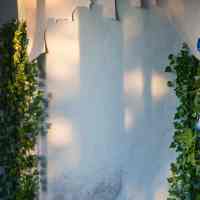
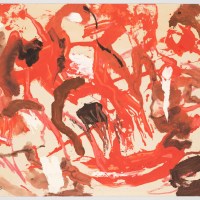
Contributed by Margaret McCann / In two shows at Bookstein Projects, excess and essence complement one other from opposite ends of simplicity. Janice Redman’s “Rough Alchemy” in the side gallery presents mostly small, hand wrought sculptures that project vulnerability, earnestly offering themselves in all their imperfections to our subjective examination. In the main gallery, Diana Horowitz’s “Light is a Place” highlights objectivity in landscape paintings that broadcast optical truth from across the room despite their tiny size. In portraying distance, they keep their own, reticently holding the walls.
Solo Shows
In Conversation: Diana Copperwhite and Erin Lawlor
In this thoughtful exchange, artist Erin Lawlor talks to Diana Copperwhite about the role of intuition and emotion in their work, their love of music, and their mutual interest in painter Howard Hodgkin. Copperwhite’s paintings will be on view alongside Hodgkin’s work at the Auckland Art Fair from May 1-4, and Lawlor ‘s solo “Divining” opens at the Highlanes Municipal Gallery in Ireland on April 26.
Rob de Oude: See what happens
Contributed by Jacob Cartwright / It is no contradiction to observe that Rob de Oude paintings in his solo show “Rhyme and Repeat” at McKenzie Fine Art are created with an exceedingly sober methodology, yet achieve intoxicating outcomes. To make something and to see something are two different things, and revealing the interrelationship between them— as de Oude’s do— is one of the greatest pleasures that paintings can offer. While it may seem inapt to call such an exacting technician an experimental painter, the designation fits. De Oude conducts his investigations in the controlled environment of his studio, where variables are adjusted with one goal in mind: to see what happens.
Catherine Murphy’s intimate realism
Contributed by Peter Schroth / At Peter Freeman, Inc., esteemed realist Catherine Murphy resurfaces with a new selection of her novel perceptions of the quotidian. In Cathy and Harry, a new documentary about the life, work, and marriage of Murphy and her husband Harry Roseman, also an artist, Murphy says that one of her prime objectives is to express “universal objectivity.” Against some strands of painting tradition, she chooses subjects so mundane as to be otherwise unremarkable, indicating a gentle contrariness.
Enzo Shalom’s meandering brush
Contributed by Sharon Butler / On view in the upstairs gallery at Bortolami, Enzo Shalom’s paintings – modest in image and muted in palette – carry a quiet intensity that has felt rare among young New York painters in recent years. At a time when traditional painterly bravado dominates, Shalom takes a different route, making vulnerability seem like a radical act. His work leans into restraint: awkward angles, washed-out tones, and just enough mark-making to read as intentional without seeming overworked. If you can imagine early Luc Tuymans’ bleached-out hues, EJ Hauser’s jagged lines, and Gary Stephan’s off-kilter compositions, you’ll land somewhere near the world of Shalom’s paintings. It’s a subdued, thoughtful space, low-key but deeply engaging.
Judith Linhares: Good gaudy painting
Contributed by Jason Andrew / Judith Linhares has a fascination with bad taste, the oh-too beautiful, and the color yellow. In her third solo exhibition at PPOW, she doesn’t hold back packing the gallery with paintings that feature strange figurative archetypes, gaudy décor, and kitschy bits all in an embrace of the subversive potential of visual excess.
Mirdidingkingathi Juwarnda Sally Gabori’s lost country
Contributed by Theodora Bocanegra Lang / Nearly half the paintings included in Kaiadilt artist Mirdidingkingathi Juwarnda Sally Gabori’s first solo show in New York, at Karma in Chelsea, are titled My Country. A few more are called My Father’s Country, and a few others Dibirdibi Country. Though her works are firmly abstract, it is impossible not to think of landscapes and location when viewing them. The artist, whose name is sometimes shortened to Sally Gabori, was born in 1924 on Bentinck Island in Australia, the ancestral homeland of the Kaiadilt people. In 1948, missionaries forcibly displaced Gabori and her people to nearby Mornington Island, where she lived for the rest of her life. She began painting in 2005, when she was about 81, and died a decade later in 2015. While she had not lived on Bentinck Island for nearly 60 years, her work reflects sharp yearning for, and irreparable separation from, her home.
Medrie MacPhee: Upcycling
Contributed by Adam Simon / The five abstract paintings in Medrie MacPhee’s “The Repair,” at Tibor de Nagy, have just enough indications of figure/ground and observed reality to evoke landscape, interior space, aerial view, blueprint. What also connects these paintings to the physical world, as we perceive it, are minor shifts of line, contour, or color that activate the surface and keep the paintings from being flat. While the paintings are large, all but one measuring 64 x 84 inches, somehow the small gallery doesn’t feel crowded.
Merlin James and the thinking of painting
Contributed by Sharon Horvath / Prominent critics have written extensively about the paintings of Merlin James, and James himself is an erudite art writer. Still, I am compelled to explore how it is that his painterly magic works on my mind. As I walked through the two rooms of his current show “Hobby Horse” at Sikkema Malloy Jenkins, the paintings struck a chord, bringing up half remembered lines of Wallace Stevens’ poetry, plucked out of context.
Nancy Evans: Cosmic absorption
Contributed by Mary Jones / One of many pleasures in “Mashups,” Nancy Evans’s show at Sargent’s Daughters, is the sensation of immersive color. Eight abstract paintings, all 26 x 20 inches, reverberate softly with veils of translucent gradients and undulating organic form. The work is grounded in American Modernism, and a baseline of particular influences come to mind: Arthur Dove, Georgia O’Keefe, Charles Burchfield, and, as a watercolorist, Helen Frankenthaler. But Evans finds her own domain through a mediated technical process that generates luminous depth.
Gerri Rachins’ raptorial abstractions
Contributed by Jonathan Stevenson / While some art pulls you in gently, Gerri Rachins’ paintings, now on display at The Painting Center, grab you like a raptor. Though unequivocally abstract, their affect, as it were, is prehensile. They seem to guard the walls, flexing with taut line and pulsing color, at once opaque and fluid.
Ross Knight: Sculpting in the material world
Contributed by Millree Hughes / With precisely targeted color, texture, and feel, Ross Knight’s sculptures in his solo show “Continuous Squeeze” at Off Paradise get at what physical artifacts mean in terms of our fears, fantasies, and daily struggles. Color is critical in Knight’s work. He keeps the palette small and specific, the colors he chooses leaning towards youthful nostalgia: the baby-blue of 1960s cars in Coupled Prop, a buoy yellow with custard drips in another Coupled Prop, the creamy hue of a rawhide dog chew-toy in Device. The band in Adjusted resembles an old, spent balloon, once yellow-orange but turned raw sienna with time. Does anyone ever get over a popped balloon? It’s a toddler’s tragedy. The fleshy knots, like umbilical cord buttons, are rendered useless.
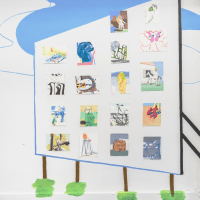
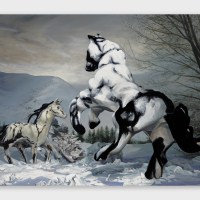
Barbara Friedman’s exquisite grotesquery
Contributed by Adam Simon / The modus operandi behind much of Barbara Friedman’s work, including her current exhibition “All Rude and Lumpy Matter” at Frosch & Co., has a name, pareidolia, which refers to finding images within abstraction. Think of the age-old pastime of finding faces in clouds.
Daisy Sheff: The anatomy of fairy tales
Contributed by Jason Andrew / Daisy Sheff’s exhibition “Begun in the Dazzling Sunshine” at Parker Gallery’s new space on Melrose in Los Angeles, intertwines reality with the fantastical. Her paintings employ leaping animals, fussy architectures, and bright flora to explain narratives that tease the peculiar logic of fairy tales. Their uneven surfaces, cleverly devised characters, and woolly layered scenes are busy and unwieldy. To interpret them is like piecing together the plot of a really great dream.
Jilaine Jones’s unfolding curiosity
Contributed by David Whelan / If I asked you to make a sculpture about walking through the woods, what would you make? How would you go about expressing an awareness of your body in relation to the dense forest – stepping over downed logs, ducking under branches, feeling your feet against the ground and the sun warm on your skin? In A Walk with D. Ann at 15 Orient, Jilaine Jones suggests that we aren’t just walking through woods but having the experience of being human. There is an emphasis on gravity and things returning to the ground throughout the show. Landscape and motion, forms and space, combine to build emotional weight in the sculptures, asserting a presence while keeping their origins just out of grasp.