Author: Two Coats Staff

Solo Shows

Tom McGlynn: Meta-minimalist-abstraction

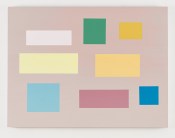
Contributed by Adam Simon / At first glance, Tom McGlynn’s paintings, on display at his solo show “What Gives” at Rick Wester Fine Art, seem to be examples of minimalist abstraction, free of narrative, subject, or anything associative. His arrangements of rectangles of solid color on a monochromatic field evoke modernism’s utopian origins: Mondrian, Van Doesburg, De Stijl, Neo-plasticism, painting purged of anything that could be thought extraneous. For contemporary abstract painters, however, these basic shapes are historically weighted signifiers, no longer free of association. One cannot now make a geometric abstract painting without it also being a depiction of a geometric abstract painting. McGlynn is fully aware of this doubling. For him, it isn’t a quandary as much as a defining characteristic of his work. What is remarkable is that, out of such seemingly depleted soil, he can conjure such visual richness.
Solo Shows

Conversation: Bob Szantyr and Valery Jung (정) Estabrook

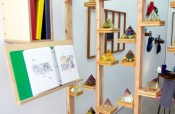
Two Coats of Paint has had an eye on Bob Szantyr since discovering his compellingly quirky, absurd, anxiety-laden work several years ago during Bushwick Open Studios. This month, on the occasion of his first NYC solo, on view at Auxilliary Projects in Greenpoint through May 13, we invited Szantyr to have a conversation about his work with a fellow artist for publication. He enlisted multidisciplinary artist Valery Jung (정) Estabrook, one of the talented artists he met in the MFA Program at Brooklyn College.

Solo Shows

Kyle Dunn’s shadowy exuberance

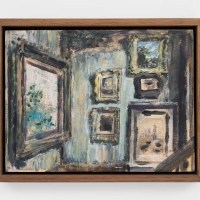
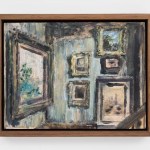
Contributed by by Margaret McCann / The theme of nocturnal interiors in Kyle Dunn’s solo show “Night Pictures” at PPOW highlights his fascinating handling of light and shadow. A pared-down technical vocabulary also shows less can be more. Absent in these paintings are cushiony bas-relief surfaces that can distract from his ingenuity on the flat plane, where illusionism and abstract pattern contend. Blending realism and Synthetic Cubism – using found or computer-generated imagery in applications like Photoshop, rather than paper and glue – cartoony simplification plays off precise description, shifting between levity and intensity.

Solo Shows

Jan Dickey: Both sides now

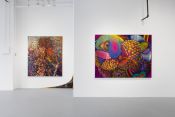
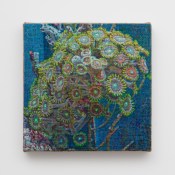
Contributed by Heather Drayzen / “Passing Through,” the title of Jan Dickey’s solo exhibition at D.D.D.D., can be read literally and symbolically. Several jewel-like paintings are mounted on the wall with a golden hinge in an oil-slick finish allowing the viewer to pass through to the other side and glimpse into the inner guts, the vein-like physicality, of the abstract earth-like paintings. In a self-penned exhibition statement, Dickey refers to their surfaces as “swirling colors of mountain mud,” and they soulfully conjure the juicy texture of our own existence, where everything is in flux and the physical and incorporeal blend together.

Solo Shows

Mie Yim: Hazardous and barely fictional

Contributed by Clare Gemima / Painter Mie Yim evidently can’t quite understand how exciting she is. “Oh, and by the way,” she said as I had one foot out of her Bronx studio, “one of the paintings in the show will be installed in front of a huge mural.” She seemed convinced of the dubiousness of this idea even though she had landed two solo exhibitions and was preparing for both at once. I thought she would elaborate, but her sentence stopped there. Over the course of our conversation, Yim’s high-energy teasing had me waiting like an excited toddler for “Belladonna” at Olympia – in coordination with “Nightshade” at Simone Subal Gallery – to open.

Solo Shows

Jennifer J. Lee’s ghostly familiarity

Contributed by Kyle Hittmeier / Jennifer J. Lee’s reactivation of shelved digital images through painting established her as a pioneer in a post Post-Internet epoch super-saturated with online photographs. “Square Dance,” Lee’s third solo exhibition at Klaus von Nichtssagend Gallery, cements her standing. As many of her predecessors doubled down on digital ephemera by creating work largely within the redundancy of the digital interface, she, as part of a new generation of painters, bulwarks digital impermanence by building a sense of physicality back into the image.

Gallery shows

Hudson Valley Selected Gallery Guide: May, 2023

This month marks the beginning of the fourth year since the pandemic drove the art community upstate, and, as readers can see from our selected guide, the gallery scene continues to expand and thrive. Seasonal spaces such as the Re Institute are reopening and the hardy year-rounders are gearing up for their busiest season yet.

Group Shows

Savoring medium-rare painting at Subtitled NYC

Contributed by Zach Seeger / The group exhibit “Medium Rare” – on display at Subtitled NYC, a second-floor Greenpoint gallery with a skylight – features paintings by Amanda Ba, Jacob Patrick Brooks, Marcus Civin, Sam Cockrell, Kevin Ford, Annette Hur, and Kate Liebman. It was curated – or rather, prompted – by Jaejoon Jang, who instructed the artists to select examples of what they considered unfinished work. Without knowledge of this specification, it would be difficult for a viewer to consider the pieces unfinished. The overarching cohesiveness of the show makes each one seem resolved. In light of Jang’s command, though, they can also be seen as hovering just outside of the artists’ respective oeuvres, meeting only some of their criteria for finished work.

Open Studios

Dumbo Open Studios in full tilt

Contributed by Patrick Neal / Open Studio events always take place on weekends throughout artist enclaves in the city, and this past weekend it was DUMBO’s turn. This year, DUMBO Open Studios included a slew of events — 140 open studios, pop-up shows in studios and conference rooms, installations in storefront windows and on sidewalks, self-guided and docent-led tours, and artists selling their wares on the street. Art in Dumbo’s website offered several helpful maps and interactive tools to assist in planning a weekend of studio hopping, and they will continue to be a useful resource for the art community. A special feature this year was Curated Guides, specializing in specific areas of interest like drawing, mixed media, sculpture, and non-objective art. Exhibitions in commercial, non-profit, and residency program galleries were abundant, as were opportunities to talk to artists in their studios and see work in progress.
Artist's Notebook

The Exhibit: Just another gig

Contributed by Adam Simon / I only watched parts of The Exhibit: Finding the Next Great Artist – the six-episode MTV/Smithsonian Channel reality show in which seven artists compete for an exhibition at the Hirshhorn Museum and $100k in prize money. Not having an MTV account, my viewing was repeatedly interrupted by ads, and I bailed after watching a few episodes. I was sorry to bail in a way because there were things I liked about The Exhibit. The artists were impressive as thinking, creative individuals and I was taken with how supportive they appeared of each other, remarkable given the stakes. If there were times of cutthroat competition, they were carefully edited out, happened off camera, or just weren’t in the bits that I saw. I’m guessing the comradery I witnessed was genuine. That said, there is a striking degree to which The Exhibit, as a reality TV show, resembles any other reality TV show, whether it’s American Idol, The Apprentice, or Top Chef. A quick scan shows over 400 reality TV shows listed on Wikipedia, dating back to my favorite, the British Up series in 1964.] 
Gallery shows

The feeling of order: Helen Frankenthaler, Trevor Shimizu, and Wallace Stevens

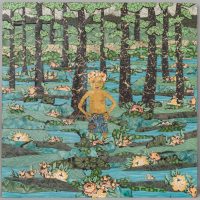
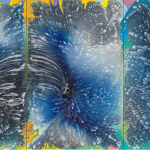
Contributed by Elizabeth Scheer / As the city transitions into solstitial warmth, two stand-out exhibitions reward the corresponding sense of emergence. Helen Frankenthaler’s “Drawing within Nature: Paintings from the 1990s,” on view at Gagosian, and Trevor Shimizu’s “Cycles” at 47 Canal are preoccupied with what the American poet Wallace Stevens described in his poem “Notes Toward a Supreme Fiction” as the discovery of “order as of a season.” Both exhibitions feature pastoral scenes that impressionistically use color, texture, and line to reveal patterns in the apparent arbitrariness of the natural elements they aim to represent.

Museum Exhibitions

Lois Dodd’s naturalism: Elegant and intricate

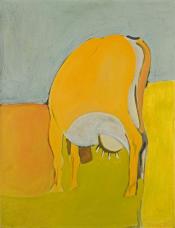
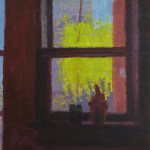
Contributed by Abshalom Jac Lahav / The Bruce Museum in Greenwich, Connecticut, has reopened after a stunning 70,000 square-foot renovation. The new building was carefully designed and constructed to blend into the surrounding New England landscape and weave together a vast tapestry of art and science. It is fitting that “Natural Order,” a retrospective of the brilliant naturalist painter Lois Dodd’s work featuring almost 80 paintings from the mid-1950s to 2021, is the revamped museum’s first major exhibition. Her personal landscapes and interiors embody a unique style that is both sentimental and painterly.

Solo Shows

Erica Mao’s unprotected souls

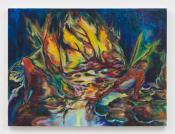
Contributed by Clare Gemima / In Erica Mao’s paintings, presented in “Reach Through the Veil” at Rachel Uffner Gallery, figures flee from danger. Yet the artist does not allow her characters access to refuge, or any guarantee that safety has ever been in reach. Mao has thrashed paint, then re-painted, and then thrashed paint again to create compositions of furious journeying, beating rhythmic anxiety into her characters’ faces. Somewhat cruelly, Mao locks her figures in unwarrantedly self-assured moments, knowingly rendered short by liquified cliffs, exotic swamps, ominous caves, and sulking tree trunks. 

Screens

Art and Film: Kelly Reichardt’s commune of angst

Contributed by Jonathan Stevenson / Kelly Reichardt excels like no other filmmaker at conveying the subtle ravages of time on earth. She brilliantly tackled the epic theme of America’s western expansion in the revisionist westerns Meek’s Cutoff and First Cow and eco-terrorism in Night Moves. But it is the day-to-day yield and subtext of history and politics that most concern her: a young housewife facing down ennui in River of Grass; a friendship deteriorating with age in Old Joy; a young woman seeking a better life unprepared in Wendy and Lucy; women extracting meaning from desolation in the post-feminist Certain Women. For Reichardt, even subdued lives are fully lived and merit sympathetic attention. They include, she insists in Showing Up, the quietly precarious existences of artists. Wise, nuanced, and penetrating, the film is also stealthily hilarious.