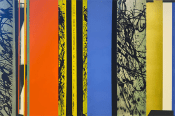
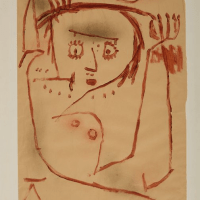
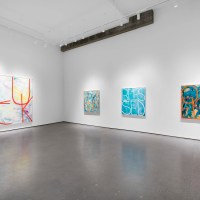
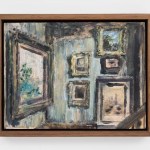
Contributed by David Carrier / Five smallish early Jo Baer paintings are on display in one white- walled gallery at DIA Beacon in her exhibition there since 2022. The show is both tantalizing and exasperating. In the 1970s, Baer became famous as a minimalist painter. Then she left New York, published a manifesto in 1983 proclaiming “I am no longer an abstract artist,” and changed her style completely.
Author: Two Coats Staff
The real deal: James Brooks reconsidered
Contributed by Laurie Fendrich / “A Painting is a Real Thing,” the Parrish Museum’s current exhibition of the work of the Abstract Expressionist painter James Brooks (1906–1992), is his first comprehensive retrospective in 35 years. On the rare occasions I’ve encountered Brooks’s paintings, I’ve paid them scant attention. Like many, I have walked on by, presumptively ranking him well below the likes of Jackson Pollock, Willem de Kooning, and Mark Rothko. With this survey of more than 100 paintings, drawings, and prints, I find myself reconsidering Brooks’s status. With the 176-page catalog containing essays by adjunct curator Klaus Ottmann and artist-writer Michael Solomon, the show makes a case that Brooks’s art is more original and important – both within and beyond the context of the AbEx movement – than most of us thought.
Nola Zirin and the march of abstraction
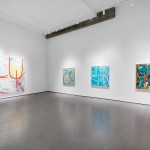
Contributed by Michael Brennan / It has sometimes been assumed that abstraction is unlimited in its possibilities. While that’s still broadly true, abstraction also has been exhaustively explored over the course of a century or more. All painting is organized around some kind of form. Abstraction is burdened with establishing form in the absence of figuration, the readiest and most natural source. There are only a few ways to define form without a figure – for instance, through geometry or gesture. It’s a limited playbook. Much of the success of Nola Zirin’s new paintings, on view at Mosaic Artspace in Long Island City, comes down to her bold expansion of the index of abstraction. Many are striking in their recombination of form and unusual mix of materials.
Leigh Behnke’s fluid sense of time
Contributed by Riad Miah / What’s a ghostly-looking ship doing in the city? Probably the same thing as the ethereal-looking figures passing through a similarly urban environment. In Leigh Behnke’s solo show “Time Travelers and Ghost Ships” at the School of Visual Arts’ Flatiron Project Space, enticing and mysterious paintings of such phenomena stimulate contemplation of the future as a manifestation of how we treat the present.
Yellow Chair Salon Introduces Symposia!
As the Yellow Chair Salon starts its fourth year, we are excited to introduce Symposia!, a six-month intensive virtual program created for artists with an advanced studio practice. It is a rare opportunity to work with some of the leading artists, educators, gallerists, and critics in contemporary art.
Elisa Soliven’s vessels of impeccable resistance
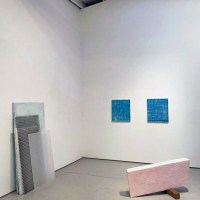
Contributed by Jonathan Stevenson / Elisa Soliven sees her dignified ceramic sculptures, now on display in a faultlessly curated solo show at LABspace in Hillsdale, as vessels containing the rich stuff of life – space, time, cultural tropes, history both grand and personal. Too eclectic and searching to be merely iconic, they are brimming with both old and new referents, and bear their weight with extraordinary grace.
Clyfford Still: A missing link?
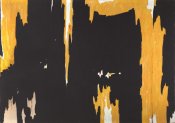
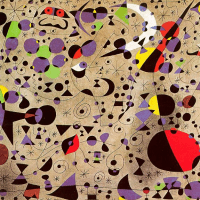
Contributed by David Carrier / It’s difficult to imagine a more effective presentation of Clyfford Still’s work than “A Legacy for Buffalo,” now in the brand-new wing of the Buffalo AKG Art Museum. In four very high, white-walled galleries, the 33 paintings – most of them made between 1937 and 1963 and bearing Still’s distinctly prosaic and thematically unenlightening titles – have room to breathe and provide a full picture of Still’s early development.
Vivid color and discreet provocation at Mrs.
Contributed by Jonathan Stevenson / The group exhibition “Resounding, Variegated, Leaves” brought together three quite divergent artists – Fabienne Lasserre, Annie Prendergast, and Lily Ramírez – who share a penchant for audacious color choices that serves to unify their work. The show yielded an intellectually satisfying and harmonious experience as well as an aesthetically edifying one. That’s a credit not only to the artists but also to the insightful curators at Mrs. Strategically postured in New York but at a tactical remove in the gritty neighborhood of Maspeth, Queens, the gallery appears to have forged a crisply nuanced niche, gently tilting towards female artists, abstraction, and vivid color.
Short story: A siren wailed on Bethune Street [Richard Roth]
At breakfast, Asher said to Rose, “I’ve been invited to give a talk at VCU.”
Carol Bruns’s aesthetic moralism
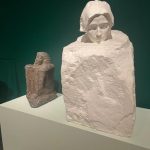
Contributed by Gwenaël Kerlidou / Heart of Darkness, Joseph Conrad’s 1899 novella, is one of the first fictionalized accounts of the ravages of European colonialism in Africa. Marlow, the narrator, while surveying the grounds of an ivory collecting station on the Congo River, catches sight of a row of shriveled heads mounted on stakes. The episode segues to a deeper exploration of the psyche of Kurtz, a terminally ill but very successful ivory harvester working for the king of Belgium. His cryptic last words – “the horror, the horror” – sum up the situation. The title and content of Conrad’s novella reverberates through Carol Bruns’s current exhibition at White Columns of mostly monochromatic frontal sculptures, in which the human figure is omnipresent, either as hieratic totems or as ritual masks. Scattered in the gallery space, an unruly mob of chimeras and other nightmarish characters seems to be stoically harboring the scars, wrinkles, creases, and other traces of immemorable sufferings.
NYC Selected Gallery Guide: August, 2023
The best painting-centric guide to art galleries in NYC, Brooklyn, and Queens / This month in Brooklyn we look forward to seeing “Frances Brady, Much More Together,” a collaborative collage project created by Marta Lee and Anika Steppe at Underdonk (opens on August 5) and Barbara Friedman’s solo show “The Hysterical Sublime” at FiveMyles (opens on August 19). On the LES, artist Ben Pritchard has organized “Summertime Rolls,” a lively group exhibition on view at Equity Gallery (closes August 12). At Spencer Brownstone, check out Mira Dayal’s thoughtful reCAPCHA drawings and “Terminus,” a group show of artists whose works mark passages of space and time. In Tribeca, at Chart, artist Shona Andrews curated a “Bellyache,” a family-and-friends show that includes many of her mentors from art school (closes August 18). Looking ahead, some of the galleries that have already closed for the summer have begun announcing their fall shows, so heads up: Charlene Von Heyl and Tomoo Gokita will be at Petzel in Chelsea, and Austin Thomas’s “City Scape” print project will be on view at Morgan Lehman. Openings begin the week of Tuesday, September 5.
Hudson Valley Selected Gallery Guide: August, 2023
With Upstate Art Weekend in the rear view, now is a good (less hectic) time to head upstate, relax, and see some shows. I’m happy to report that the Two Coats of Paint campsite is already booked. See you up there, under the stars.
Kent O’Connor’s triumphant mundane
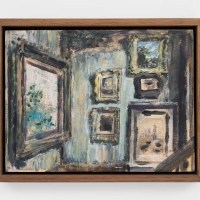
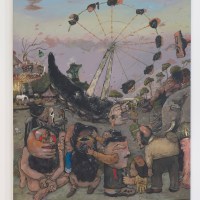
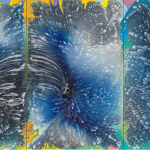
Contributed by Margaret McCann / Kent O’Connor’s “Everything All at Once” at Mendes Wood DM comprises small portraits, landscape studies, and several larger paintings, including still-lifes in shallow interiors, which he calls tabletops. The show’s evocative title, which relates to their multiplicity, may also be after a song or film. O’Connor’s description qualifies intense observation with the levity of comics.
“Object Lessons” at the Florence Griswold Museum: Diverse American artworks from Princeton University find common ground
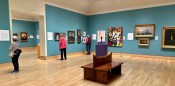
Contributed by Emma Flaherty / George Washington, George Inness, Georgia O’Keeffe—oh my! A diversity of subjects and artists hang in close juxtaposition inside the special exhibition galleries at the Florence Griswold Museum in Old Lyme, CT, this summer. Bright colors—royal purple, Princetonian orange, and an inviting teal—convey the excitement that the curators intend these object-partnerships to provoke. Object Lessons in American Art: Selections from the Princeton University Art Museum, on view through September 10, features four centuries of artworks, merging a broad range of paintings, sculptures, photographs, and works on paper with utilitarian objects, such as baskets and pottery.
Mark Bradford’s urgent abstraction
Contributed by Jonathan Stevenson / “You Don’t Have to Tell Me Twice,” Mark Bradford’s galvanizing tour de force at Hauser & Wirth, was a three-story exhibition of arresting coherence. His muscular paintings grab you by the lapels, pull you in, and visually immerse you to a point of satisfying comprehension.