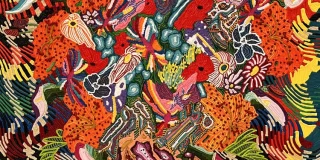
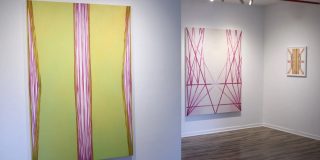
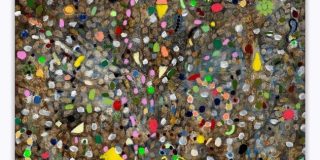
Contributed by Anne Swartz / Since its origins in the 1970s, practitioners and advocators of the Pattern and Decoration movement have countered claims that decorative art lacked seriousness. In America at the time, critical arguments focused on the exhaustion of painting, positioning it as an outmoded visual form. Several artists resisted this affront. Instead, they embraced images for their pleasure, opposing the notion of immediacy often considered synonymous with other mediums such as photography.
Author: Editor
Fiction: Murder in the Studio [Laurie Fendrich]
Contributed by Laurie Fendrich / Three days had passed since Muriel Redpathwho had hated her given name since birth and instead liked to be called Murehad seen Luke. Now here she sat, reading the news of his death on Twitter.
Alan Prazniak’s kaleidoscopic view
Contributed by Jonathan Goodman / Alan Prazniak’s small paintings, on view at Geary Contemporary in NYC and Millerton, align with one another, offering a kaleidoscopic account of open meadows and grasslands, perhaps informed by early memories.
Thoughts on that small Yuskavage painting
A twelve-inch canvas Lisa Yuskavage included in her exhibition at David Zwirner upstages the entire show and much of the work the artist has exhibited to date.
Elizabeth Murray in Buffalo and for the ages
Contributed by Dana Tyrrell / From 1965 to 1967, Elizabeth Murray a towering presence in contemporary painting who died in 2007 lived and worked in Buffalo, New York. Having moved from San Francisco to teach at Rosary Hill College (now Daemen College), she used her time in Buffalo to build up to living and working in New York City. Elizabeth Murray: Back In Town, Anderson Gallery at the University at Buffalo, demonstrated that this interlude was formative to the canonically understood Elizabeth Murray.
Bad Boyfriends and Pink Bathers : A conversation with Janice Nowinski
Contributed by Sangram Majumdar / On the occasion of her first exhibition, beautifully installed at Thomas Erben Gallery, Janice Nowinski and I talked about how time presents itself in every aspect of her paintings – from references to art and personal histories, to the very material qualities of the work.
Transformation: Douglas Melini’s new work at Miles McEnery
Contributed by Sharon Butler / When I saw Douglas Melinis new work at Miles McEnery (on view until October 16), I was surprised how much it had changed since I saw his pattern paintings In “YOU HAVE TO PEER INTO THE SKY TO SEE THE STARS,” a 2016 solo show at 11R. I reached out via email to ask him about the bold transition.
Two Coats Selected Gallery Guide: October 2021
UPDATED OCT 23 / Welcome to the Two Coats of Paint painting-centric guide to gallery exhibitions in New York City.
Transmitter: Painting’s undying versatility
Contributed by Jonathan Stevenson / Painting is persistently and emphatically alive and well. Indeed, the notion that it is dead — or, more kindly, moribund — is so vapid and hidebound that merely saying that the notion is a cliche is itself a cliche. Yet in putting the lie to it one more time, the Bushwick gallery Transmitter’s succinctly penetrating group show “Material Mutations, part one: The Canvas” brings fresh insights in what might otherwise be an eye-rollingly redundant conversation.
Stacy Lynn Waddell: Moving backwards to jump ahead
Contributed by Jonathan Goodman / In �Mettle,� Stacy Lynn Waddell�s expansive show at Candice Madey, the artist embraces different cultures throughout the world: Malian life in the 1960s; nineteenth-century American painting reflecting burgeoning capitalism; and seventeenth-century Dutch flower painting.
Caroline Kent: A set of symbols
Contributed by Jonathan Goodman / Caroline Kent, a painter based in Chicago, is having her first show at Casey Kaplan. She makes schematic abstract paintings, which have aspects of doubled, mirror-like imagery. An underlying fiction of her art is the presence of twins, Victoria and Veronica, who speak to each other and to the painter�s audience via the works she creates. Kent�s sign-like abstraction involves a set of symbols whose meaning depends not on any explicitly prescribed content but rather on their visual orientation in terms of form and placement.
The new theatrical space of Amy Lincoln
Contributed by Jason Andrew / Amy Lincoln�s soaring trajectory has locked in the natural world, the phenomena within it, and the epic world of myth. Ten new paintings now on view at Sperone Westwater embrace these pervasive elements while exploring a bold new theatrical space.
Fiction: The Real, the Fake, and the Ugly [Laurie Fendrich]
Contributed by Laurie Fendrich / What a mess. And today was doomsday. Eliza Netsua couldn’t get back to sleep, so she dragged herself out of bed at five a.m. Her loft, long ago a sewing sweatshop renovated only insofar as the splintery floors had been sanded and the walls slapped with multiple coats of white paint, was already hot and stuffy. A full-on August heat wave in New York. The gallery was closed for the month and, moreover, it was Monday, a day even she, the assistant director, wouldn’t ordinarily be working….
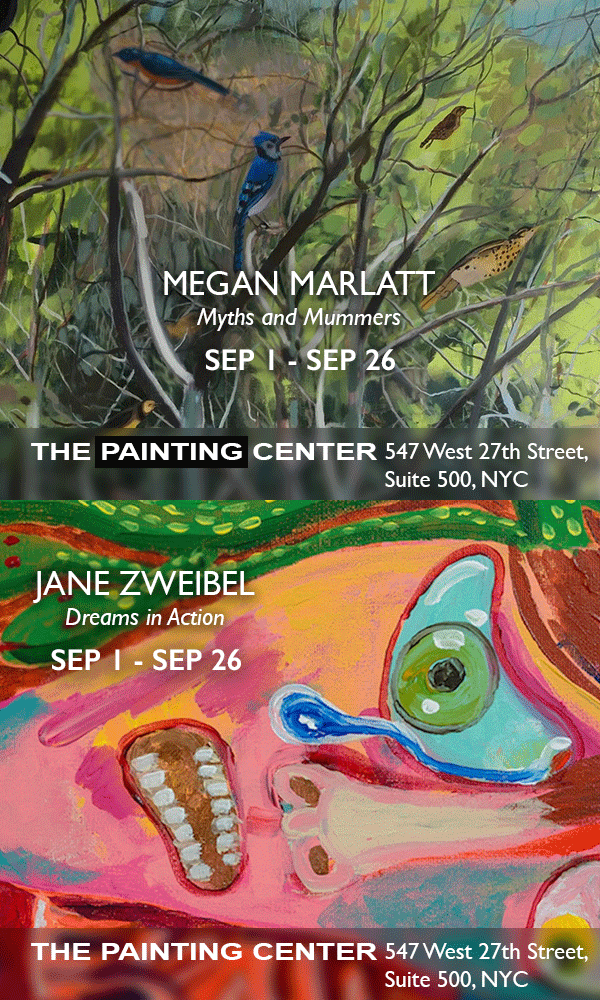
Two Coats Selected Gallery Guide: September 2021
Welcome to the Two Coats of Paint painting-centric guide to gallery exhibitions in New York City. There’s a lot to see this month. We’re in the thick of hurricane season, with Tropical Storms Kate and Larry currently brewing over the Atlantic, so let’s hope inclement weather doesn’t get in the way.
The postman’s palace in hauterives
Contributed by Ken Buhler / Imagine the most elaborate, fanciful and bizarre fairy-tale like sand castle possible. Ferdinand Cheval’s masterpiece, Le Palais Idal, is teeming with, octopi, dragons, ostriches, flamingos, lions, elephants, deer, plants, gods, fairies, giants, and historical figures all interwoven with architectural forms whose references include Hindu, Buddhist, and Egyptian temples, Islamic mosques, and Swiss chalets.