
Contributed by Sharon Butler / I was born in New London, Connecticut, still known as “The Whaling City,” having trailed only New Bedford in vessels and voyages in the late nineteenth century and amassed much of its wealth from that maritime oil trade. Sea captains were the sturdiest pillars of the community and their grand homes punctuated the city’s streets. One was Captain Lyman Allyn (1797–1874), who commanded a whaling ship at age 21 and went on to serve as director of a bank, an insurance firm, and a railroad. Harriet Upson Allyn (1840–1926), the youngest of his six children, spent her entire life in New London. In her will, she dedicated funds to establish an art museum, prospectively naming it after her father. I’ve been enjoying the Lyman Allyn for years, and it’s a terrific regional museum – small and stately with a permanent collection of roughly 20,000 works, spanning paintings, drawings, prints, sculpture, furniture, and decorative arts. While its strongest suit is American painting and decorative arts from the eighteenth through the twentieth century, it is now fielding several winningly divergent shows.
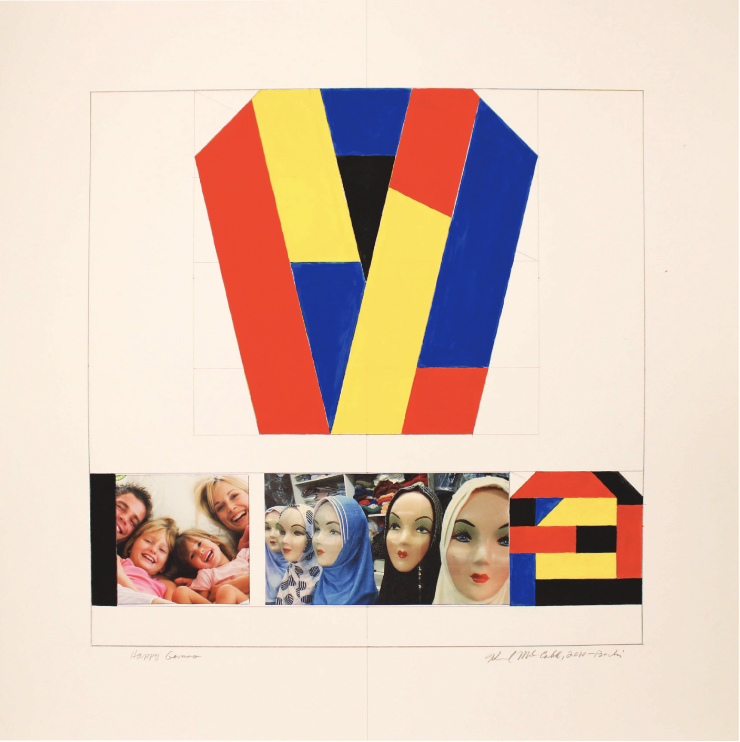
and graphite on paper, 19 3/4 x 19 3/4 inches

67 1.4 x 67 1.4 inches

and graphite on paper, 19 3/4 x 19 3/4 inches
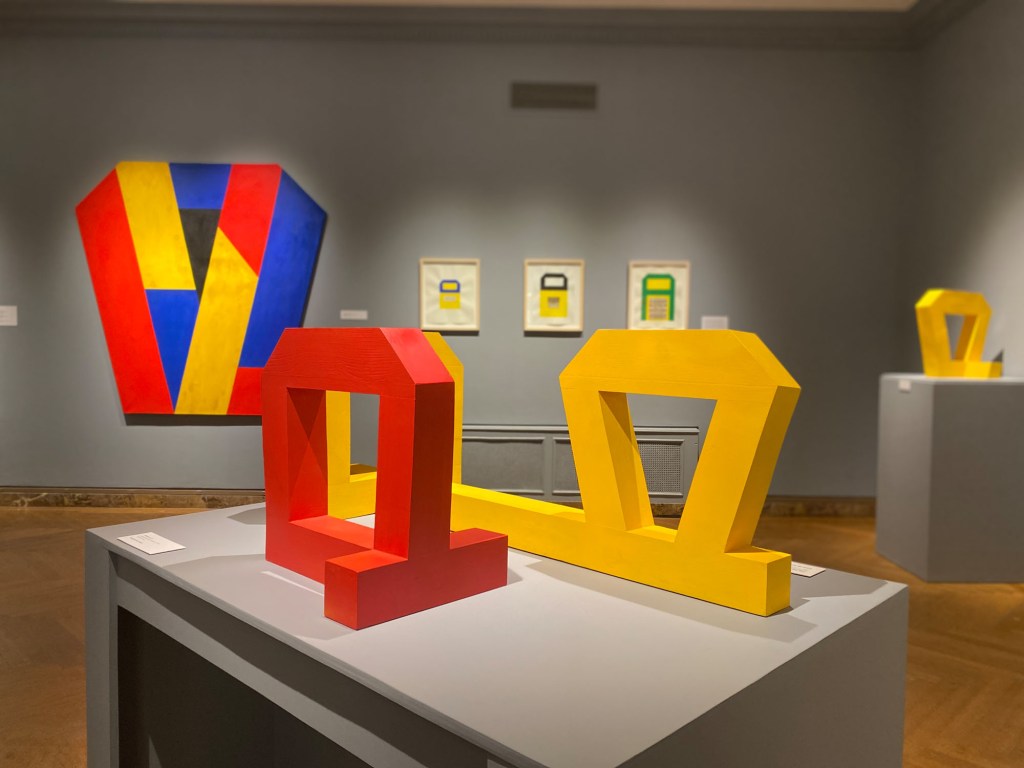
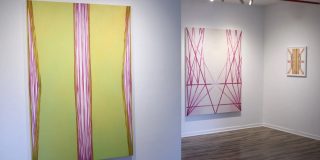
On the first floor, beyond a gift shop with an appropriately maritime flavor, is Howard McCalebb’s solo show “The Golden Mean,” Although he spent more than a decade in Berlin running a gallery and artist residency (Kunstraum) Dada Post, for the past few years, McCalebb has been living up the Thames River in Norwich, where he has a new gallery – Dada Post USA. He is inspired by the elegant, recursive versatility of the Golden Ratio, whereby a deconstructed rectangle yields other compatible shapes with algebraically kindred proportions. It is often found in natural phenomena such as leaf formations and shells. Renaissance architects Andrea Palladio and Leon Battista Alberti used the golden ratio and other classical proportional systems to determine building designs, as did modern architects Frank Lloyd Wright and Le Corbusier. Piet Mondrian’s grid-based compositions might be analyzed in terms of golden-ratio proportions, although they emphasize harmony more broadly.
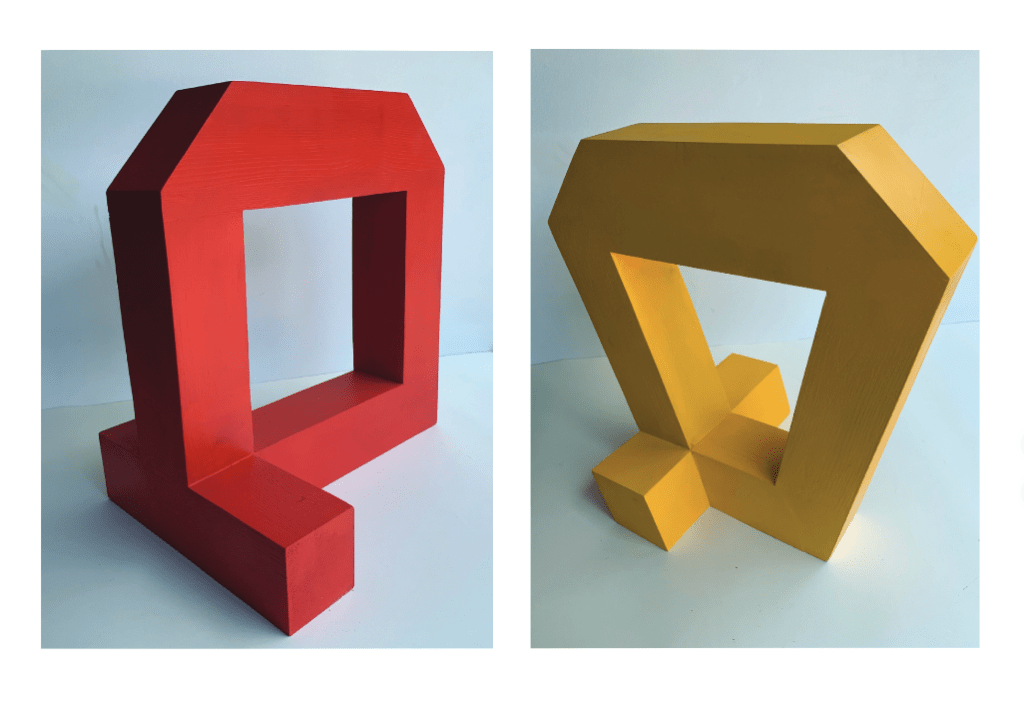
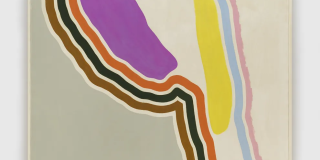
In McCalebb’s minimalist abstraction, which in this succinct retrospective comprises work on paper and small painted wooden sculptures covering more than 30 years, he uses the ratio to explore universal ideals and cultural harmony, which have enduringly concerned him. In a series of 2010 collages and one more recent screen print, he affixes images from magazines and newspapers to the initial drawings, which hauls the work into contemporary context. I was reminded of the boxes On Kawara made for his date paintings that corresponded with the newspapers he read on the days he made them. In McCalebb’s charmingly knowing tabletop sculptures, each painted monochromatically in a bold primary color, he combines products of the ratio in ways that reinterpret it without destabilizing its essential balance. The negative space around the objects extends the playfully arranged and truncated forms beyond their physical characteristics. Fusing figurative and architectural tropes, he adds “feet” and “knees” that help the structures stand. Also impressive are two large shaped canvases. While they superficially recall Ellsworth Kelly’s work, McCalebb rejects Kelly’s pristine aloofness.

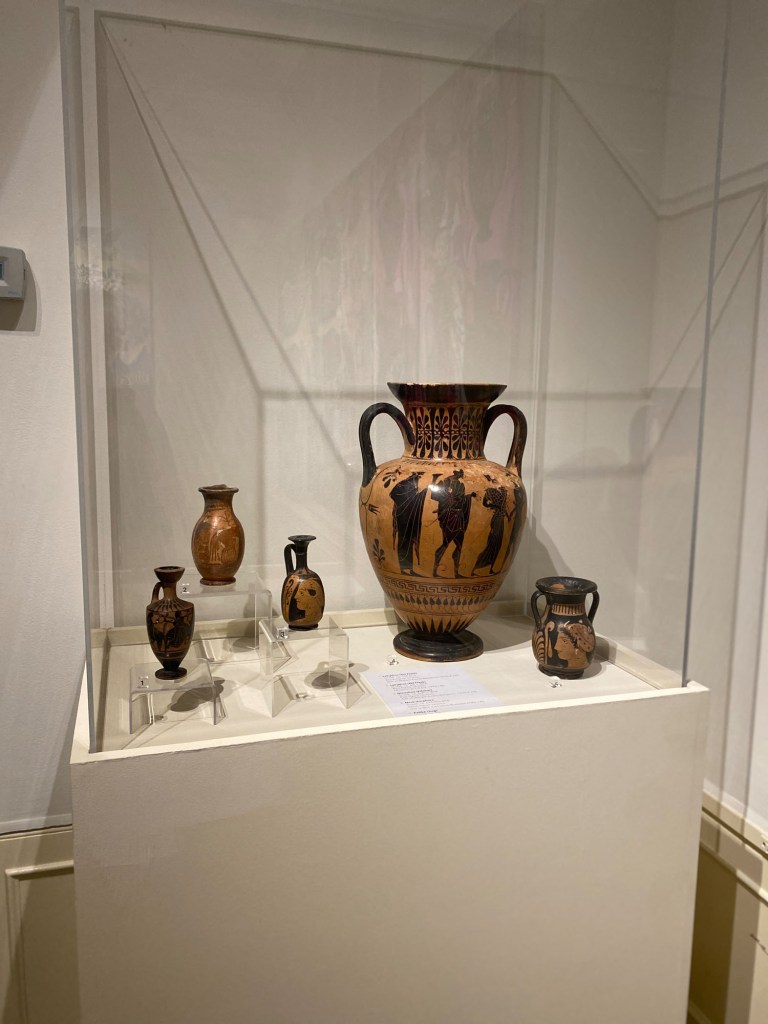
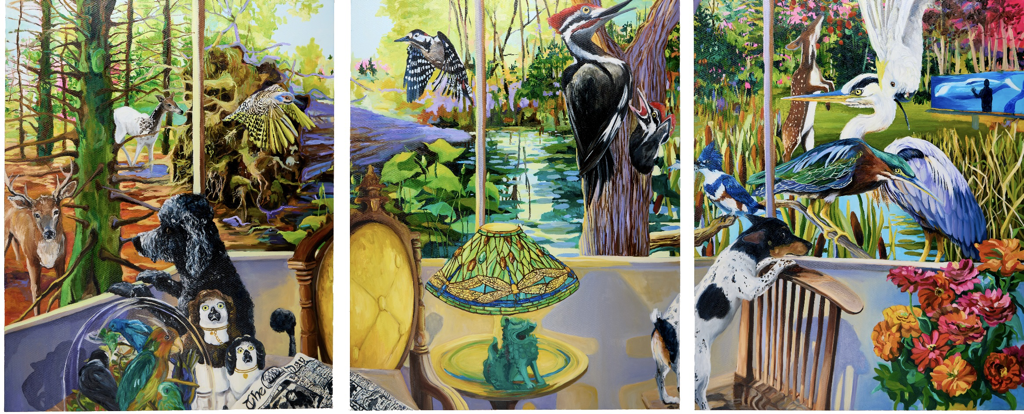
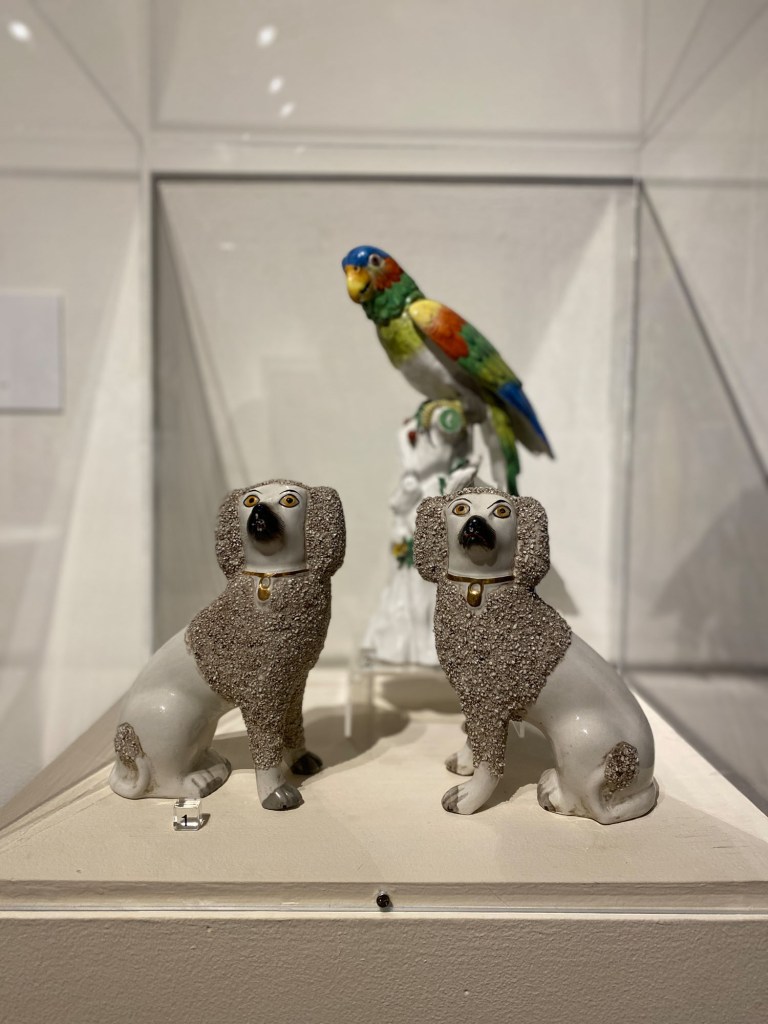
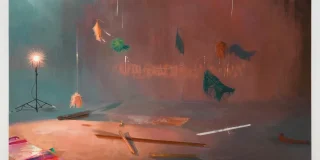
Upstairs in a set of smaller galleries, Kat Murphy and Heidi Johnson’s work is presented in “A Tin Can on a String: Conversations from the Collection.” After judiciously digging through the museum’s storage and online database, they selected images and objects from all major categories – nineteenth–century painting, Egyptian funerary objects, ancient Greek vases, decorative China, taxidermized birds, furniture, and more – to spark new bodies of work. Johnson includes decorative objects in her brightly colored, aggressively painted landscapes – one a particularly engagiing triptych titled Porch – setting up portals from indoor to outdoor space. Animals are key activating agents, comforting or menacing depending on their placement and attitude in the tableau. Murphy extracts images from paintings and crafts them into three dimensions using construction foam, papier-mache, and plenty of gold paint and foil leaf. She inventively manipulates scale, in one piece taking a diminutive cameo and blowing it up to the scale of a mid-size painting using foam and papier-mache. Abram Poole’s eerily dark life-size painting The Spanish Sisters, made in 1938, gives rise – improbably but successfully – to a pink neon piece that outlines the girls dresses. In Murphy’s work too, animal imagery abounds.

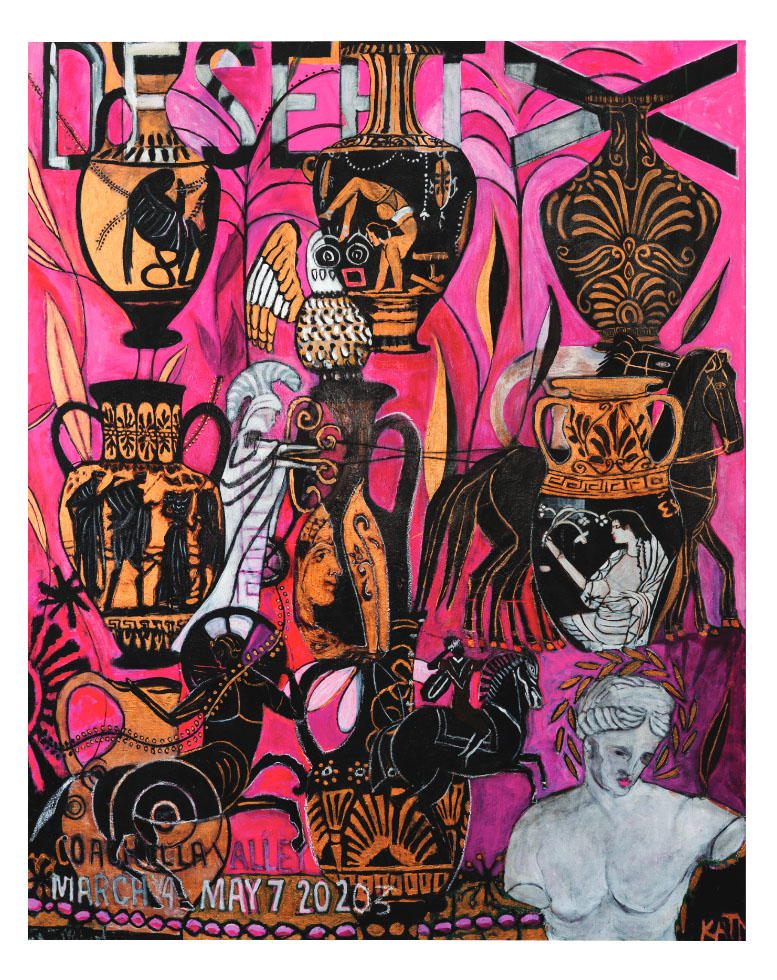
60 x 48 inches

acrylic, charcoal, collage, white gold, 60 x 48 inches

In several nearby galleries, Shepard Fairey’s itinerant exhibition “Facing the Giant: Three Decades of Dissent,” arraying his distinctly imperative prints, lends topicality to the proceedings. They are, of course, politically on-the-nose, but that is the point and now is the time. Each of the three shows – one resolutely abstract, one playfully post-modern, one self-consciously provocative – is a sound and exuberant contemplation. Such a range of sensibilities might not be expected of a regional museum rooted in a defunct if romantic industry. The Lyman Allyn proves to be far more than that.
“Howard McCalebb: The Golden Mean,” curated by Tanya Pohrt, Lyman Allyn Art Museum, 625 Williams Street, New London, CT. Through October 4, 2026.
“Kat Murphy and Heidi Johnson: A Tin Can on a String: Conversations from the Collection,” curated by Tanya Pohrt, Lyman Allyn Art Museum, 625 Williams Street, New London, CT. Through August 9, 2026.
“Shepard Fairey – Facing the Giant: Three Decades of Dissent,” Lyman Allyn Art Museum, 625 Williams Street, New London, CT. Through September 6, 2026.
About the author: Sharon Butler is a painter and the publisher of Two Coats of Paint.










Thank you for this wonderful review of Howard McCalebb’s Solo show, The Golden Mean, at the Lyman Allyn Art Museum. Coincidentally, when visiting the Skoto Gallery in Chelsea last Wednesday, I purchased his ‘Autobiography as Critique’ 2013, Dada Post, Berlin, which I am now reading. It is a probing, fascinating commentary on cultural politics. Quote: “With Autobiography as Critique’, Howard McCalebb, a sculptor and active figure on the international art scene, offers an expanded critique on the role of identity politics in art practice.” I met Howard (he was in the MFA and I was in the BFA program at Cornell University in the early 1970s’). Also, I enjoyed reading about the other exhibitions and the history of the museum! I will plan a visit soon.
This is such a great show and the LAAM is it for Jim definitely worth the trip👏
I’m on the Metro North to New London tapping this out on the phone after reading your thoughtfully constructed piece…it’s a wonderful use of the power of three, with the concise short form reviews following up a wonderful introduction to the institution itself. My first visit may have been late in the Pandemic, and one of my first takeaways had to do with how nimble and effective the institution’s response was to cultural shifts. I admit it, I read label copy…and it was a real lift to see Lyman Allen rise to the occasion as quickly and effectively as they did.
Very much looking forward to getting over there this weekend. Cheers all!
Thank you for introducing me to Howard McCalebb’s work, very thoughtful and interesting work. A pleasure to read