Tag: Ellsworth Kelly

Solo Shows

Fran Shalom: Merging vernaculars

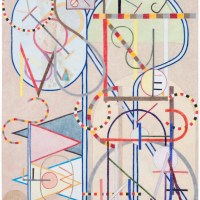
Contributed by Adam Simon / I’ve been aware of Fran Shalom’s paintings for a while and have been interested in how at times they seem like a comic version of abstract painting. She excels at what I would call formal wit, eliciting not a belly laugh but a knowing smile from those familiar with the vernacular. Her humor is a foil of sorts, providing cover for a serious investigation into the way shapes can carry associations and embody feelings. Looking at one of Shalom’s paintings can be as psychologically charged as an encounter with an eccentric person. My assumption is that the paintings are arrived at, as the title of her current show at Kathryn Markel Fine Arts, “Everyday Improvisations,” suggests, through trial and error.

Group Shows

Art history diagrammed at the Milton Resnick and Pat Passlof Foundation

Contributed by David Carrier / Anyone old enough to remember Claude Levi-Strauss’s books on structural anthropology or Rosalind Krauss’ famed structuralist account of sculpture, all richly suggestive sources of art theory, will likely appreciate “Building Models: The Shape of Painting,” currently up at the The Milton Resnick and Pat Passolf Foundation and curated by Saul Ostrow. The central question he poses is how you construct a painting. In the 1960s and 1970s, when painting was beleaguered and political experimentation was a related concern, tribes of New York artists were consumed with answering that question.

Gallery shows

The Tomayko Foundation: Four artists and the promise of Pittsburgh

Contributed by David Carrier / Sobia Ahmad makes silver fiber prints and inkjet images responding to Sufi traditions of poetry and oral storytelling. Her The Breath within the Breath is a 30-foot-long inkjet print on Japanese paper, mounted on a platform running diagonally across the gallery. Maggie Bjorklund does oil paintings. Her Assumption of the Virgin (After Titian) is a close-up rendering of that subject. Centa Schumacher manipulates photographic images, and her Salt Fork, Rain on Lake superimposes a white circle on an archival inkjet print. Elijah Burger had developed private codes of quasi-abstract images, like Hex Centrifuge. The unifying theme of the four-artist exhibition “I Believe I Know” that includes this work, now up at the Tomayko Foundation in Pittsburgh, is concern with transcendence. With due reference to William James’s The Variety of Religious Experience, the four artists’ shared goal is to offer visual presentations of mystical experiences. That is a familiar and traditional modernist theme, but here it receives strikingly original treatment. 

Museum Exhibitions

Rachel Ruysch: Late bloomer

Contributed by David Carrier / Significant twentieth-century artists occasionally depicted flowers. Andy Warhol was one, Ellsworth Kelly another. But it’s hard to think of any major painter today who focuses predominantly on them. Rachel Ruysch (1664–1750) lived in a very different world. Thanks to the bountiful worldwide empire of Golden Age Holland, even this stay-at-home painter could obtain an amazing variety of imported flowers. The Toledo Museum of Art’s “Nature into Art,” drawn from her 150 surviving works, is, improbably, the first major exhibition devoted to her. Botany thrived in Ruysch’s time due in part to Dutch imperialism. Flower painting became a major artistic genre, and she and her rivals enjoyed access to an enormous variety of exotic flowers (and insects). Critics rightfully consider her pre-eminent. “At her best,” the catalogue says, “Ruysch painted like a novelist, creating scenes within a framework at large.“ Indeed, her intricately crafted, remarkably varied paintings convey the story of Dutch capitalism. 

Books Solo Shows

Fergus Feehily: The Horse and The Rider                      

Contributed by Joe Fyfe / Fergus Feehily, who is from Ireland but has lived in Berlin for years, is an unusual contemporary visual artist by virtue of his very careful degree of quiet obliquity. One almost hesitates to approach writing about him and, in this case, writing about his writing. It might be best to get the disclaimers over with: we share gallery representation in Köln, from Galerie Christian Lethert. He recommended me to the gallery, though at the time, long ago, I had never heard of him nor his work. I have since met him a few times. Once we had breakfast at Balthazar in New York and I remember how thoroughly he buttered and spread preserves on two sizable croissants. Feehily is somehow obscure but in plain sight, admired among an informed coterie of artists and collectors and an avid sharer. He does a lot of communicating. He posts on Instagram often, mostly very different kinds of artworks, though he appears to have something of a penchant for religious art. On his website are long year-end lists, an annī of enthusiasms for what he has read and listened to and looked at, whom he has met and spoken with.

Gallery shows

Unsung galleries: Notes from a walkabout

Contributed by Michael Brennan / A while ago, with a half dozen adventurous galleries operating, a new art corridor seemed to be emerging on Atlantic Avenue in Brooklyn. This made geographical sense. Brooklyn was reaching critical mass in terms of artist residents, and the street itself was long and central, with excellent public transportation access…

Hacked

The trouble with JPEGs

Baltimore Museum of Art presents an intimate show of Ellsworth Kelly’s paintings and drawings selected from local collections and the museum’s vault. In the City […]