Tag: Sharon Butler

Group Shows Interviews

palladium/Athena Project: Democratizing art

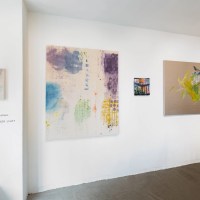
Contributed by Mary Shah / Greg Lindquist and Theresa Dadezzio, co-founders of palladium/Athena Project, just opened their inaugural show, “Works on Paper,” featuring an impressive 175+ artists at their new curatorial space in Greenpoint, Brooklyn. I sat down and talked with Theresa and Greg about the project.

Solo Shows

Alan Butler: Data-driven

Contributed by Sharon Butler / In “Assets,” on view at Green on Red Gallery in Dublin through December 13, Alan Butler – no relation – practices what could be called digital-age synesthesia, the neurological quirk by which the senses get their wires crossed. Synesthetes may taste color or see it as numbers. While Kandinsky had the insight and talent to create arguably the first Western abstract paintings by translating music into painting, Butler has taken on a distinctly twenty-first-century project: transforming open-source digital information – stock quotes, climate data, video game coding, and other assorted online effluvia – into playful physical objects that directly engage the senses.

Artist's Notebook

Sharon’s Substack / December 4, 2025

Contributed by Sharon Butler / A few days after the final 2025 Two Coats of Paint Resident Artist left, I packed a bag and tagged along with the editor on a short trip to Dublin. He had a non-art-related conference, and I so I walked around the city, admiring countless wool tweeds and hand-knit sweaters, checking out art, and catching up with friends. When we got back, he wrote about Stephanie Deady’s painting show at Kevin Kananvaugh, and I tackled Alan Butler’s mind-spinning data-driven spectacle at Green on Red.

Group Shows

Spring Projects’ epic subway series

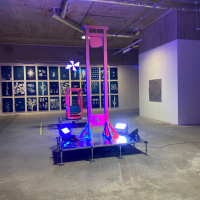
Contributed by Jonathan Stevenson / Most New Yorkers couldn’t live without the subway. It is their savior if occasionally their oppressor. They love it so much that they hate it when it lets them down, but the opprobrium is often oddly affectionate. Barroom arguments have fulminated and flourished over which subway line is worse – the F or the 7, the 2 or the L. Patronizing the subway can be a point of gritty cosmopolitan pride: real New Yorkers don’t use Uber. And it’s a great social equalizer, as reflected in Ralph Fasanella’s 1950 folk-art painting Subway Riders, now ensconced in the wall of 53rd Street/Fifth Avenue Station and as idealistic as ever. “Subway Riders” the group show is now up at Springs Projects. It keenly captures the subway’s pervasive, multivalent thrum through New York life with work by over 100 artists and a few eager amateurs (one is me).

Solo Shows

Paul Feeley: When paintings want to be sculptures

Contributed by Sharon Butler / “Paul Feeley: The Shape of Things” is Garth Greenan Gallery’s fourth solo exhibition for the painter, who died in 1966. But it is the first to ask – and answer – what happened when Feeley, known for re-introducing geometry to post-war abstraction, grew tired of his signature style. This show at last gives proper attention to Feeley’s drive to move beyond the flatness of the canvases he had been producing for years.

Resident Artist

Two Coats Resident Artist: Lawre Stone, October 20 – 27

Contributed by Sharon Butler / On October 20, Two Coats of Paint welcomes Lawre Stone from the countryside near Hudson, New York. She is aesthetically as well as socially concerned with ecological displacement and how species adapt, invade, and persist in landscapes reshaped by human intervention. Her paintings reveal the hidden-in-plain-sight world of botanical life.

Resident Artist

Two Coats Resident Artist: Alice Pixley Young, October 12–17

Contributed by Sharon Butler / On October 12, Two Coats of Paint welcomes Alice Pixley Young. She hails from Cincinnati, Ohio, where the Rust Belt and ancient fossil beds meet nuclear contamination sites. She creates installations that tease out ideas about the complex archaeology of the industrial landscape, uncovering stories of displacement, exploitation, and environmental degradation that have come to characterize twenty-first-century America.

Conversation

Painters in conversation: Jeanette Fintz and Stephen Westfall

Contributed by Sharon Butler / At 68 Prince Street Gallery, a spacious new gallery in Kingston, now featuring Jeanette Fintz’s paintings alongside Monika Zarzeczna’s architecturally oriented work in “Elusive Thresholds,” Fintz engaged in a freewheeling conversation with noted painter Stephen Westfall. I was fortunate enough to get hold of the recording and here try to distill some wisdom. Both artists are geometric abstractionists, and they discussed the evolution of Fintz’s artistic practice from cubist-influenced studies in the 1980s to her current explorations of the environment through geometry, touching on philosophical and technical considerations underlying contemporary abstract painting.

Resident Artist

Ariel Bullion Ecklund, August 3–8 

Contributed by Sharon Butler / Next month, Two Coats of Paint Residency Program welcomes Ithaca, NY, artist Ariel Bullion Ecklund. Ecklund creates ceramic objects and photographs that draw from the memories she accumulates as she moves through the world. Universal themes such as absence, impermanence, memory, and yearning inform work that is also deeply personal. For our next resident, our bodies hold memories as much as our minds do. This understanding is the foundation for everything she makes.

Resident Artist

Two Coats Resident Artist Sage Tucker-Ketcham, July 20–25

Contributed by Sharon Butler / This month, Two Coats of Paint welcomes Vermont artist Sage Tucker-Ketcham. Sage’s recent nature-based work operates in the space between observation, memory, and imagination. Each painting begins with something she saw on a walk or caught in her peripheral vision from a car window – moments that lodge into her consciousness, like seeds waiting to germinate.

Solo Shows

Enzo Shalom’s meandering brush

Contributed by Sharon Butler / On view in the upstairs gallery at Bortolami, Enzo Shalom’s paintings – modest in image and muted in palette – carry a quiet intensity that has felt rare among young New York painters in recent years. At a time when traditional painterly bravado dominates, Shalom takes a different route, making vulnerability seem like a radical act. His work leans into restraint: awkward angles, washed-out tones, and just enough mark-making to read as intentional without seeming overworked. If you can imagine early Luc Tuymans’ bleached-out hues, EJ Hauser’s jagged lines, and Gary Stephan’s off-kilter compositions, you’ll land somewhere near the world of Shalom’s paintings. It’s a subdued, thoughtful space, low-key but deeply engaging.